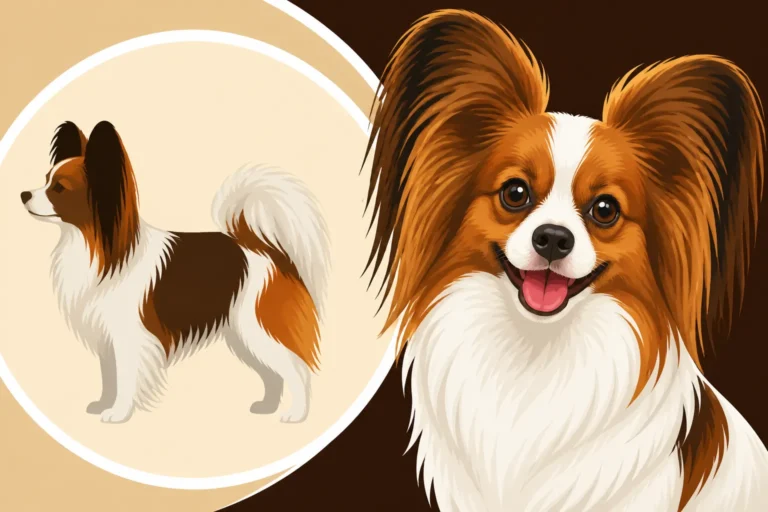
Whether Spitz Blood Made the Papillon’s Ears Stand
There's a persistent little whisper that floats around Papillon circles, a kind of historical "what if" that really gets you thinking about how our beloved butterfly dogs came to be. Many of us look at those magnificent, erect ears, so distinct and full of character, and wonder: how on earth did they get that way? The drop-eared Phalene was the original, after all. So, did some clever breeder intentionally introduce a dash of "Spitz blood" to get those ears to stand up, or is there another story entirely? This guide dives deep into that fascinating question, exploring the history, genetics, and enduring theories behind the Papillon's iconic ears.
The Ancestry of the Papillon: From Drop Ears to Butterflies
Before we even begin to ponder the "Spitz blood" theory, it's essential to understand the Papillon's beginnings. Our modern Papillon, with its distinctive erect, fringed ears, descends from a line of small, elegant companion dogs known as Continental Toy Spaniels or Dwarf Spaniels. These dogs were popular among European nobility for centuries, gracing the laps of royalty and appearing in countless famous portraits. Think of those beautiful, dainty little dogs in paintings by Titian or Rubens – those were the ancestors.
For most of this history, these charming little spaniels predominantly sported drop ears, much like their larger spaniel cousins. This variation is now known as the Phalene, a French word meaning "moth," referring to its ears that resemble a moth at rest. These were exquisite dogs, cherished for their intelligence and affectionate nature, but their ear carriage was distinctly pendulous. What a Titian Spaniel Looked Like gives you a great visual of these early dogs. The shift to the erect-eared variety wasn't just a minor tweak; it was a defining moment in the breed's evolution and popularity. It fundamentally changed their silhouette and gave them the name they carry today: Papillon, French for "butterfly."
The exact moment and method of this transformation are a bit shrouded in the mists of time, as many historical canine developments are. We know that the erect-eared variety began to appear and gain favor in the late 19th and early 20th centuries, becoming increasingly popular over the traditional drop-eared Phalene. This wasn't a sudden, overnight phenomenon, but a gradual shift that breeders embraced. The question then becomes: how did this genetic change occur? Was it a spontaneous mutation that was then selectively bred for, or was there an intentional introduction of outside genes from another breed? That's where the "Spitz blood" theory truly takes flight.
The "Spitz Blood" Theory and Its Plausibility
The theory that Spitz breeds contributed to the Papillon's upright ears isn't entirely baseless if you consider the visual evidence. Spitz-type dogs, such as Pomeranians or even small Huskies, are well-known for their prick ears, often tightly triangular and standing proudly erect. When you look at a Papillon's ears – large, well-fringed, and indeed erect – it's easy to draw a superficial parallel and imagine a crossbreeding scenario. The idea suggests that breeders, perhaps seeking to create a new, fashionable look, might have introduced a small Spitz-type dog into their Continental Toy Spaniel lines.
However, the historical record doesn't provide strong, definitive proof of such crosses. Unlike some breeds where crossbreeding events are relatively well-documented or strongly suspected based on later breed development, there's no widespread consensus or direct evidence pointing to specific Spitz infusions in the Papillon's lineage. Most breed historians focus on the internal development of the Continental Toy Spaniel line, emphasizing selective breeding within existing populations. This doesn't entirely rule out the possibility, of course. Sometimes, small, unrecorded crosses happen, especially in the early stages of breed refinement before formal kennel club registries and strict pedigrees were established.
One argument against the direct Spitz cross theory is the overall appearance and temperament of the Papillon. While they share the erect ears, the Papillon's head shape, delicate bone structure, and famously silky, flowing single coat are quite distinct from typical Spitz characteristics. Spitz breeds often have denser double coats, broader skulls, and more robust builds. If significant Spitz blood had been introduced, you might expect to see more of these traits consistently appearing in the Papillon, which generally isn't the case. How a Papillon Differs From a Pomeranian further highlights these distinctions, suggesting that while there are superficial similarities (like erect ears), the breeds are quite different at their core.
The Genetic Reality of Ear Carriage
Understanding how ear carriage is inherited in dogs helps us evaluate the Spitz theory. Generally, ear carriage is influenced by multiple genes, but there are often dominant and recessive traits at play. Erect ears tend to be a dominant trait over drop ears in many breeds. This means that if even one parent carries the gene for erect ears, some of their offspring could inherit that trait.
Consider the emergence of the erect ear within the existing Continental Toy Spaniel population. It's entirely possible that a spontaneous mutation occurred in one or more individuals, resulting in upright ears. Once this trait appeared, discerning breeders who found it appealing could have then selectively bred these individuals, gradually increasing the prevalence of the erect ear within their lines. Over generations, through careful selection, the Papillon's distinctive "butterfly" ear could have become a fixed characteristic. This doesn't require an outside breed; it simply requires variation within the existing gene pool and directed breeding efforts. When the Erect Ear First Appeared would have been a significant moment, whether through mutation or intentional cross.
The fact that Papillons and Phalenes are still born in the same litter today further supports the idea that the two ear types are simply variations within the same breed, controlled by genetic factors that can be passed down. Why a Papillon and a Phalene Are Born in the Same Litter explains this phenomenon. It suggests a shared genetic heritage where the erect ear is one expression, and the drop ear is another. This doesn't necessarily preclude an ancient, undocumented cross, but it certainly makes a strong case for internal genetic variation and selection being the primary driver of the ear change.
It's a testament to the power of selective breeding that breeders were able to not only establish the erect ear but also refine it into the beautifully proportioned and heavily fringed "butterfly" ear we adore today. Whether The Erect Ear Was a Deliberate Change is less of a question of "if" and more of "how." Breeders clearly had a vision, and they worked to achieve it.
The Modern Papillon's Ears: Beyond the Historical Debate
Today, both the Papillon (erect ears) and the Phalene (drop ears) are recognized varieties of the same breed, the Continental Toy Spaniel. They share the same breed standard, differing only in ear carriage. This official recognition solidifies their shared heritage, irrespective of how the erect ear initially came about. While the historical debate about Spitz blood might never be definitively settled, what's clear is that the Papillon's ears are now a hallmark of the breed, carefully cultivated and maintained through generations of dedicated breeding.
Breeders pay close attention to ear set, size, and fringe when selecting breeding pairs, ensuring that the characteristic "butterfly" appearance continues. Owners often admire the sheer elegance of the ears, which contribute so much to the breed's expressive face. From a practical standpoint, the ears require a bit of care to keep those fringes looking their best – a good quality slicker brush and comb, perhaps picked up from a place like Chewy, is essential for keeping tangles at bay. Whether a Papillon's Ears Can Change After a Year is a common question, as puppies' ears can sometimes waver before settling into their final position.
Ultimately, whether a long-ago genetic nudge from a Spitz-type dog played a role, or if it was purely a fascinating tale of mutation and masterful selective breeding, the Papillon's ears remain one of its most enchanting features. The enduring fascination with their origin only adds to the mystique of this ancient and beloved toy breed. Both ear types are equally cherished, though Which Ear Type Buyers Ask For More can often depend on current trends and personal preference.
| Ear Type | Description | Historical Precedence | Modern Prevalence | Defining Trait |
|---|---|---|---|---|
| Phalene | Drop-eared, resembling a moth at rest. | Original and dominant ear type for centuries. | Less common than Papillon, but still recognized. | Pendulous, folds softly against the head. |
| Papillon | Erect-eared, resembling a butterfly with spread wings. | Emerged later, gained popularity in the 19th/20th century. | More common and widely recognized as the breed's namesake. | Large, erect, well-fringed, set obliquely. |
The journey of the Papillon's ears from humble drop-eared beginnings to the iconic butterfly shape is a fascinating chapter in canine history. It reminds us that breeds evolve, sometimes through subtle genetic shifts, and sometimes through intentional human design, always guided by what captures our hearts and imaginations.
Disclaimer
This article is for general informational purposes only and does not constitute professional advice. Laws, prices and regulations vary by location and change over time. Consult a qualified professional for guidance on your specific situation.