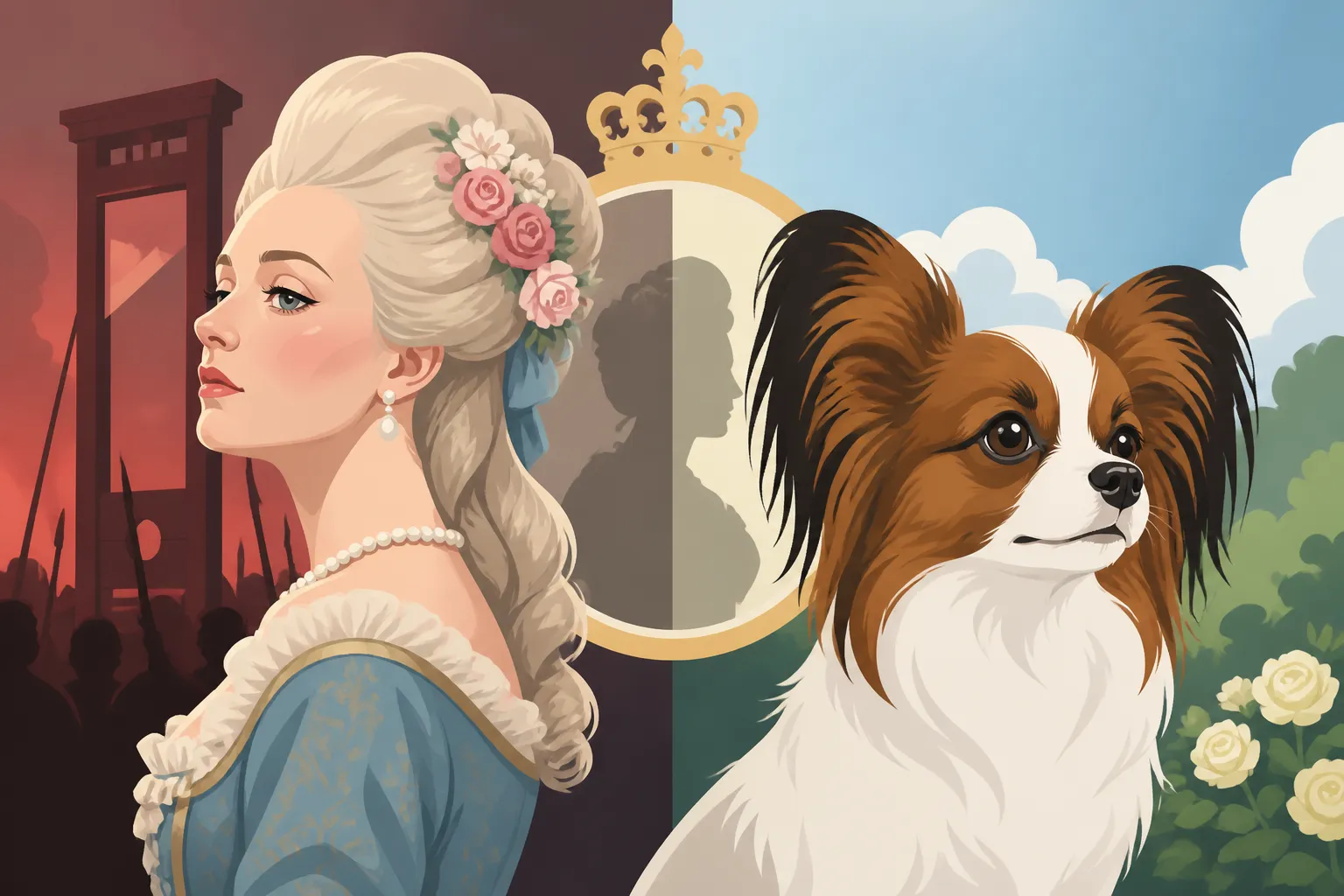
Whether Marie Antoinette’s Dog Survived Her
Marie Antoinette’s dogs are often folded into a heartbreaking story: a little spaniel supposedly stayed with her through imprisonment and execution, then lived on after her death. But the details are difficult to verify, and later retellings do not always agree on the dog’s name or fate. This guide separates the tradition from what can be said with confidence.
The story of Marie Antoinette’s dog
Which dog is the story about?
The dog most often associated with Marie Antoinette in Papillon histories is called Thisbe. The name appears in accounts of the queen’s love of small dogs, and the animal is commonly described as a small spaniel. That connection has helped link the story to the modern Papillon, whose ancestors were among the small, long-eared companion dogs kept in European courts.
But stories about the queen’s dogs are not always consistent. Different retellings can give different names, breeds, or circumstances, and some accounts blur together the pets she owned at different times in her life. A dog associated with her childhood, one said to have been at court, and one connected to her imprisonment may become a single animal in a simplified version of the story.
That uncertainty matters when asking whether “Marie Antoinette’s dog” survived her. Before answering, it helps to know which dog a particular version means. The broader history of royal companion dogs is covered in Which Royal Households Kept Papillons, while Whether Marie Antoinette Owned a Papillon looks at the queen’s connection to the breed more specifically.
What the popular account says
In the familiar version, a small dog remained close to Marie Antoinette during the upheaval of the French Revolution. Some tellings say the dog was with her during imprisonment; others suggest it was nearby when she was taken to the guillotine. The story often ends with the dog escaping death and being cared for by someone else.
It is an emotionally powerful image: a devoted pet remaining beside its person through the most frightening period of her life. It also fits the way people remember companion dogs. A small dog can seem especially vulnerable in the middle of grand historical events, and the idea of it surviving when its owner did not gives the story a tender ending.
Yet a moving story is not automatically a well-documented one. Details repeated in modern breed histories and popular articles do not, by repetition alone, establish what happened. Accounts may preserve a genuine tradition, but they can also pass along embellishments or merge separate stories. That is why the dog’s reported survival should be treated as a possibility in the legend, not as a firmly established fact.
Did the dog survive Marie Antoinette?
What can be said with confidence
Marie Antoinette was executed in 1793. The question is not whether she survived, but whether the dog named in later stories was still alive afterward and, if so, who cared for it. There is no simple, universally accepted account that settles those details beyond doubt.
Some versions say the dog survived and was taken in by another person. Others focus on the dog’s loyalty or presence near the queen without providing a clear account of what happened afterward. When the story is retold briefly, the difference between “the dog was said to have survived” and “the dog’s survival is documented” can disappear.
A careful answer, then, is that the dog may have survived her, as the tradition claims, but the details are uncertain. Without a reliable contemporary record that clearly identifies the animal and follows its life after the queen’s death, it is safer not to present the survival story as proven fact.
Why the ending is hard to verify
A pet’s life rarely leaves the same kind of paper trail as a monarch’s. Court records, letters, inventories, and memoirs might mention an animal, but they may not document where it went years later or who eventually cared for it. A name could also be recorded in one source but omitted in another, making it difficult to confirm that different accounts refer to the same dog.
The Revolution created further difficulties. Marie Antoinette’s household was disrupted, people were displaced, and belongings and animals could pass into other hands. Even if a dog did survive, tracing its later life would require more than an evocative anecdote. It would require evidence tying the specific animal to its new keeper or circumstances.
There is also a natural tendency to make stories complete. A tale that ends with a dog’s survival feels more satisfying than one that ends with unanswered questions. Later writers may repeat that ending because it is memorable, even when the sources behind it are unclear. For a closer look at how the execution story has been retold, see Whether the Guillotine Story Is True and Whether the Guillotine Story Has Any Source.
Why the story gets linked to Papillons
The historical dogs and the modern breed
Papillons are named for their upright, butterfly-shaped ears. The breed is related to the small companion spaniels seen in European art and associated with court life. Those older dogs were not necessarily identical in appearance or ancestry to today’s registered Papillons, so calling every small court spaniel a modern Papillon can make history sound more certain than it is.
That distinction does not make the connection meaningless. Papillons belong to a long tradition of small companion dogs, and their ancestors were represented in portraits and kept in aristocratic households. But a historical painting or story usually cannot establish a dog’s exact modern breed classification on its own. The background to the name is explored in What the Name Papillon Refers To, and Whether the Papillon Appears in Spanish Court Paintings offers another glimpse into the breed’s historical associations.
It is also worth remembering that “Papillon” and “Phalène” describe the two ear types recognized within the same breed: upright ears for the Papillon and dropped ears for the Phalène. Older accounts may use terms such as spaniel or dwarf spaniel rather than the labels people expect today. For more on that relationship, read Whether a Phalene Is a Separate Breed.
What portraits can and cannot prove
Paintings are valuable evidence of the kinds of dogs people kept and how they were represented. A small dog sitting beside a noblewoman can suggest that lap-sized companions were part of court life. Its coat, ears, and body shape may resemble a later Papillon, offering a visual link that helps explain why the breed’s history reaches back through European portraiture.
But a portrait is not a pedigree. Artists might stylize an animal, and a painting usually does not name the dog or explain its ancestry. A resemblance can support a broader historical connection without proving that the animal was Thisbe or that it belonged to the exact breed recognized today.
This is why discussions of Marie Antoinette’s dog can feel both plausible and uncertain. The queen’s association with small companion dogs fits the wider history of the type, but the identity and fate of a particular pet need stronger evidence than resemblance or repetition. The Papillon’s long visual history is discussed in The Papillon Has Seven Hundred Years of Portraits Behind It, including why old images are fascinating without serving as definitive breed records.
How to read the survival story today
Separate the queen’s history from the dog’s legend
When you come across a claim that Marie Antoinette’s Papillon survived her, look for what the account actually says. Does it identify the dog by name? Does it point to a contemporary letter, diary, or record? Does it explain who cared for the animal afterward? Or does it repeat the story without showing where the details came from?
Those questions are useful because the wording often signals how strong a claim is. “A dog is said to have survived” leaves room for uncertainty. “The dog definitely lived with a named person afterward” is a much stronger statement and needs correspondingly clear evidence. If a short article offers no source or explanation, treat its version as folklore or tradition rather than settled history.
It can also help to distinguish two separate questions: whether Marie Antoinette owned small dogs, and whether one particular dog survived her. The first fits the broader history of aristocratic companion animals. The second is a specific claim about an individual animal’s final years, and it is harder to establish. Keeping those questions separate prevents an appealing detail from being mistaken for proof.
Why the story still matters
Even without a conclusive ending, the story captures something real about the place pets occupy in people’s lives. A beloved dog is not just a decorative detail in a royal household. It is an everyday companion, present through routines and upheaval alike. That is part of what makes the image of a small dog beside a condemned queen so affecting.
For Papillon enthusiasts, the account also provides a doorway into the breed’s history. It encourages questions about the small spaniels shown in portraits, the changing names used for them, and the difference between an ancestor and a modern breed. The most responsible version of the story can preserve that fascination while acknowledging that the dog’s identity and fate are not securely known.
So, did Marie Antoinette’s dog survive her? The traditional story says that it may have, but the dog’s survival and later life are not firmly established by a clear, reliable account. It is best told as a poignant historical legend rather than a confirmed fact.
Disclaimer
This article is for general informational purposes only and does not constitute professional advice. Laws, prices and regulations vary by location and change over time. Consult a qualified professional for guidance on your specific situation.