Which Royal Households Kept Papillons
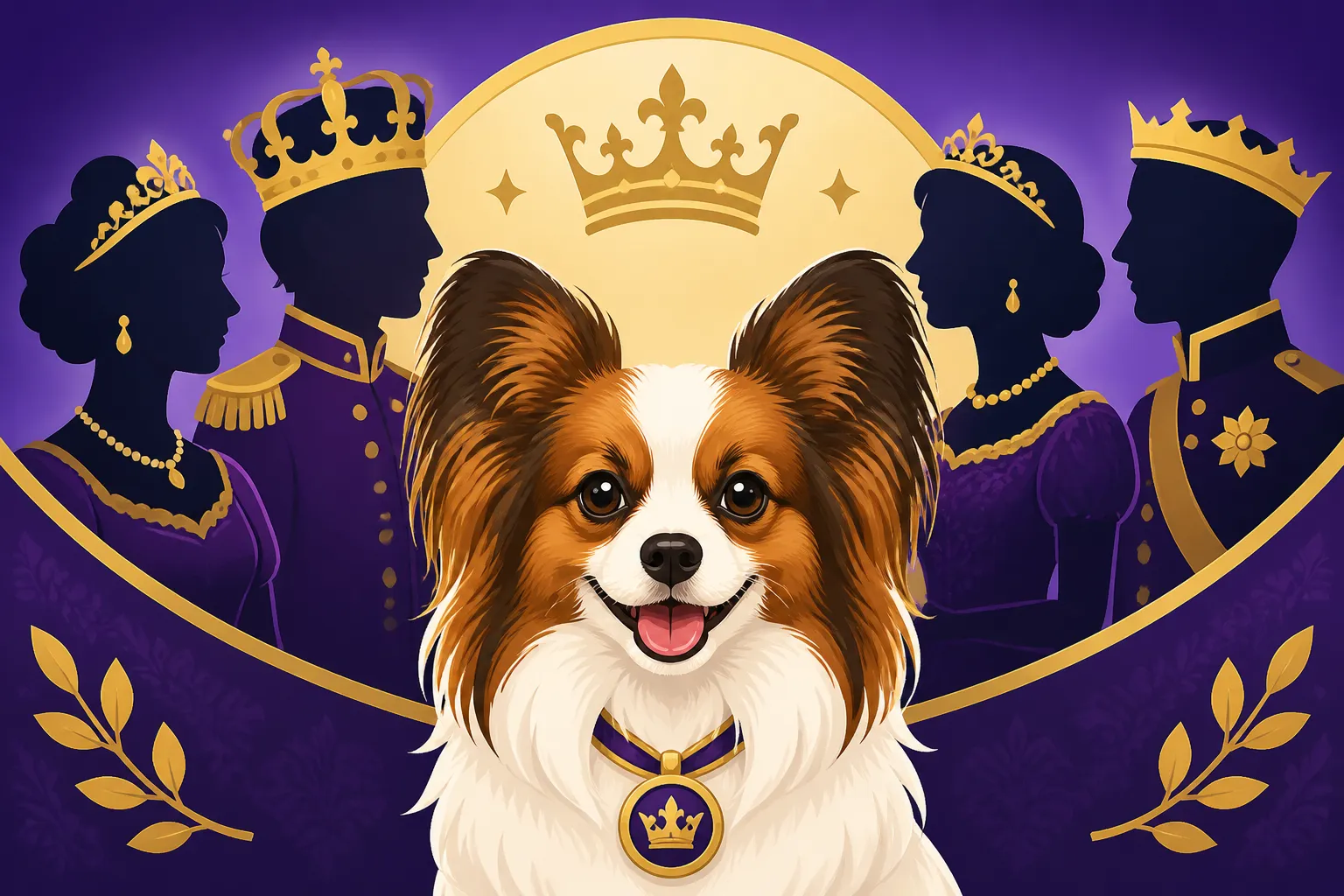
A tiny, feather-eared dog in a royal portrait can look unmistakably like a Papillon, but the history is less tidy than the picture suggests. European courts kept small spaniels for centuries; the modern Papillon breed took shape later. This guide separates well-supported court history from familiar legends, including the claim that Marie Antoinette carried a Papillon to her execution.
Why royal portraits do not prove a dog was a Papillon
Small spaniels appeared in European court life long before the modern breed
The ancestors associated with Papillons are often described as dwarf spaniels or continental toy spaniels. Small dogs of this general type appear in European art over several centuries, sometimes beside noblewomen and sometimes among the possessions of wealthy households. Their presence suggests that petite companion dogs were valued in courtly life well before “Papillon” became the familiar breed name.
That does not mean every little spaniel in a portrait was a Papillon in the modern sense. Artists showed the dog’s appearance as they saw it, not a modern breed registration. A painted dog might have drop ears, upright ears, or a shape that is hard to interpret through the style and condition of an old canvas. Those details can be interesting clues, but they are not enough to establish a precise breed identity.
It helps to think of the history as a gradual transition rather than a straight line. Small spaniels were kept and depicted across generations, while the distinctive upright-eared form now associated with the Papillon became part of the breed’s identity later. The historic relationship is worth exploring, but it should not be mistaken for a documented family tree linking each painted dog to today’s Papillons. For broader background, see Where the Papillon Comes From and Whether the Papillon Descends From a Spaniel.
Portraits reveal fashion and status, not always ownership records
A court portrait can show that a small dog was fashionable, familiar, or symbolically useful. It cannot always tell us who owned the dog, whether the animal lived with the sitter, or what name people used for its type. In some paintings, a dog may be a companion; in others, it may contribute to a broader visual message about wealth, domestic life, affection, or status.
The dog’s small size made it easy to include beside a seated sitter, on a lap, or near a chair. Its presence could make a formal portrait feel more intimate without making the subject seem less important. That is one reason these dogs show up in images of elite life: they were both living companions and visually appealing details.
When looking at historical images, it is useful to ask three separate questions: What does the dog look like? What does the setting suggest about the household? And what written evidence, if any, identifies the animal? Keeping those questions apart makes it easier to enjoy the Papillon-like resemblance without turning a visual guess into a firm historical claim. The dogs in such portraits are part of the wider story described in Which Other Painters Included Dwarf Spaniels.
Royal and princely households associated with small spaniels
French courts helped make little companion dogs fashionable
French royal life is closely connected with the popular story of the Papillon, and small companion dogs were indeed part of European court culture. But “the French court kept Papillons” can be too definite if it suggests that every dog was already the standardized breed known today. Older records and images more often point to small spaniels or toy spaniels, which may have included dogs related to the Papillon’s ancestry.
The French court changed considerably across the centuries, and so did the dogs kept by its members. A fashionable companion dog might be recorded under a broad description rather than a precise breed name. That makes it difficult to attach a modern label to a particular royal pet unless a reliable written record identifies it clearly.
The connection still matters. French court culture helped preserve and popularize small companion dogs among people with the means to keep them as household pets. It is a useful part of the breed’s cultural history, even if it does not prove that a present-day Papillon lived in every royal residence later associated with the breed. For a closer look at the famous queen in this story, see Whether Marie Antoinette Owned a Papillon.
Spanish and Italian courts also kept small dogs
The French court was not the only elite setting where small dogs appeared. European court art, including work connected with Spain and Italy, shows that petite companion dogs were familiar in aristocratic households across more than one region. Painters such as Titian are often discussed in relation to the ancestry of the Papillon, though an image alone cannot confirm the exact breed of the dog shown.
In Spain, court portraits offer examples of small dogs within the visual world of royal and noble families. In Italy, Renaissance paintings likewise place small spaniel-like dogs beside prominent sitters. These pictures support a broad historical point: companion dogs of this kind were not confined to one royal family or one country.
The records are uneven, though. A painting may tell us that a small dog was present in a high-status setting, while leaving its owner, name, and breed uncertain. It is safer to describe these as courtly or aristocratic small spaniels than to state that a named royal household kept a Papillon exactly as the breed is defined today. Titian Painted the Dog the Papillon Came From explores why Titian’s work is often brought into this discussion.
| Court or setting | What the historical record can suggest | What it does not establish by itself |
|---|---|---|
| French royal court | Small companion dogs were part of elite life and fashion | That every such dog was a modern Papillon |
| Spanish court portraiture | Small dogs appeared in images of royal and noble households | A dog’s exact breed, name, or daily owner |
| Italian Renaissance courts | Small spaniel-like dogs were familiar in aristocratic settings | A direct, documented line to a particular Papillon |
| European courts more broadly | Toy-sized companion dogs crossed regional boundaries | That the modern breed existed in its finished form centuries ago |
The Marie Antoinette story and what can be said about it
A popular tale should not be treated as settled fact
The best-known royal story says Marie Antoinette owned a Papillon and that the dog accompanied her during the French Revolution, sometimes in a dramatic account connected with her execution. It is a memorable image, which is one reason it continues to be repeated. But repetition is not the same as clear documentation.
The central problem is the specificity of the claim. Historical accounts may refer to small dogs, spaniels, or pets associated with royal life, but that does not automatically identify one as a Papillon. The breed name and the modern breed type are not interchangeable with every earlier reference to a small spaniel.
There is also a difference between a plausible general setting and a verifiable individual story. It is entirely plausible that members of the royal household kept small dogs. Proving that Marie Antoinette had a particular dog of a particular type, and that it was present at a specific event, requires evidence that goes beyond later retellings. That distinction is especially important with the execution story, which is often shared as fact without a clear trail of contemporary documentation. For a focused examination, read Whether the Guillotine Story Is True.
How to evaluate claims about royal Papillons
When you come across a claim about a royal Papillon, look for the source and the wording. Does it cite a contemporary letter, household record, inventory, or other document? Or does it rely on a later anecdote that names the dog as a Papillon without explaining how that identification was made?
Also notice whether the claim uses a modern breed name for an earlier dog. That may be convenient shorthand, but it can blur an important distinction. “A small spaniel resembling a Papillon” is not the same as “a Papillon” if the modern breed had not yet been defined in the way it is today.
A sensible conclusion can hold two ideas at once: small dogs were genuinely part of royal and aristocratic life, and some specific stories about named monarchs and Papillons remain uncertain. You do not need to dismiss the wider history just because one popular anecdote is hard to verify. The broader development of the breed is covered in How Old the Papillon Breed Is.
What royal history means for the Papillon today
The breed’s story is cultural as well as biological
Papillon history is often told through portraits, court fashions, and stories about famous owners. Those details make the breed’s past vivid, but they are only one strand of the story. The modern Papillon is also a recognized breed with a defined appearance and characteristics that developed over time. Historic images offer context; they do not replace breed records or establish every step in that development.
The name itself reflects the breed’s recognizable ears. “Papillon” means butterfly in French, while the drop-eared variety is known as the Phalene, meaning moth. Those names help explain why later audiences found the dogs so visually distinctive. The history of the two ear types is explored in Papillon Means Butterfly and Phalene Means Moth and Why a Papillon and a Phalene Are Born in the Same Litter.
For a modern owner, the royal associations are enjoyable background, not a guide to choosing or caring for a dog. Temperament, health, responsible breeding, daily exercise, and household fit matter much more than whether a dog’s distant ancestors appeared in a court portrait. A helpful next step for prospective owners is Who the Papillon Actually Suits.
Historical interest can inspire responsible modern care
Sometimes a portrait or a royal anecdote is what first draws someone to the breed. If that curiosity turns into a decision to live with a Papillon, it is worth shifting from history to practical preparation: learn about the breed’s grooming, dental care, training, and health needs before bringing a dog home.
For example, a small grooming kit needs to suit the dog’s fine coat and feathering, and equipment should fit a small body safely. Retailers such as Chewy may be one place to compare ordinary pet-care supplies, but product descriptions do not replace advice from a veterinarian or experienced groomer. If you browse Chewy or another store, check sizing and intended use rather than buying simply because an item is marketed for small dogs. Chewy is a modern shopping option, of course—not evidence about the Papillon’s historical court connections.
The most accurate way to describe the royal connection is also the most interesting: small spaniels were cherished in elite European households, and the Papillon’s history is linked to that long tradition. But a portrait resemblance, a broad old description, or a familiar story should not be presented as proof of a modern breed identity. That careful distinction lets the history remain charming without making it more certain than the evidence allows.
Disclaimer
This article is for general informational purposes only and does not constitute professional advice. Laws, prices and regulations vary by location and change over time. Consult a qualified professional for guidance on your specific situation.