Whether Asymmetry Is Faulted on a Papillon
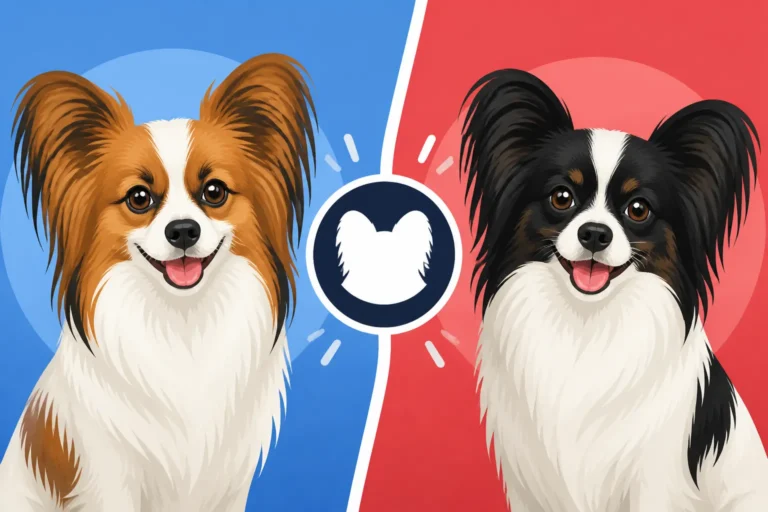
A Papillon’s face may have a blaze that veers to one side, a patch that reaches one eye more than the other, or markings that simply do not mirror each other. That can look strikingly uneven in photos, but it does not automatically disqualify a dog from the show ring. Here’s how facial asymmetry is viewed, what the breed standard prefers, and when unevenness may raise a different concern.
Does facial asymmetry count against a Papillon?
Symmetry is preferred, not an absolute requirement
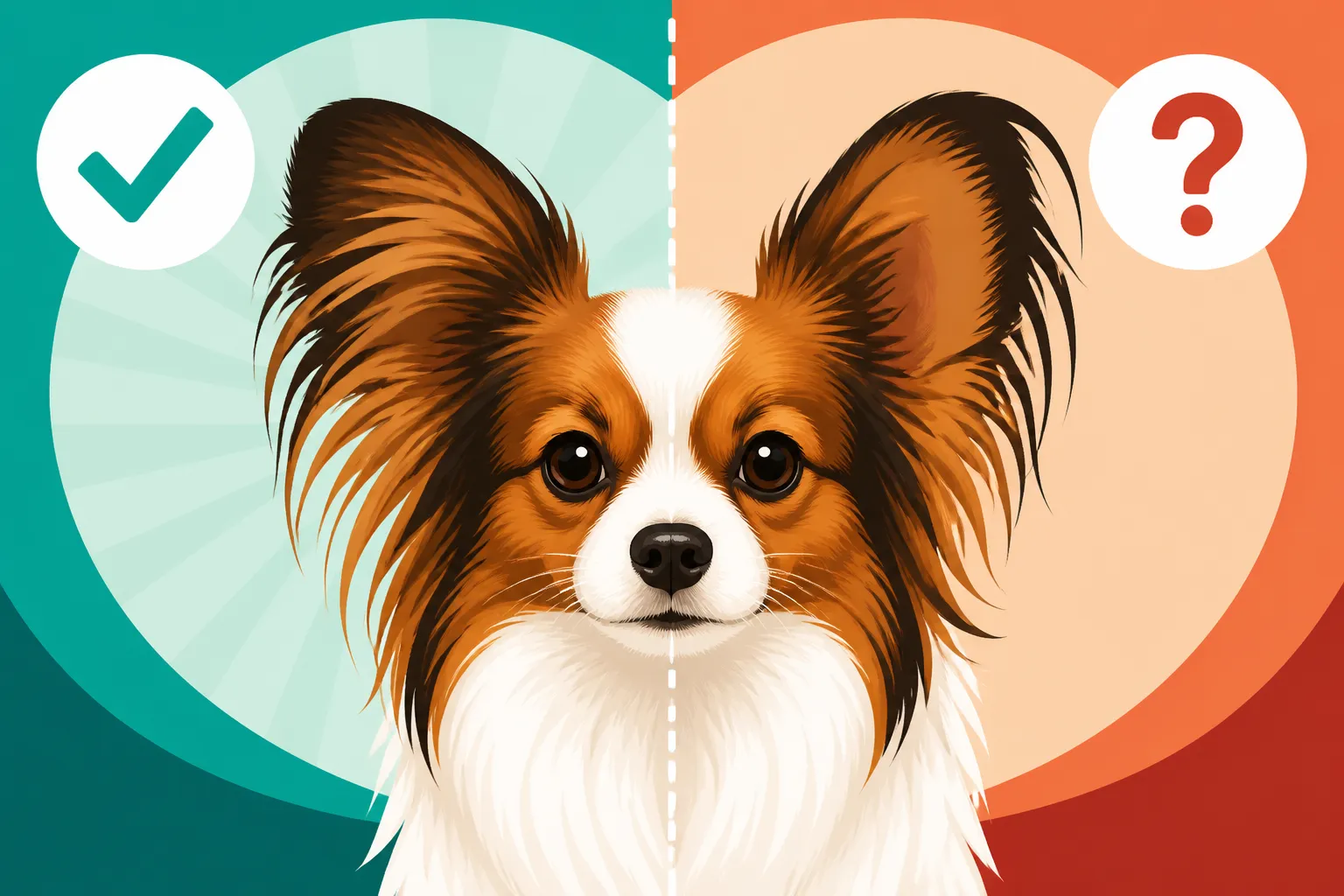
The Papillon standard prefers symmetrical facial markings, but a preference is not the same as a requirement. A Papillon with an uneven blaze or differently sized patches around the eyes is not automatically disqualified or ruled out as a show dog because of that detail alone. The markings are considered as part of the dog’s overall appearance.
That distinction matters if you are looking at a puppy whose face is not perfectly balanced. A white blaze might sit slightly left of center, or one colored patch may extend farther down the cheek. Those features can make the face look less symmetrical, but they do not, by themselves, tell you whether the dog meets the rest of the breed standard.
The standard also does not require a perfectly mirrored mask. Papillons have a white base coat with patches of color, and the pattern can vary from dog to dog. If you are trying to understand the range of accepted coat patterns, Which Colors the Papillon Standard Accepts and Which Colors a Papillon Comes In offer useful context.
A preferred feature is different from a disqualifying fault
In dog shows, some traits are required, some are preferred, and some are considered faults. These categories are not interchangeable. A preferred feature is something a judge may value when comparing otherwise similar dogs, but its absence does not necessarily make a dog incorrect.
For example, a judge could prefer a Papillon with balanced facial markings over one with a strongly uneven blaze, assuming the dogs are otherwise comparable. That does not mean the asymmetrical dog must lose, nor does it mean that a slight imbalance is automatically a serious fault. The judge considers the whole dog, including its structure, movement, expression, coat, and temperament in the ring.
A useful way to think about it is that facial symmetry can influence the overall impression without acting as a pass-or-fail test. A pronounced asymmetry may be more noticeable than a subtle one, but a visible difference alone does not determine a dog’s quality or show potential.
What owners mean by an uneven face
“Uneven markings” can describe several different patterns. One Papillon may have a blaze that is narrow on one side and wider on the other. Another may have a colored patch around one eye but mostly white around the other. A third may have a mark that crosses the blaze or sits asymmetrically on the forehead.
Those patterns are about coat color and placement. They are different from a face that appears physically uneven because of the shape or position of the eyes, muzzle, or jaw. A color patch can make one side of the face look more prominent in a photograph even when the underlying features are balanced.
If you are unsure what you are seeing, look at the dog in person and from more than one angle. A head-on photo can exaggerate small differences, especially when the dog is turning, squinting, or holding its ears unevenly. For more on how the breed’s head is evaluated, see What a Papillon's Head Should Look Like.
How Papillon facial markings are judged
The markings are considered with the whole dog
A judge does not assess a Papillon by looking only at its blaze or eye patches. The dog is evaluated as a whole, and the markings are one part of its appearance. A balanced, well-moving Papillon with an uneven blaze may make a stronger overall impression than a dog with perfectly symmetrical markings but more significant shortcomings elsewhere.
This is one reason show results can seem surprising to new exhibitors. Someone watching from the sidelines may focus on a striking face pattern, while the judge is also assessing the dog’s outline, proportions, ears, movement, coat, and presentation. The preferred markings matter, but they do not replace the rest of the standard.
It also helps to distinguish personal taste from judging criteria. You may find an asymmetrical face especially charming, or you may prefer a neat, centered blaze. Neither reaction changes what the standard says. If you want a broader picture of what a judge examines in the ring, What a Papillon Judge Puts a Hand On First explains how the evaluation goes beyond coat color.
A white blaze is a separate question
Facial symmetry and the presence of a white blaze are related to appearance, but they are not the same issue. A blaze is a strip or area of white running between the eyes or over the forehead. The standard’s preference for a blaze does not mean that every blaze must be centered perfectly, and the preference for symmetrical markings does not turn a slight imbalance into an automatic disqualification.
A narrow blaze that shifts to one side may still be a blaze. A broader white area on one side may create an uneven look without changing the basic color pattern. The details of how white and color are distributed can be easier to understand when considered separately from whether the face appears balanced. See Whether a Papillon Must Have a White Blaze for more on that distinction.
When comparing puppies, try not to reduce the decision to “perfect blaze” versus “imperfect blaze.” Ask about health, temperament, structure, and the breeder’s priorities as well. A coat pattern can be memorable, but it is only one aspect of a companion dog—and only one of many features a judge considers.
Markings can look different as a puppy grows
A puppy’s face may not look exactly the same throughout development. The coat changes as the puppy grows, and the proportions of the head also change as the dog matures. That can alter how prominent a blaze or patch appears, even when the underlying pattern remains.
Photos can make this harder to judge. Lighting, camera angle, wet or tousled coat, and the puppy’s expression can all make a marking look wider, narrower, or more off-center than it does in person. If you are choosing a puppy, ask to see several clear photos and, if possible, meet the dog rather than relying on one image.
It is sensible to avoid assuming that an uneven pattern will become perfectly symmetrical later. A breeder may be able to describe how markings have appeared in related puppies, but coat patterns are not a guarantee of future show results. For related context, read Whether a Papillon Puppy's Markings Change and Whether a Papillon's Color Fades With Age.
When asymmetry may mean something other than markings
Coat asymmetry does not necessarily indicate a physical problem
A color patch on one side of the face can create an optical illusion. For instance, a dark patch around one eye may make that eye appear smaller, even if both eyes are similar in shape and position. Likewise, an off-center blaze can make the muzzle seem tilted in a head-on photo.
Before treating a visual difference as a structural issue, look at the dog calmly in natural light. Check whether the eyes themselves appear similarly positioned and whether the dog holds its head straight. A short video can be more informative than a still image because it shows the dog moving and looking around.
If the face still appears physically uneven, or if the dog has a sudden change in facial appearance, ask a veterinarian rather than assuming it is a breed-standard question. A sudden droop, swelling, squinting, or difficulty eating is not a coat-marking issue and deserves professional attention.
Structural differences are evaluated separately
A judge may notice an uneven physical feature differently from an uneven color pattern. For example, a visible difference in how the eyes sit, a jaw that appears misaligned, or a head that is consistently carried at an angle is not simply a matter of asymmetrical coat markings. The relevance depends on what the feature is and how it affects the dog’s overall conformation or function.
This is also where online photos can cause unnecessary worry. A puppy may tilt its head toward a sound, turn slightly away from the camera, or have one ear lifted while the other is relaxed. Papillon ears are expressive, and a momentary difference in ear carriage is not the same as a permanent structural imbalance.
If you are buying from a breeder, ask what they observe when the puppy is standing, walking, and interacting normally. A responsible breeder should be willing to discuss both appealing features and areas that may not match a show ideal. For broader questions about appearance and breed standards, How Papillon Standards Differ Between Countries can help explain why details may be discussed differently across settings.
What to do if you are choosing or showing a Papillon
If you are choosing a pet, focus on the whole puppy
For a companion home, a slightly off-center blaze is usually a matter of appearance, not a practical concern. It is reasonable to like or dislike a particular pattern, but it should not overshadow the puppy’s health, temperament, and suitability for your household. A sweet, confident puppy does not become a lesser companion because one eye has a larger color patch.
Ask the breeder about health screening, early socialization, the parents’ temperaments, and the puppy’s behavior in ordinary situations. Observe how the puppy responds to being handled, new sounds, and gentle interaction. If your main goal is a family companion, those everyday qualities will affect your life far more than perfect facial symmetry.
If you need routine supplies for grooming or puppy care, retailers such as Chewy may be one place to compare basic items, but shopping choices do not replace advice from your breeder or veterinarian. Choose products suited to a small, feather-coated dog, and ask for guidance if you are unsure what is appropriate for a young puppy.
If you are considering conformation shows, get an experienced opinion
If showing is your goal, ask the breeder to explain how the puppy compares with the breed standard—not just whether the markings are symmetrical. A breeder with show experience can discuss the dog’s overall strengths and weaknesses, including its structure, movement, expression, and coat. They should also be candid that no single marking can guarantee success in the ring.
You can also attend a local dog show and watch Papillons being evaluated. Seeing a range of accepted patterns in person helps put the word “symmetrical” in perspective. Compare how judges assess the dogs as a whole rather than focusing only on head markings.
If you are preparing a dog for the ring, keep the coat clean and comfortably maintained, and practice calm handling. Chewy may carry ordinary grooming supplies such as combs or brushes, but the right tool depends on your dog’s coat and grooming routine. Ask your breeder or groomer how to work around the ear fringe and facial coat without pulling or irritating the skin.
A practical comparison
| What you notice | What it usually describes | What to keep in mind |
|---|---|---|
| A blaze that sits slightly off-center | Uneven coat marking | Symmetry is preferred, but this alone does not automatically disqualify a Papillon |
| A larger colored patch around one eye | Asymmetrical color pattern | It can affect the face’s visual balance without indicating uneven eye structure |
| One ear looks higher in a photo | Ear carriage or camera angle | Check the dog standing naturally before drawing conclusions |
| One eye appears smaller because of a dark patch | Possible optical illusion | Observe the eyes directly and in different lighting |
| A sudden facial droop, swelling, or squint | A possible health concern | Contact a veterinarian rather than treating it as a show-marking question |
Chewy can also be useful as a place to browse everyday grooming basics, but it is not a source for deciding whether a Papillon meets the breed standard. For show eligibility or an interpretation of a specific dog’s conformation, speak with an experienced Papillon breeder or qualified show mentor.
The main point is straightforward: a Papillon’s facial markings do not have to be perfectly mirrored for the dog to be considered. Symmetry is preferred, and a judge may take it into account, but it is only one piece of a much larger evaluation. For most owners, a charmingly uneven face is simply part of the individual look of their dog.
Disclaimer
This article is for general informational purposes only and does not constitute professional advice. Laws, prices and regulations vary by location and change over time. Consult a qualified professional for guidance on your specific situation.