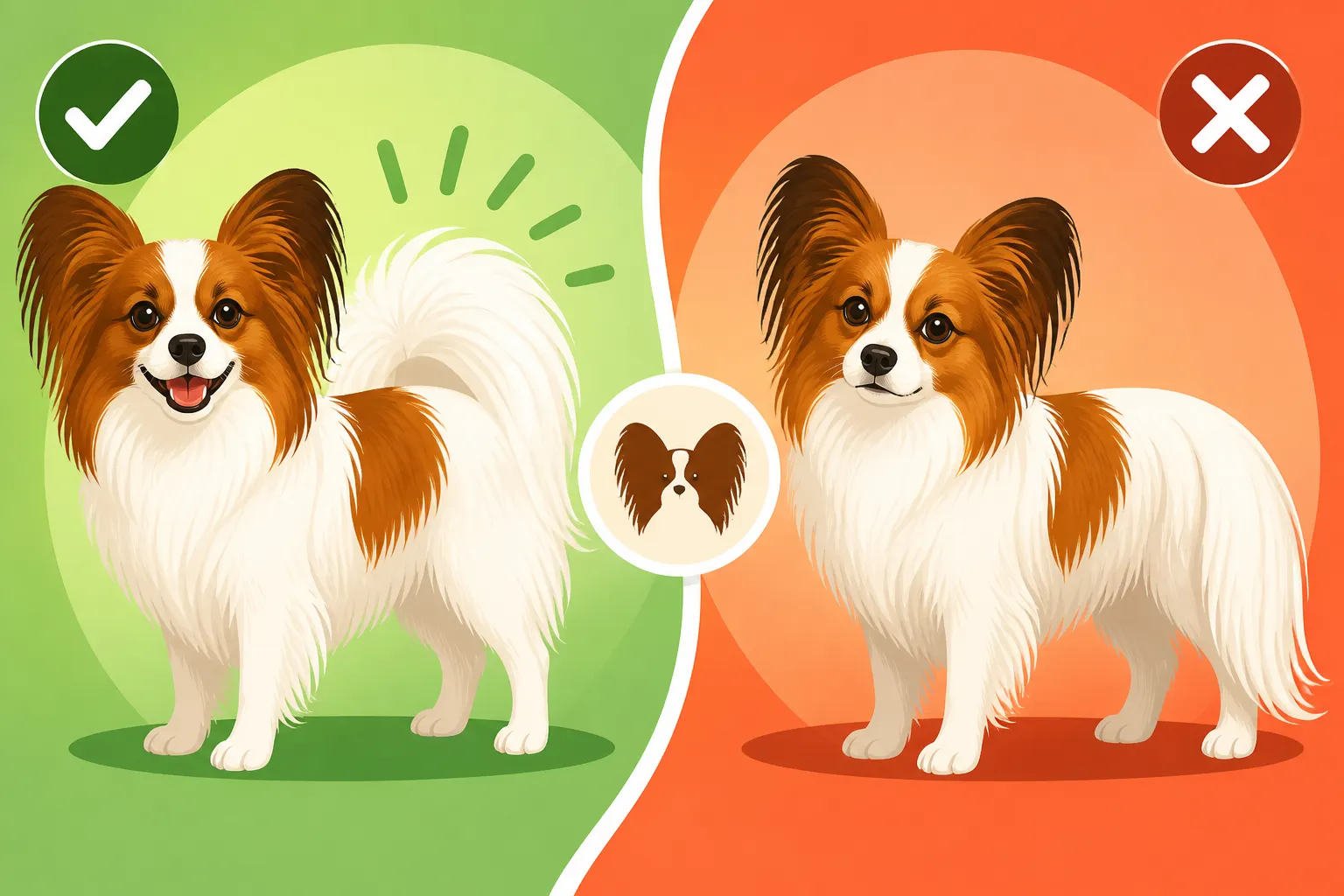
Whether a Papillon’s Plume Should Fall Over Its Back
A Papillon’s tail plume is one of the breed’s most recognizable features, but it can leave owners wondering whether the tail should always curl over the back. Usually, that graceful arch is normal; the tail may still lower when your dog is relaxed or change position while moving. This guide explains typical carriage, coat development, grooming, and signs that deserve a closer look.
What a Papillon’s tail plume should look like
The plume is feathering, not the tail itself
The Papillon’s plume is the long, silky hair growing from its tail. The tail underneath is a structure of bones, skin, and muscle; the coat creates the dramatic fan-like fringe that flows over the back. Because the plume can look full even when the tail is resting, it helps to distinguish the hair’s appearance from the tail’s position.
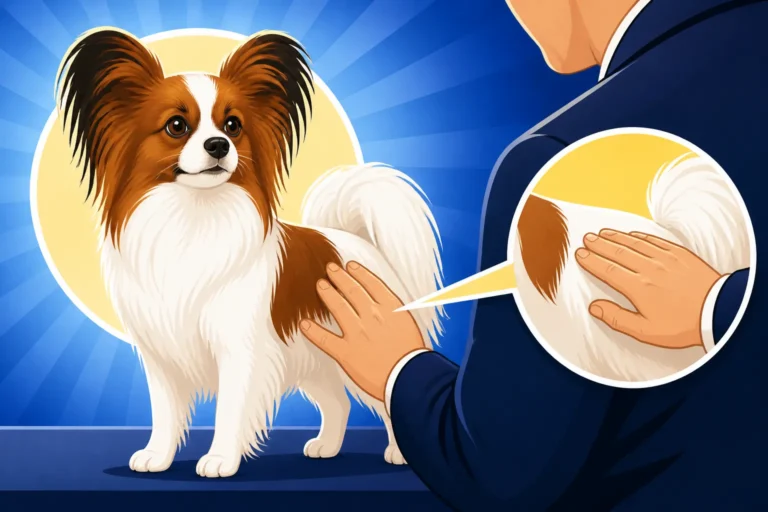
A Papillon’s tail is generally set high and carried arched over the back, with its long fringe falling to one side. It should look like a natural extension of the dog’s outline, not like a stiffly fixed ornament. When the hair is parted or brushed aside, you may see that the tail itself is not as thick as the plume makes it appear.
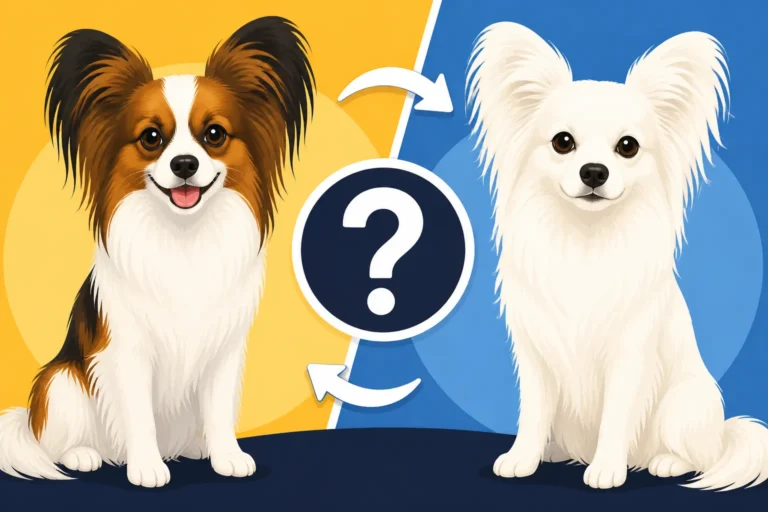
The tail and plume can change in appearance with age, coat condition, and grooming. A young Papillon may not yet have the adult length and fullness of feathering. An adult with a recently trimmed or tangled plume may look less dramatic, even though the tail’s structure and carriage have not changed. For more detail on keeping the fringe in good condition, see What a Papillon's Tail Plume Needs.
Should the tail always fall over the back?
No. The breed is known for a high-set tail carried arched over the back, but that does not mean it must stay in precisely the same position every moment. A relaxed Papillon may let the tail lower. During a walk, a burst of excitement, or a close sniff of something interesting, the tail may shift or sway. The important distinction is between ordinary changes in position and a sudden, persistent change from your dog’s usual way of holding it.
Pay attention to what is normal for your individual dog. One Papillon may carry the tail in a pronounced arch most of the time, while another may let it rest lower indoors and lift it when alert. A single snapshot rarely tells the whole story. Look at your dog standing comfortably, walking freely, and responding to familiar people.
If you are comparing your dog with a breed description, remember that a written standard describes a typical outline, not a promise that every dog will pose identically at home. How a Papillon's Tail Should Be Carried gives related context on normal carriage, while What a Correct Papillon's Outline Looks Like explains how the tail fits into the breed’s overall shape.
Tail carriage and mood
Tail position can vary with a dog’s attention and emotional state. A Papillon greeting a familiar person may hold the tail differently from one resting in a quiet room. A dog that is uncertain may also carry its body and tail differently from one feeling confident. Read the whole dog rather than interpreting the plume in isolation: posture, facial expression, movement, and willingness to interact all provide useful context.
For example, imagine your Papillon’s tail looks lower after a long nap, but rises into its usual arch when you bring out a favorite toy. If your dog is otherwise comfortable and moving normally, that variation may simply reflect a change in activity or attention. By contrast, a tail that suddenly hangs low and stays there—especially if your dog seems sore or avoids movement—deserves closer attention.
How age, movement, and coat affect the plume
Puppies and developing coats
Papillon puppies do not arrive with the full adult plume. Their coat changes as they grow, and the length and texture of the tail feathering can take time to develop. A young dog’s tail may therefore look less lush than an adult’s, even if its underlying shape is developing normally.
Coat development does not happen on an identical schedule for every Papillon. Genetics, age, coat changes, and individual variation all affect the finished look. If you are raising a puppy, avoid judging its mature plume by a single stage of growth. A puppy with a short or sparse-looking tail fringe is not automatically destined to have an unusual adult coat.
The tail should also be considered as part of the dog’s complete outline, not as a standalone beauty feature. If you are choosing a puppy or following its development, look at health, movement, temperament, and the breeder’s care practices alongside appearance. What Papillon Owners Wish They Had Known offers broader perspective on living with the breed beyond its distinctive looks.
Movement can change how the plume appears
When a Papillon walks or trots, the tail plume may sway, bounce, or shift to one side. Feathering moves with the body, so a tail that looks dramatically arched while standing may appear looser in motion. That alone does not mean the dog is carrying it incorrectly. Watch the dog move freely over several steps rather than focusing on a single moment.
A change in movement matters more when it comes with signs of discomfort. A dog that suddenly guards the rear end, resists being touched near the tail, moves stiffly, or seems reluctant to sit or jump may need an examination. The same applies if the tail carriage changes suddenly and stays changed. Avoid pulling, bending, or repeatedly testing the tail yourself; a veterinarian can examine it safely and assess the dog’s comfort.
A practical comparison can help you decide what you are seeing:
| What you notice | What it may mean | A sensible next step |
|---|---|---|
| The tail lowers briefly while resting | A normal change in posture may be possible | Observe whether it returns to your dog’s usual position during activity |
| The plume swings or shifts during a walk | Feathering naturally moves with the dog | Watch for comfortable, even movement |
| The tail suddenly hangs low and stays that way | Could reflect discomfort or another change that needs assessment | Contact your veterinarian, especially if other signs are present |
| Your dog reacts when the tail or rump is touched | Possible soreness or sensitivity | Stop handling the area and arrange veterinary advice |
| The plume looks shorter or thinner than expected | Coat development, shedding, or grooming may affect its appearance | Check coat condition and ask a groomer or veterinarian if the change is unexplained |
For a wider view of what normal movement looks like in this breed, see How a Papillon Should Move. If your concern is tied to jumping or rough play rather than tail position, a veterinarian can help assess your dog’s comfort and activity needs.
When a tail change deserves a vet call
A brief change in carriage is not automatically an emergency. Context matters: when it started, whether it persists, and whether your dog seems unwell or uncomfortable. Seek veterinary advice if your Papillon’s tail suddenly stays low, your dog cries or flinches, or you notice swelling, a wound, weakness, or a marked change in normal movement.
Other concerning changes can include reluctance to sit, difficulty getting comfortable, unusual sensitivity around the hindquarters, or trouble using the bathroom. These signs do not point to one specific cause on their own, so it is better not to diagnose from tail position alone. A veterinarian can consider the full history and examine the tail and surrounding area.
If you are unsure, note when you first saw the change and whether it appears during rest, walking, or handling. A short video of your dog moving naturally may help your veterinarian understand what you observed. Do not force your dog into a pose for the recording, and do not delay care if the dog appears to be in significant pain.
Caring for a Papillon’s tail plume
Brush gently and check underneath the fringe
The long hair can catch debris and tangle, especially after walks through grass, brush, or wet ground. Start with your fingers to separate loose strands, then work gently through the plume with an appropriate comb or brush. Support the hair near the base so you are not tugging the skin when you reach a snag.
Pay attention to the area beneath the plume as well as the visible outer hair. A full fringe can conceal small tangles or debris close to the skin. If you find a knot, loosen it gradually with your fingers or a comb rather than pulling hard. A painful grooming session can make a dog wary the next time you approach the tail.
If you are shopping for a comb or grooming brush, focus on whether the tool suits fine, silky coat and feels comfortable in your hand. Chewy can be one place to compare grooming tools and read product descriptions, but the most important test is how gently the tool works through your own dog’s coat. For a broader routine, Whether a Papillon's Coat Needs Anything Between Grooms covers everyday coat care.
What to do about mats
Mats can form when loose hair, moisture, or debris gets caught together. The tail plume may look smooth from the outside while a tight knot sits closer to the skin, so check the coat in sections. If a tangle will not loosen with gentle work, do not keep pulling. That can hurt the dog and may irritate or injure the skin underneath.
A small, loose tangle may respond to patient finger separation and careful combing. A tight mat close to the skin is different: it can be difficult to remove safely at home, particularly if your dog wiggles or dislikes having its tail handled. A professional groomer can advise whether it can be worked out or needs careful removal. If the skin looks red, sore, or damaged, contact your veterinarian.
Chewy’s grooming listings may help you compare detangling products, but use any product according to its label and avoid getting it into your dog’s eyes or mouth. A product is not a substitute for gentle technique. For a detailed discussion of when home removal is not the right call, see When a Mat Should Be Cut Out of a Papillon.
Avoid trimming for the sake of shaping
The plume’s natural length and flow are part of the Papillon’s recognizable look. Routine trimming to create a different tail shape is usually unnecessary for everyday care. Some owners may have the feet or hygiene areas tidied, but substantial changes to the tail fringe can alter its outline. If you are considering a trim, explain your goals to a groomer familiar with the breed before any hair is removed.
For a simple home routine, focus on keeping the hair clean, free of tangles, and comfortable. After a muddy outing, check the plume and let the coat dry properly before combing through it. If you need a brush or comb, Chewy may offer options to compare, but choose tools for comfort and coat type rather than assuming a particular product will suit every Papillon.
If your Papillon is uncomfortable with tail grooming, break the process into short sessions. Let your dog sniff the comb, reward calm handling, and stop before frustration builds. A few gentle minutes at a time can be more successful than trying to finish a full grooming session when your dog is tired or restless.
What to check when the plume looks different
Separate coat changes from tail-position changes
A plume can look different because the coat is tangled, damp, dirty, recently brushed, or still developing. Those are appearance changes, not necessarily changes in the tail’s position. Part the hair gently and observe the tail itself from a comfortable distance. Is it being held differently, or is the feathering simply lying in a new direction?
For example, after a bath the plume may look flatter until it is fully dry and brushed. After a walk, small bits of grass may cling to the fringe and make it look uneven. A Papillon may also shed or change coat over time. If the skin looks healthy and your dog moves comfortably, a cosmetic difference may be less concerning than a sudden change in posture accompanied by sensitivity or altered movement.
When comparing photos, use similar conditions: the dog standing naturally, at a similar angle, with the coat dry. A close-up of a plume from one day and a full-body image from another may make ordinary differences seem more dramatic. If you still cannot tell whether the tail itself has changed position, a short video of your dog walking can be useful for a groomer or veterinarian.
Make grooming a calm, predictable routine
Small, regular checks are easier than waiting until the plume is heavily tangled. Run your fingers through the fringe after walks and look for burrs, leaves, or knots. Keep sessions low-key, with your Papillon standing or lying comfortably. If the dog turns away, stiffens, or repeatedly tries to leave, pause and try again later rather than holding the tail in place.
Chewy can be useful for comparing basic grooming supplies, but your dog’s comfort should guide the routine. A narrow comb may reach through the coat more precisely than a large brush, while a soft brush may feel better for a dog that is sensitive. Start with gentle strokes and see how your Papillon responds. If you are not sure which tool is appropriate, ask a groomer to demonstrate on your dog.
Make note of changes that persist, especially if they involve both posture and comfort. A sudden shift in tail carriage, a new reaction to touch, or trouble moving normally is a reason to get professional advice rather than experimenting with grooming tools. The plume is beautiful, but the dog’s comfort matters more than keeping every strand perfectly arranged.
A practical way to assess the tail at home
When the plume catches your attention, take a moment to observe rather than immediately brush, trim, or reposition it. First, look at your Papillon standing naturally. Then watch a few steps of comfortable walking. Finally, check whether the dog reacts to ordinary, gentle handling around the back and tail. Do not press, stretch, or manipulate the tail to test it.
If the tail is simply lower while your dog is relaxed and returns to its familiar carriage later, that may be normal variation. If the position is new and persistent, or the dog seems uncomfortable, arrange veterinary advice. For coat-only concerns, a groomer experienced with long, silky coats can help you maintain the plume without changing its natural outline.
A Papillon’s tail plume should generally form a graceful arch over the back, but real dogs do not hold a perfect pose every minute of the day. Knowing your own dog’s normal posture, keeping the fringe comfortable, and noticing persistent changes will help you tell ordinary variation from a reason to ask for help.
Disclaimer
This article is for general informational purposes only and does not constitute professional advice. Laws, prices and regulations vary by location and change over time. Consult a qualified professional for guidance on your specific situation.