Whether a Papillon’s Blaze Should Be Even
A Papillon’s white facial blaze can look slightly crooked, narrow, or uneven, and that can make puppy photos feel like a bigger deal than they are. The short answer is that a perfectly centered stripe is not a universal requirement. This guide explains what the blaze means, how breed standards treat it, and what to look at beyond one facial marking.
What a Papillon’s blaze is
The white stripe is one part of the dog’s markings
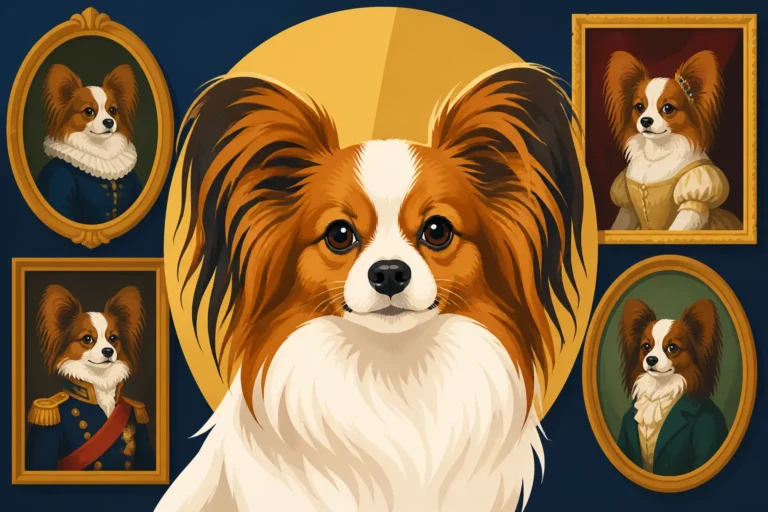
A blaze is a white marking that runs up the center of a dog’s face, usually along the bridge of the nose and toward the forehead. On a Papillon, it sits within a pattern that also includes colored patches on the head and large, fringed ears. Some blazes look broad and easy to spot; others are narrow, off-center, or interrupted by color.
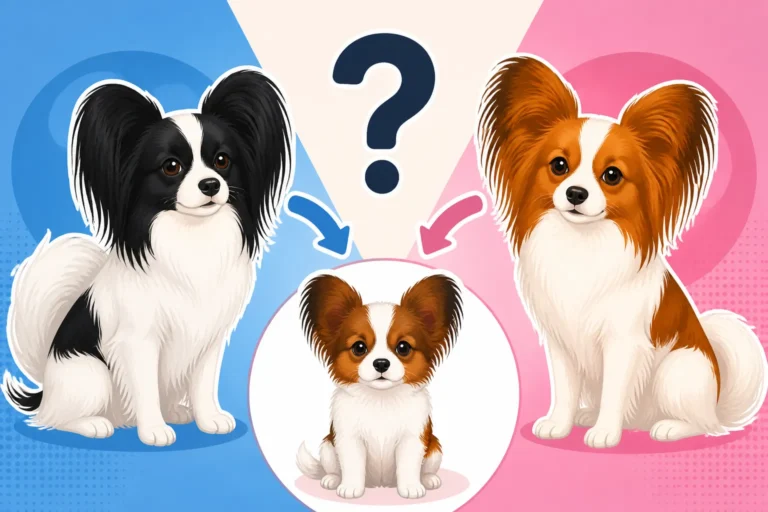
That variation can be especially noticeable in puppy pictures. A Papillon puppy may have a small head and short coat, so a slight difference in the width or direction of a white stripe can seem dramatic. As the puppy grows, the face becomes more defined and the surrounding coat develops. The blaze itself does not necessarily become perfectly centered, though, and a photo taken at an angle can make a balanced marking look uneven.
A white blaze is not the only way a Papillon can have white on the face. The amount and placement of white can vary, and markings need to be considered alongside the colored areas of the head. For a broader look at coat patterns, see Which Colors a Papillon Comes In and Whether a Papillon Must Have a White Blaze.
The blaze does not need to look like a ruler-drawn line
It is easy to compare a puppy’s face with a symmetrical example online and start looking for a matching stripe. In real dogs, facial markings are rarely as tidy as a graphic design. The blaze may curve a little, widen near the forehead, or sit closer to one eye. A small difference from side to side does not automatically mean anything is wrong.
A useful way to assess the marking is to look at the whole face straight on, in natural light, when the dog is relaxed. Then look at the dog’s head from the side and in ordinary movement. This helps distinguish a genuinely uneven marking from a camera angle, a tilted head, or fur that is lying differently on each side.
If you are choosing a puppy, try not to make the decision from a single close-up. Ask for several recent photos or a short video, and compare the puppy’s markings with the rest of its appearance and temperament. A blaze is a cosmetic marking, not a measure of health, trainability, or suitability as a companion.
Do Papillon standards require an even blaze
A clear blaze may be preferred without being compulsory
Breed standards describe a general ideal for appearance; they are not a promise that every individual dog will have identical markings. In the American Kennel Club standard, a white blaze is preferred but not required. The standard also describes how colored areas should appear on the head. It does not make a perfectly centered blaze a universal requirement.
That distinction matters if you are wondering whether an uneven stripe makes a Papillon “not a Papillon” or automatically disqualifies a dog from showing. A marking that is not perfectly symmetrical is not, by itself, the same as failing a requirement for the breed’s color pattern. The exact wording and judging rules can differ among registries and countries, so anyone planning to show should check the standard used by the organization where the dog will compete.
For everyday owners, the practical takeaway is simpler: don’t treat a slightly slanted or off-center blaze as a red flag on its own. The broader pattern, the dog’s overall structure and movement, and the requirements of the relevant registry matter more than whether the white stripe splits the face into two mirror images. For related questions, see Whether a Papillon's Face Markings Should Be Symmetrical and Whether Asymmetry Is Faulted on a Papillon.
Show preferences and pet suitability are different questions
A show judge evaluates how closely a dog matches a written standard, including its overall appearance. That is different from deciding whether a dog will make a good family companion. A Papillon with a crooked blaze can be affectionate, lively, healthy, and well suited to home life. Conversely, a perfectly centered blaze does not tell you whether a puppy has been well socialized or responsibly bred.
If showing is your goal, ask a knowledgeable breeder how the puppy’s markings compare with the standard for your registry. A breeder can explain whether a particular feature may affect show prospects without suggesting that a cosmetic preference determines the puppy’s value as a pet. It is also reasonable to ask to see adult relatives, since looking at a family’s range of markings can give you a clearer sense of what is typical in that line.
| What you are assessing | What to consider | What an uneven blaze means |
|---|---|---|
| Pet suitability | Temperament, health, socialization, and fit with your household | Usually just a cosmetic variation |
| Breed appearance | The full coat pattern and overall head, not only the center stripe | A small asymmetry does not define the whole pattern |
| Show prospects | The standard and judging rules used by the relevant registry | Ask an experienced breeder or exhibitor about the specific dog |
| Puppy photos | Camera angle, lighting, head position, and coat direction | A photo can exaggerate or disguise unevenness |
How markings can look different as a Papillon grows
Puppy coats and photographs can be misleading
A puppy’s face changes as it grows, and its coat becomes longer and more developed. The white and colored areas may appear more or less prominent as the head and surrounding hair mature. That does not mean the blaze is reliably going to move into a more even position. Think of growth as changing the overall proportions and presentation, not as a guarantee that an asymmetrical marking will correct itself.
Photos add another layer of confusion. A puppy holding its head slightly to one side can make the blaze appear to lean. Shadows can make one patch of color look larger, while fluffy hair may partly cover the edge of a marking. If the question matters to you, ask for a front-facing photo taken in natural light, plus views from both sides. You can also ask when the photos were taken so you know whether they show the puppy’s current appearance.
Markings can also seem different when the coat is freshly brushed or damp. Fur lying flat may reveal boundaries that were less obvious in a fluffy photograph. If you are curious about how a puppy’s coat pattern develops, Whether a Papillon Puppy's Markings Change covers that question in more detail.
A white blaze can be visible without being perfectly balanced
When people say a blaze is “even,” they may mean different things. They might mean that the stripe is centered between the eyes, that it has the same width from forehead to muzzle, or that the color patches on either side are similar. These are separate visual details, and a dog can have a clear blaze that is not identical on both sides.
It can help to describe what you actually see rather than relying on a general label. For example: “The stripe is narrow near the nose and wider at the forehead,” or “The white line sits slightly closer to the left eye.” Clear descriptions make it easier for a breeder or experienced Papillon owner to answer your question without assuming you mean something else.
If the white area looks like a sudden change rather than a stable coat marking, or if the skin or eye area appears irritated, treat that as a separate health or grooming concern rather than a question about symmetry. A coat marking should not be confused with redness, discharge, or a change in the eyes themselves. When in doubt, ask your veterinarian to assess a physical change.
Choosing a Papillon without overfocusing on the blaze
Look at the complete dog and the breeder’s answers
It is normal to have preferences. You may love a broad white stripe or find a particular face especially charming. But if you are comparing puppies, try to weigh the blaze alongside the things that affect daily life: how the puppy responds to handling, the environment in which it is being raised, its interactions with people and littermates, and the breeder’s openness about health and care.
Ask the breeder what they know about the puppy’s parents and relatives, and what health checks are appropriate for their breeding program. You can also ask what they think the puppy’s likely adult coat and appearance will be, while remembering that predictions about appearance are not guarantees. A responsible discussion should make room for questions without pressuring you to choose based on one photograph or one marking.
For a wider look at what belongs in a Papillon’s overall appearance, see What a Papillon's Head Should Look Like and Which Colors the Papillon Standard Accepts. If you are weighing breeders, What a Papillon Breeder Should Have Tested can help you keep health questions in view rather than letting coat color dominate the conversation.
Keep routine face care gentle
White facial markings may make food residue, dust, or tear staining more noticeable, but a crooked blaze does not need special treatment. For ordinary mess, start with a soft cloth dampened with clean water and wipe gently around the fur. Avoid scrubbing the eyes or applying products near them unless your veterinarian has advised that the product is appropriate.
If you keep basic grooming supplies at home, choose items intended for pets and follow their labels carefully. Retailers such as Chewy offer general pet-care supplies, but availability in a store is not the same as a recommendation for use around a dog’s eyes. If you are unsure whether a wipe or grooming product is suitable for your Papillon, ask your veterinary clinic before using it.
A second practical concern is keeping long facial hair from becoming uncomfortable or tangled. Check the hair around the cheeks and ears during regular grooming, and handle the puppy gently so face care becomes an ordinary, low-stress routine. You can keep a small cloth in your grooming kit, whether you shop through Chewy or elsewhere, and use it only for simple external cleaning. For any persistent staining, irritation, or discharge, ask your vet rather than trying stronger products.
Disclaimer
This article is for general informational purposes only and does not constitute professional advice. Laws, prices and regulations vary by location and change over time. Consult a qualified professional for guidance on your specific situation.