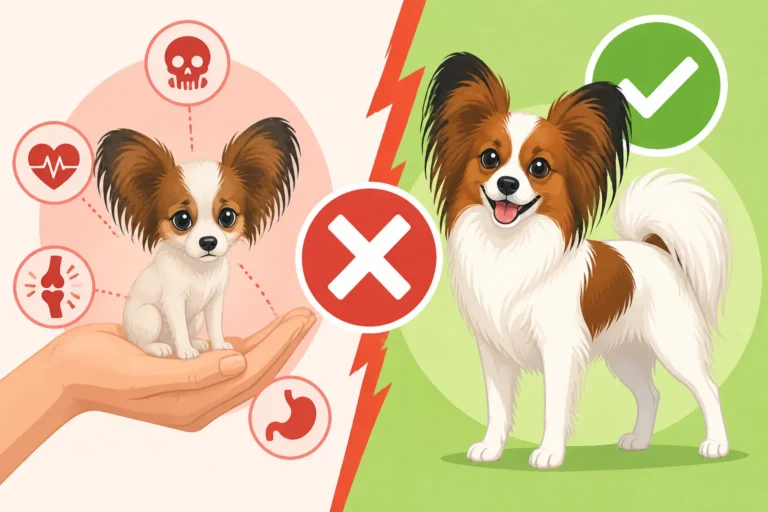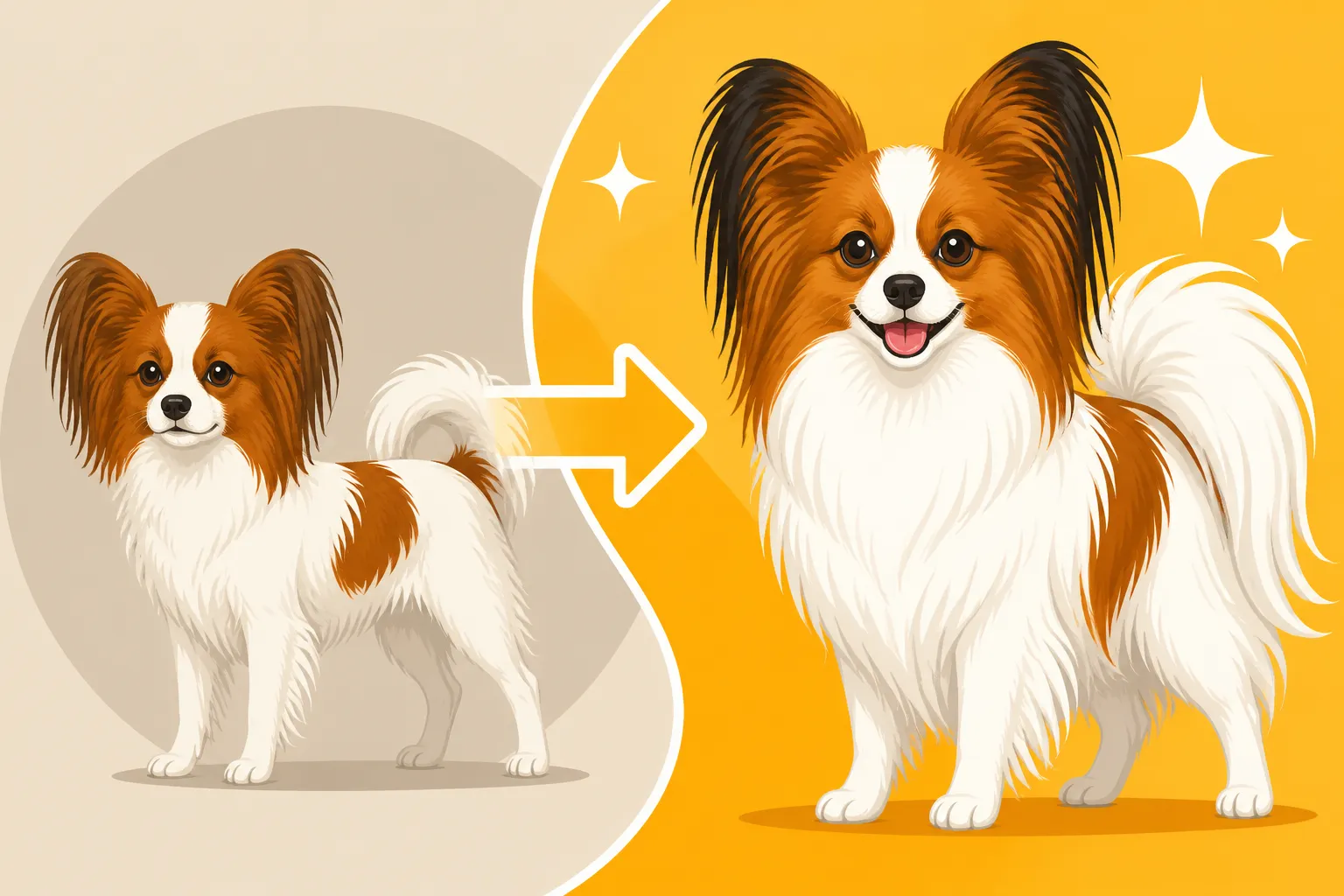
How the Papillon Standard Has Changed
A Papillon in an old portrait may look familiar, yet the dog beside a show ring today can seem more refined, better groomed, or even different in ear shape. That can make it hard to tell whether the breed standard itself changed or whether breeding and judging simply changed how it is interpreted. This guide separates documented standards from shifting preferences.
What a breed standard describes
A written ideal, not a snapshot of every Papillon
A breed standard is a written description of the ideal representative of a breed. It gives breeders and judges a shared framework for assessing features such as size, proportion, head, ears, coat, color, and movement. It is not a guarantee that every Papillon will look identical, nor does it mean a pet-quality dog is deficient because it does not match every detail.
Standards also are not always permanent. Kennel organizations can revise their wording, clarify how a feature should be assessed, or adjust descriptions as knowledge and breeding priorities develop. A change in wording can matter, but a new edition does not necessarily mean the breed has been remade. Sometimes it makes an existing expectation easier to understand.
It helps to distinguish three things that are often bundled together as “the standard changed”: an official written revision, a change in the way judges emphasize a feature, and a gradual shift in the dogs being bred and shown. Those processes can influence each other, but they are not interchangeable. A Papillon may look different from an ancestor in a portrait without any single revision explaining the difference.
For a broader picture of the breed’s long history, see The Papillon Has Seven Hundred Years of Portraits Behind It. Portraits offer useful clues about the small spaniels people valued, but they are not technical records. Artists could idealize their subjects, and the dogs depicted were not necessarily bred under the same rules that guide modern conformation shows.
Why country and kennel organization matter
There is not one worldwide document that dictates every Papillon’s ideal appearance. Different kennel organizations publish their own standards, and their wording or emphasis can vary. A dog evaluated under one country’s rules may be discussed somewhat differently under another organization’s rules, even when the underlying breed type is recognizably Papillon.
That is why a claim such as “the Papillon standard now says…” needs context. Which organization’s standard is being discussed? Which edition? Is the statement quoting an official document or describing a judge’s preference? Those questions are especially useful when comparing online descriptions, breeder comments, and show critiques.
If you are looking at a particular dog, start with the standard used by the event or organization that will judge it. Then read the document as a whole. Isolated phrases about ears, color, or proportions can be misleading when separated from the rest of the description. The article How Papillon Standards Differ Between Countries explores why the same breed can be described with slightly different language across registries.
How Papillon type developed over time
The Papillon and Phalene share a breed history
The most immediately noticeable change in Papillon type is often the ear. The Papillon is known for erect, butterfly-like ears; the Phalene has drop ears. They are forms of the Continental Toy Spaniel, not unrelated dogs simply because their ears differ. Both types can occur within the same breed population, and ear carriage is one of the features that makes the Papillon’s history especially interesting.
Historical depictions of small spaniels do not always look like modern show dogs. Ears may hang, sit differently, or be hard to interpret in a painting. As breeding preferences developed, erect ears became strongly associated with the Papillon, while the drop-eared Phalene remained part of the breed picture. The name difference reflects ear shape: papillon means butterfly, and phalene means moth. For more on that distinction, read Papillon Means Butterfly and Phalene Means Moth.
It is tempting to tell the story as though breeders made one simple change and produced the modern Papillon. Breed development is rarely that tidy. Traits emerge and become more or less common over generations, and people may select for a particular look without every feature changing at once. The presence of both ear types is a reminder that breed history contains variation, not just a straight line from old paintings to today’s show ring.
Refinement does not mean every feature changed at once
Modern show Papillons are often presented as polished, balanced little dogs. Their coat may be carefully arranged, their outline may look crisp, and their ears may be especially striking. But presentation can make a dog appear more different from an old portrait than its underlying structure really is. Grooming, posture, photography, and artistic style all affect what we notice.
A standard describes several features together, so judging is not meant to be a search for one dramatic trait. Proportion, sound movement, expression, and overall balance contribute to the impression of a correct Papillon. A striking ear fringe cannot, by itself, tell you whether a dog is well made. Nor does an especially abundant coat automatically make a dog a better example of the breed.
When comparing dogs across generations, it can help to ask what kind of difference you are seeing. Is it a change in the written description? A change in the frequency of a particular trait? Or simply a difference in grooming and photographic presentation? Keeping those questions separate prevents a common misunderstanding: assuming that every visible shift proves that an official standard was rewritten.
Features people often think have changed
Size, proportion, and the overall outline
The standard’s description of size and proportion helps establish what a Papillon should look like as a whole. The breed is small, but the desired impression is not simply “as tiny as possible.” A correct outline should read as balanced and sound rather than fragile. A dog can be petite without being reduced to a narrow, weak-looking version of the breed.
You may see individual Papillons that differ in height, body proportions, bone, or overall presence. That variation does not automatically mean a standard changed. It may reflect normal differences among dogs, differing breeding priorities, or the distinction between a pet and a dog selected for conformation competition. For a focused description of the breed’s dimensions, see What a Papillon Weighs and How Tall It Stands.
The phrase “breed type” is useful here. It refers to the combined impression created by a dog’s features rather than a single measurement or characteristic. What a Correct Papillon's Outline Looks Like explains that idea in more detail. When people say the modern Papillon looks “more refined,” they may be describing an overall impression shaped by head, expression, coat, and presentation—not pointing to one newly introduced feature.
Coat, color, and markings
A Papillon’s coat contributes strongly to its appearance, especially the feathering on the ears, chest, legs, and tail. That can make current show dogs look more elaborate than dogs in older images. But a dramatic fringe is not the same thing as a change in body structure, and the way a coat is groomed can affect the outline a judge sees.
Color and markings can also lead to confusion. People may assume that a popular or visually striking pattern is a newer requirement, when the standard’s actual language may be broader. The details matter: a dog’s base color, the placement of markings, and the effect of those markings on expression are different considerations. See Every Color a Papillon Is Allowed to Be and Whether a Papillon's Face Markings Should Be Symmetrical for more on those features.
For everyday coat care, the show standard is not a shopping list. A family Papillon does not need elaborate show preparation to be a healthy, comfortable companion. If you are putting together basic grooming supplies, Chewy can be one place to compare combs and brushes, but choose tools based on your dog’s coat and comfort rather than on a show-ring look. A gentle comb-through that prevents tangles is more useful than chasing an exaggerated fringe.
How to read claims that the standard changed
Check the document before trusting a confident claim
If someone says a Papillon standard was changed, ask what specifically changed. Was a phrase added or removed? Was a feature redefined? Did an organization publish a new edition? A clear answer should identify the organization and explain the wording, rather than relying on a vague statement that “the breed used to look different.”
A practical way to assess the claim is to compare the relevant descriptions side by side. Focus on the feature being discussed, then read nearby passages for context. A small adjustment to a phrase can clarify how a feature is judged without changing the breed’s overall identity. Likewise, a difference in how judges interpret language does not necessarily mean the official document changed.
It is also worth separating written standards from show trends. If many successful show dogs share a particular look, that can influence what breeders and exhibitors favor. But popularity in the ring is not proof that the feature became mandatory. For examples of how a written description can be applied to specific traits, see Which Faults Judges Penalize in a Papillon.
| What you notice | What it may mean | What to check |
|---|---|---|
| Papillons in old art have different-looking ears | Artistic depiction, historical variation, or a different ear type | Whether the dog is shown with erect or drop ears |
| Show dogs appear more polished | Grooming, posture, and presentation may shape the impression | The written description of coat and outline |
| A feature seems more common today | Breeding preferences may have shifted over time | Whether an official standard actually changed |
| Two organizations describe a feature differently | Their standards may use different wording or emphasis | Which organization’s rules apply to the event |
| A pet Papillon does not match a show ideal | Normal individual variation or different breeding priorities | Health, comfort, and the applicable standard if relevant |
Remember that a standard is not a pet-owner checklist
For most owners, the standard is useful background, not a scorecard for judging their dog at home. A companion Papillon can be charming, healthy, and very much a Papillon without having every feature that would be prioritized in a conformation ring. Breed standards are meant to guide evaluation and breeding decisions, not to diminish the bond people have with their dogs.
If you are buying grooming supplies or planning routine care, focus on your dog’s actual needs. Chewy may help you compare basic coat-care options, but a specific product cannot make a dog more “standard.” The same goes for trimming: keeping the feet tidy for comfort is different from altering a dog’s natural appearance to create a particular silhouette. When in doubt about a grooming choice, ask a groomer familiar with the breed.
And if you are considering a puppy, look beyond a single attractive photograph. Ask the breeder how they prioritize health, temperament, and sound structure, and request an explanation of the relevant health testing. The guide What a Papillon Breeder Should Have Tested is a useful companion read. A breed standard can help explain the ideal, but responsible breeding is also about producing dogs who can live comfortably as companions.
A final practical point: show language can sound intimidating when you first encounter it. Terms about proportions, markings, or carriage are easier to understand when you see how they fit together, rather than treating each one as a pass-or-fail test. If you want a grooming routine that is manageable at home, Chewy is one retailer where you can compare ordinary brushes and combs; the best choice is the one your Papillon tolerates and that helps you keep the coat free of tangles.
Disclaimer
This article is for general informational purposes only and does not constitute professional advice. Laws, prices and regulations vary by location and change over time. Consult a qualified professional for guidance on your specific situation.