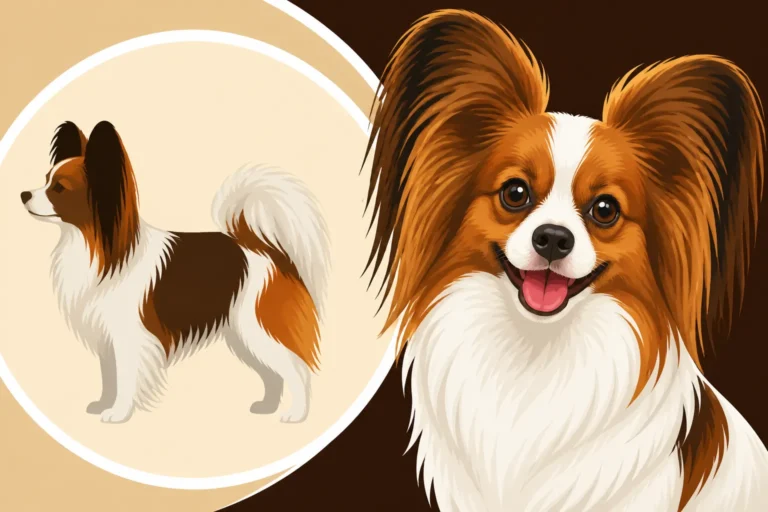
When the First Papillons Reached America
The first Papillons in America did not arrive in one famous, well-documented moment. They came gradually from Europe, and early records do not give us a single arrival date that settles the question. This guide explains what can be said with confidence, how the breed became established in the United States, and why recognition dates are not the same as arrival dates.
When Papillons first came to the United States
There is no confirmed single arrival date
Papillons reached the United States through a gradual process of importation rather than a clearly documented public debut. Individual dogs could have been brought over by travelers or breeders before the breed appeared in organized American records. That makes it difficult to name one dog, one owner, or one year as the definitive “first.”
The early history is also complicated by naming. The small, long-coated spaniels associated with the Papillon existed in Europe before modern breed labels and registries made their identity easier to track. A dog described in an old record as a dwarf spaniel or Continental Toy Spaniel may belong to the breed’s wider history, but the wording alone does not prove that the dog was registered or recognized as a Papillon in the modern sense.
So when someone asks when the first Papillons reached America, the most accurate answer is that the breed was arriving around the turn of the twentieth century, but a precise first-arrival date is not firmly established. That is different from saying there were no Papillons in the country before a particular registry date. Individual imports may have preceded the paperwork that later made the breed easier to identify.
The wider European background helps put those imports in context. For more on the breed’s earlier development, see Where the Papillon Comes From and How Old the Papillon Breed Is. The American story is part of that longer history, not the moment the breed itself began.
Early imports were different from an established American population
A handful of imported dogs can introduce a breed without creating a lasting population. Early Papillon owners needed to find suitable mates, share knowledge about the dogs, and maintain consistent records. Those steps take time, especially when a breed is still unfamiliar to local dog fanciers.
Imported dogs also did not necessarily look or behave exactly like the Papillons people picture today. Coat, markings, size, and ear carriage can vary among individuals. And because the drop-eared Phalene is closely related to the erect-eared Papillon, older descriptions may not always make the distinction that modern breed conversations expect. The two forms have long been connected; learn more in Why a Papillon and a Phalene Are Born in the Same Litter.
For an American buyer or breeder in the early twentieth century, obtaining a dog from Europe could involve more than choosing a puppy from a nearby litter. It could mean finding a contact overseas, assessing a dog at a distance, arranging transport, and then introducing that dog to a small circle of local fanciers. Without today’s instant photos, online pedigrees, and routine communication, that process was far less straightforward.
That is why the first imports and the start of a stable American breed community should be treated as related but separate milestones. The first tells us when dogs began arriving; the second tells us when people were building a more organized presence for the breed.
Arrival, registration, and recognition are not the same thing
What an official recognition date tells us
The American Kennel Club recognized the Papillon in 1915. That date is a useful marker in the breed’s U.S. history, but it does not establish the exact year the first Papillon arrived. Official recognition concerns the breed’s status within an organized registry, not necessarily the first time any individual dog crossed into the country.
It is easy to see how those milestones get mixed up. A familiar date appears in breed summaries, and over time it can be repeated as if it were the date of the first import. But a breed may have been present for years before a registry formally recognizes it. Conversely, recognition does not automatically mean there are already many breeders or a large, well-established population.
For a simple comparison:
| Milestone | What it tells us | What it does not prove |
|---|---|---|
| First known or possible imports | Papillons began arriving in the country | That a thriving breeding community already existed |
| AKC recognition in 1915 | The breed gained formal recognition in the American registry | That the first Papillon arrived that year |
| Formation of an organized breed community | Owners and breeders began coordinating more consistently | That every earlier import was recorded or preserved in the records |
The distinction matters because breed histories are built from different kinds of evidence: import records, pedigrees, show catalogues, registry information, and accounts from breeders. Those sources do not always start at the same point. For more on the registry milestone, see When the AKC Recognized the Papillon.
Recognition did not instantly make the breed common
Formal recognition gave Papillons a clearer place in American dog circles, but it did not turn them into a familiar household breed overnight. Recognition can help organize show participation and breeding records; it cannot, by itself, create a wide network of breeders or make puppies easy to find.
The same distinction applies to the word “established.” A breed may be recognized yet remain relatively uncommon. People interested in Papillons still need to find knowledgeable breeders, learn the breed’s history, and understand the difference between an occasional import and a generation of dogs bred in the United States.
This gradual change is typical of how many less-common breeds take root. One owner tells another about a dog; a breeder finds an appropriate match; puppies bring new people into the community. Over time, a breed that was once known mainly to dog enthusiasts becomes easier to encounter beyond specialist circles.
If you are curious about the Papillon’s place among American breeds today, How Rare the Papillon Is and Where the Papillon Sits in AKC Popularity offer helpful context. They also underline why recognition and popularity should not be treated as interchangeable measures.
How European roots shaped the American Papillon
The breed crossed an ocean with its existing identity
Papillons were not created in the United States. Their story developed in Europe, where small spaniels appear in art and historical accounts long before modern American kennel records. When dogs arrived in America, they brought that background with them, even as American breeders began shaping local pedigrees and communities.
The name itself points to one of the breed’s most recognizable features. “Papillon” means butterfly in French, a reference to the upright ears and long fringe. The drop-eared variety is known as the Phalene, meaning moth. Those two ear types help explain why older records and descriptions may not always match the labels used today.
American breeders and owners also had to work with the terminology and standards available to them at the time. Breed names, registry categories, and judging practices can change or become more precise as organizations develop. That makes it useful to compare the American story with the breed’s wider European one rather than assuming every country used the same categories from the beginning. For the broader comparison, see Whether the Papillon Reached Britain Before America and Whether Europe Judges Papillon and Phalene Separately.
American breeding grew from imports and local continuity
Once Papillons were in the United States, lasting progress depended on more than bringing in additional dogs. Breeders needed to preserve useful information about ancestry, choose compatible dogs, and keep the breed recognizable across generations. A healthy breed community also depends on people sharing practical knowledge rather than treating every litter as an isolated project.
For an owner looking back at the breed’s history, this gradual development helps explain why a single “first” can be hard to pin down. The early dogs may have arrived privately, and the records that later made Papillons easier to trace may have started only after interest had grown. A written registry is valuable evidence, but it is not a complete diary of every dog brought into the country.
The relationship between European imports and American breeding continued to matter as the breed became more familiar. Local lines developed, but the Papillon remained part of an international breed community. Differences between countries can reflect breeding choices, show traditions, or changing standards rather than a simple split into unrelated types. See Whether British and American Papillons Differ for more on that comparison.
What the early American history means for Papillon owners
A long history does not guarantee easy access to old records
Today, it is tempting to expect every breed’s past to be searchable in one neat database. Older records may be scattered among registry materials, historical club documents, pedigrees, show catalogues, and personal accounts. Some early imports may be mentioned in one place but absent from another, while the spelling or breed name used in a record may differ from modern usage.
If you are tracing a particular dog’s ancestry, start with the documents connected to that dog: the registration information, pedigree, breeder records, and any available health documentation. Then work outward. Ask the breeder or breed community whether older pedigrees or club records might help. Be cautious about treating a repeated internet claim as proof if it does not identify the underlying record.
For a prospective owner, the more useful lesson is not that every historic detail can be settled. It is that responsible breeding depends on keeping clear records now. Learning what health information breeders should provide is a practical next step; What a Papillon Breeder Should Have Tested explains the health-testing side of that conversation.
History can make the breed more interesting, but daily care still matters
The Papillon’s history is part of its appeal: a small, alert dog with a long European story and a distinctive look. But a historic reputation does not tell you whether a particular dog suits your home. Temperament, training, health, age, and the care an individual dog receives matter far more in everyday life than the date its ancestors first arrived in America.
If you are moving from breed research to preparing for a dog, make a realistic list of ordinary needs: safe travel equipment, a comfortable resting place, grooming tools, food, and veterinary care. Chewy is one retailer owners may compare when looking for routine supplies, but choose items for the individual dog’s size and needs rather than buying based on a breed label alone. A small dog still needs secure equipment and careful handling.
For example, a Papillon who rides regularly in a car needs a properly fitted, secure travel setup; one who spends time on slippery floors may benefit from changes to the home environment. Chewy may be useful for comparing some everyday pet-care products, but it cannot replace a veterinarian’s guidance about health needs or a breeder’s records about a dog’s lineage. And if you are using Chewy to browse supplies, check product measurements and safety details instead of assuming every “small dog” item will fit a Papillon.
Disclaimer
This article is for general informational purposes only and does not constitute professional advice. Laws, prices and regulations vary by location and change over time. Consult a qualified professional for guidance on your specific situation.