How Long a Papillon’s Muzzle Should Be
A Papillon’s face can look very different as a puppy, after a haircut, or when photographed from an odd angle, so it is easy to wonder whether the muzzle is too long or too short. This guide explains the breed’s expected muzzle shape and proportion, how to assess it fairly, and when a facial change is a reason to contact your veterinarian.
The Papillon muzzle in plain language
What the breed standard describes
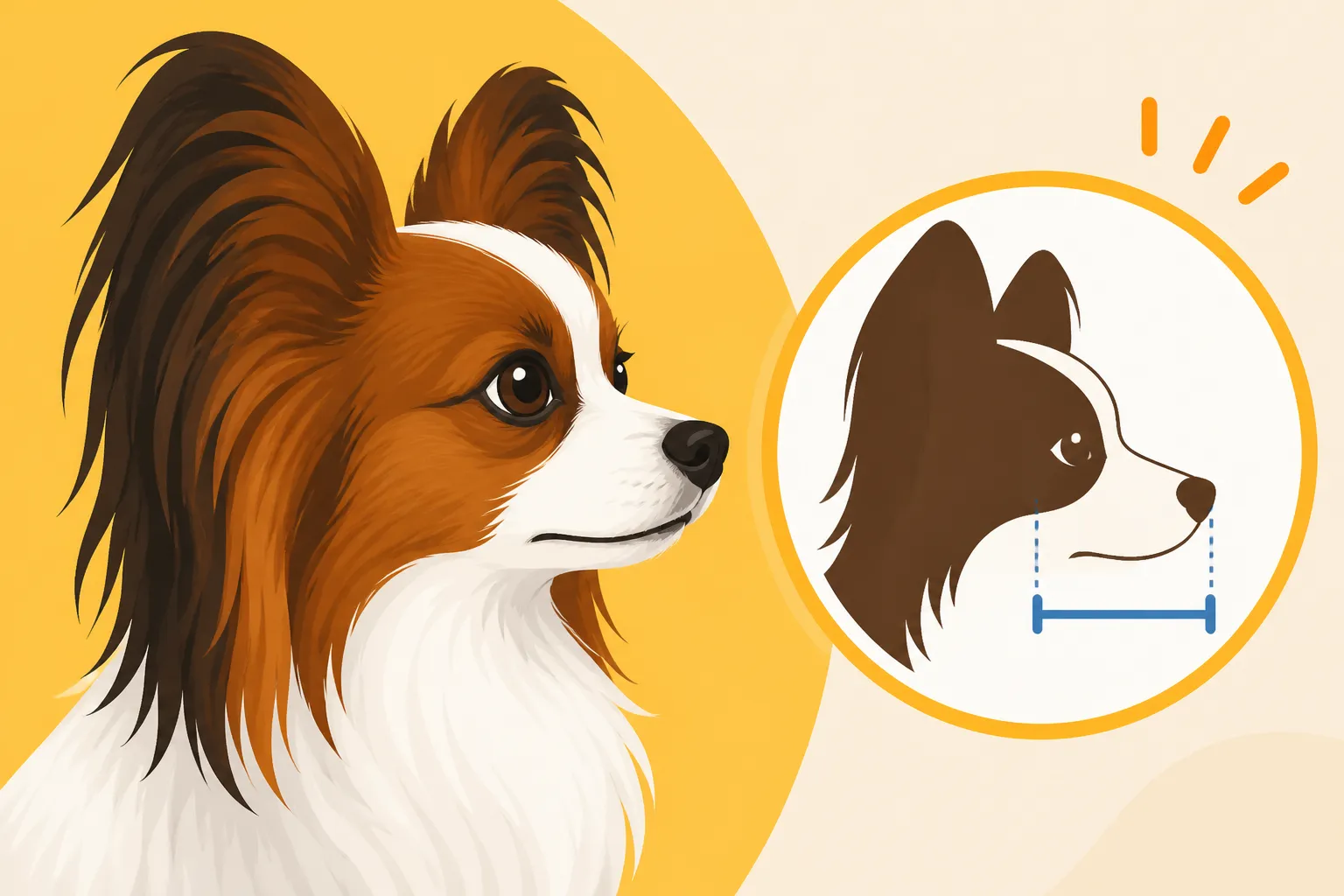
A Papillon’s muzzle should be fine and pointed, with a gradual taper toward the nose. It should look delicate without appearing pinched, blunt, or weak. In the American breed standard, the muzzle is described as approximately one-third the length of the head. That wording is a guide to overall proportion, not a demand that every dog’s face match a measurement taken with a ruler.
The muzzle is the portion of the face in front of the stop, the transition between the forehead and the muzzle. On a Papillon, that transition is noticeable but not abrupt enough to make the face look flat. The nose sits at the end of the taper, and the overall expression should remain refined and alert.
If you are comparing a dog with a written standard, read the standard for the registry or country relevant to your question. Wording and judging priorities can differ. The broader idea remains useful: a Papillon should have a tapered muzzle that balances with its small head, rather than a very short, broad face or an exaggeratedly long one. For more about the whole head, see What a Papillon's Head Should Look Like.
How muzzle length fits the rest of the head
Muzzle length is only one part of head type. A muzzle may seem longer when the forehead is narrow, the coat is clipped around the face, or the dog is photographed from the side. In a straight-on picture, the same face can look shorter because perspective compresses the nose-to-skull distance. That is why one photograph is rarely enough to judge proportion.
Look at the head as a whole: the width and shape of the skull, the stop, the muzzle’s taper, and the placement of the eyes all contribute to the expression. A Papillon’s ears and ear fringe can also draw the eye upward and outward, making the muzzle appear more delicate. The breed’s overall outline and balance matter too; What a Correct Papillon's Outline Looks Like gives useful context for seeing individual features in proportion.
Try to assess a relaxed dog in natural light, from the side and from the front. Avoid pressing the lips or holding the head rigidly just to get a photograph. If you are evaluating a puppy, remember that the head can look temporarily out of balance as the puppy grows. A single awkward stage does not establish what the adult face will look like.
What “approximately one-third” does and does not mean
The one-third description is best treated as a visual proportion, not a strict home test. Breed standards use language to help describe type; they are not medical instructions or a formula that owners need to calculate. Head landmarks can also be difficult to identify consistently on a wiggly dog, and coat, camera angle, and facial expression can all affect what you see.
If you want to compare proportions for your own understanding, use a clear side view and compare the nose-to-stop section with the rest of the head. Do not use a hard ruler near the eyes or nose, and do not stretch the lips or force the dog to hold still. A calm visual comparison is enough for an informal check.
For showing or breeding decisions, measurements and impressions at home cannot replace an experienced evaluation. A breeder, conformation judge, or knowledgeable breed mentor can assess the complete head and outline in person. For a broader discussion of the fine-boned look expected in the breed, see Why a Papillon Should Look Fine Boned but Not Frail.
How to assess muzzle proportion fairly
Start with a calm, natural view
Settle your Papillon on a nonslip surface or let the dog stand comfortably on the floor. Get down to the dog’s level and look at the face without pulling the head upward. A side view can show the taper and the transition at the stop; a front view helps you notice whether the muzzle appears balanced with the skull.
Take more than one view if you are comparing photographs. Keep the camera roughly level with the dog’s face and avoid a close-up taken with a phone held inches from the nose. Wide-angle perspective can make the nose look unusually large or the muzzle unusually short. If a photograph looks surprising, step back and use a modest zoom rather than bringing the camera closer.
A simple comparison can help organize what you notice:
| What you are looking at | Typical Papillon impression | What can distort the impression |
|---|---|---|
| Muzzle shape | Fine and gradually tapering | A close camera angle or a wet, flattened fringe |
| Muzzle length | Balanced with the rest of the head | A puppy growth stage or an unusual pose |
| Stop | Noticeable transition from skull to muzzle | Raised head, shadows, or a strong expression |
| Overall face | Refined, alert, and proportionate | Clipped facial hair or comparison with another breed |
This is not a scoring chart. It is a reminder to consider several features together instead of deciding that a muzzle is “wrong” based on one detail.
Separate coat and camera effects from anatomy
Papillons have fine facial hair and prominent ear fringe, but coat styling can change the apparent shape of the face. A groom that tidies the cheeks or muzzle may reveal more of the outline than usual. Conversely, damp hair or food caught in the fringe can make the muzzle look broader or messier in a snapshot. Neither effect changes the underlying bone structure.
Photographs can be especially misleading when one dog is photographed in profile and another from the front. Even two side views may not be comparable if the dogs are standing at different angles or one has its head tilted. For a fair comparison, use similarly positioned images and look at the whole head, not just the nose-to-stop area.
This matters when comparing a Papillon with a long-coated Chihuahua. Both may have fine facial features and a coat that frames the face, but they are distinct breeds with their own expected head type. A comparison can be interesting, but another breed’s proportions are not the measure of whether a Papillon’s muzzle is correct. See How a Papillon Differs From a Long Coated Chihuahua for broader breed context.
Consider age and individual variation
Puppies can look out of proportion for a while. Their skull, muzzle, coat, and overall body do not necessarily develop in a perfectly synchronized way, so a young Papillon may temporarily appear longer-faced or shorter-faced than you expect. A growing dog should be assessed over time, ideally in natural, comparable views rather than through daily close-up checks.
Adult dogs also vary. A breed standard describes the desired type, but it does not mean every healthy Papillon has an identical face. A modest difference in muzzle length by itself does not establish a health problem, a poor-quality dog, or a reason to seek treatment. If you are choosing a puppy, ask the breeder to explain the puppy’s developing features and show you the parents when possible.
For a show evaluation, a judge considers the dog as a whole and applies the relevant standard. If you are curious about the hands-on assessment and other features considered in the ring, What a Papillon Judge Puts a Hand On First offers related context. A home owner does not need to turn ordinary facial variation into a constant examination.
When appearance may signal a health concern
A muzzle that looks different is not automatically a problem
A naturally longer-looking or shorter-looking muzzle is usually a question of appearance and proportion, not a diagnosis. The more important concern is a change from your dog’s usual face or a sign that the dog is uncomfortable. Swelling, a sudden change in facial symmetry, bleeding, discharge, difficulty opening the mouth, or trouble eating deserves attention from a veterinarian.
Pay attention to function as well as looks. Notice whether your Papillon chews comfortably, picks up food as usual, breathes normally, and allows gentle handling around the face. A dog that suddenly avoids having its muzzle touched may be reacting to pain, irritation, or fear. Do not force an inspection if the dog is distressed.
The muzzle’s shape alone cannot tell you whether the teeth are healthy or correctly positioned. Papillons can have dental crowding because of their small jaws, so mouth health should be checked separately. For that topic, The Teeth in a Papillon's Small Jaw explains why a small face can still need careful dental attention.
Signs to discuss with your veterinarian
Contact your veterinarian if the muzzle or surrounding face changes quickly, seems painful, or is accompanied by other symptoms. Examples include persistent pawing at the mouth, dropping food, chewing on one side, unusual drooling, reluctance to eat, or a visible lump. These signs do not point to one specific cause, but they are more meaningful than a muzzle simply seeming a little long in a photo.
A veterinarian can examine the teeth, gums, lips, jaw movement, and surrounding tissues. If your dog has trouble breathing or a sudden severe facial injury, seek urgent veterinary guidance rather than waiting to see whether the appearance settles. Do not give human pain medication or try to manipulate a suspected injury at home.
Keep a brief note of when the change began and whether eating, drinking, or behavior has changed. A clear photo taken from a normal distance may help you explain what you noticed, but it should not delay care if your dog is in distress. For general visual features that may be considered in the ring, Which Faults Judges Penalize in a Papillon is a separate subject from veterinary assessment.
Keep breed evaluation and health care separate
It is easy to mix up “Does this match the breed’s ideal?” with “Is my dog healthy?” They are different questions. A muzzle that does not perfectly match a show description does not automatically need correction, and a dog that looks very breed-typical can still have dental or other health needs.
If you are selecting a puppy, ask the breeder what they observe about the puppy’s head as it develops, but avoid expecting a guarantee about an adult’s exact appearance. Ask to see the parents and discuss health, temperament, and the puppy’s care as well as looks. The standard is useful background, but it is not a substitute for a thoughtful match between a dog and your household.
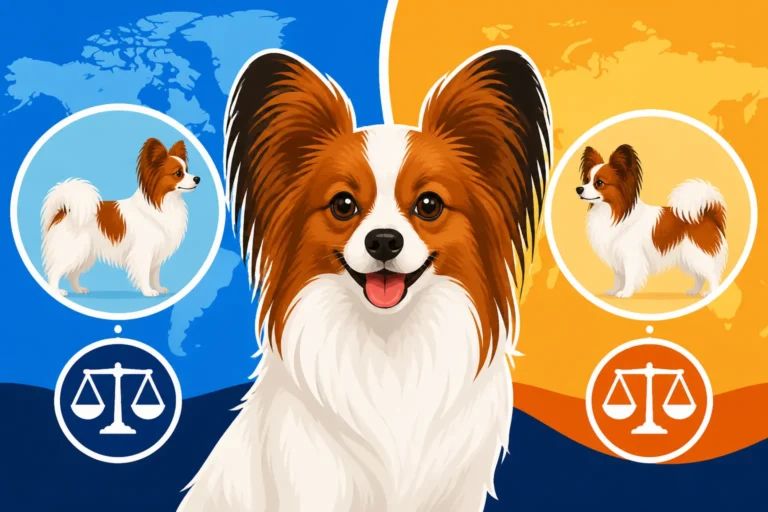
Registry standards can also phrase features differently, so it helps to compare like with like rather than mixing descriptions from different countries. How Papillon Standards Differ Between Countries can help explain why the same feature may be described or weighed somewhat differently across registries.
Common questions about Papillon muzzle length
Can a Papillon’s muzzle be too long?
A muzzle can look long compared with the standard’s preferred proportion, but appearance should be judged in the context of the whole head and dog. A longer-looking muzzle is not, by itself, proof of illness or a health defect. Camera perspective, puppy development, coat, and the shape of the skull can all influence what you see.
If you are asking about show type, have the dog assessed against the relevant breed standard by someone familiar with Papillons. If you are asking because your dog’s face has changed or seems painful, focus on the change and any accompanying symptoms and contact your veterinarian.
Can a Papillon have a muzzle that is too short?
A very short or blunt-looking muzzle may differ from the fine, tapered look described for the breed. But do not draw conclusions from one close-up or from comparison with a different breed. Look at a natural side view, the stop, and the whole head together.
If the dog eats, breathes, and behaves normally, a difference in appearance alone is generally a breed-type question rather than an emergency. If normal function changes, seek veterinary advice regardless of whether the muzzle appears to match a standard.
Should I measure my Papillon’s muzzle at home?
You do not need to measure it for routine care. The standard’s approximate proportion is descriptive, and home measurements can be inconsistent because the landmarks are hard to identify and the dog may move. A soft tape measure is not necessary for deciding whether your Papillon is healthy.
For most owners, the useful approach is simple: know your dog’s usual face, look at it in natural light, and watch for meaningful changes or discomfort. If your question is about showing, ask an experienced breed evaluator; if it is about health, ask your veterinarian.
Disclaimer
This article is for general informational purposes only and does not constitute professional advice. Laws, prices and regulations vary by location and change over time. Consult a qualified professional for guidance on your specific situation.