Whether a Papillon Owner Needs a Tunnel and Weaves
Bringing a Papillon into your life is an absolute joy, especially when you start exploring their incredible intelligence and boundless energy. Many of us dream of seeing our little butterflies soar over jumps and weave through poles, picturing them as tiny agility champions. But then the practical questions hit: do you really need a full set of agility equipment, like tunnels and weave poles, for your backyard to make that dream a reality? It's a common dilemma for Papillon owners, and this guide is here to walk you through all the considerations, from cost to commitment, so you can decide what's right for you and your clever companion.
Understanding Agility Equipment for Papillons at Home
The world of dog agility is vibrant and exciting, and Papillons, with their quick minds and athletic builds, often excel. It's natural to want to bring some of that excitement home. But before you start clearing out your yard or dedicating a corner of your garage, it's worth understanding what backyard agility entails, especially when it comes to pieces like tunnels and weave poles.
The Basics of Tunnels and Weave Poles
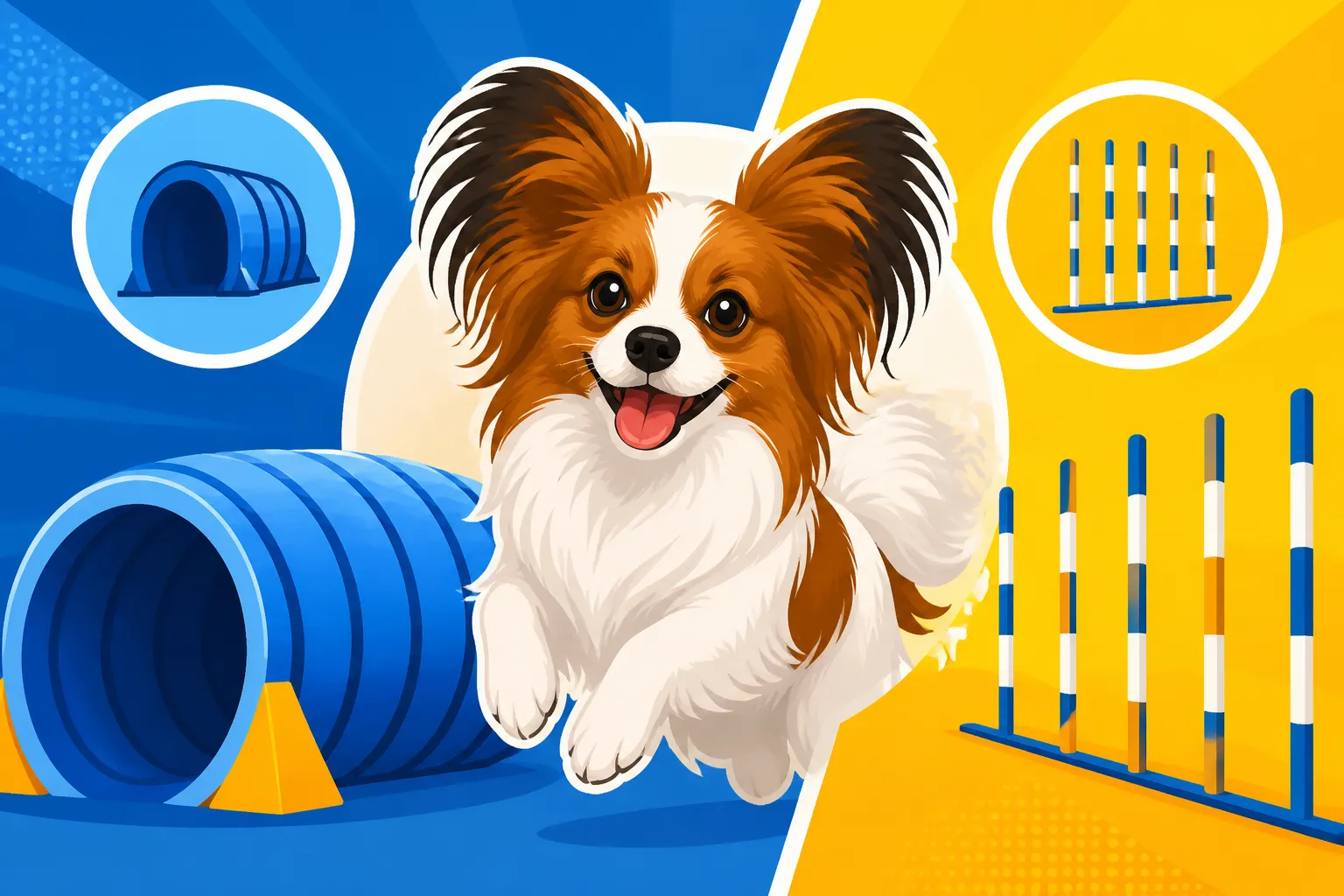
Let's break down these two iconic pieces of equipment. Tunnels are essentially collapsible fabric tubes that dogs run through. They come in various lengths and diameters, and some are "chute" tunnels where one end is open and the other is collapsed, requiring the dog to push through. Weave poles, on the other hand, are a series of upright poles, typically 6 or 12, that the dog must weave through in a specific pattern, entering with the first pole on their left.
For a Papillon, both types of obstacles offer fantastic mental and physical stimulation. A tunnel encourages speed and confidence, allowing your little dog to rocket through, often disappearing and reappearing with glee. Weave poles, though, are a whole different beast. They demand precision, body awareness, and a lot of focus, making them one of the more challenging obstacles to teach. Watching a Papillon flow seamlessly through a set of weaves is truly a sight to behold, a testament to their intelligence and your patient training. However, replicating this standard at home requires specific types of equipment, not just makeshift alternatives.
Why Backyard Equipment Can Be Beneficial
Having agility equipment at home, even just a few key pieces, can offer some wonderful advantages. For one, it provides an unparalleled convenience. You don't have to pack up the car, drive to a training facility, or adhere to a strict class schedule. This flexibility means you can squeeze in short training sessions whenever your Papillon is feeling energetic, or when you have a spare ten minutes. This is particularly great for building consistency, which is key to mastering complex skills like weaves.
Beyond convenience, home equipment can be a fantastic way to deepen your bond with your Papillon. Training together in a relaxed, familiar environment can build trust and communication. It allows for a low-pressure learning atmosphere where you can experiment with different training methods and celebrate every small success. Plus, it's excellent exercise. Papillons are active little dogs, and mental and physical challenges like those offered by agility can help burn off excess energy, preventing boredom-related behaviors. It’s a wonderful way to give your dog a fulfilling "job," whether it's learning How a Papillon Manages Weave Poles or practicing going over a small jump.
Space and Safety Considerations
Before you click "add to cart" on a full agility set, pause and consider your physical space. Tunnels, even collapsible ones, take up a good amount of room. A 15-foot tunnel, when extended, needs a clear run. Weave poles, especially a standard set of 12, require a significant straight line. You need enough space not just for the equipment itself, but also for your Papillon to approach and exit the obstacles safely, and for you, the handler, to move alongside them. A crowded, cluttered yard is an accident waiting to happen.
Safety is paramount. Agility equipment, even for small dogs, needs to be stable and well-maintained. Cheap, flimsy equipment can lead to injury. Ensure tunnels are anchored down so they don't roll or collapse on your dog. Weave poles should be securely planted and not easily tipped over. Think about the ground surface too. Grass is ideal, offering cushioning. Concrete or slippery decking can be dangerous. Also, consider the weather – direct sun can heat tunnels rapidly, and wet surfaces can be treacherous. Remember, a Papillon's delicate bone structure means even a minor fall can have serious consequences, especially for their knees. Whether a Papillon Should Be Stopped From Jumping Off Furniture is a concern for their overall joint health, and agility, while beneficial, must be approached with extreme care.
Assessing Your Papillon's Agility Journey and Your Goals
Deciding whether to invest in home agility equipment isn't just about space or money; it's deeply tied to your aspirations for your Papillon and their individual capabilities. Not every dog (or owner!) wants to be a competitive champion, and that's perfectly fine.
Starting Out: Classes vs. Home Setup
For many Papillon owners who are just dipping their toes into agility, formal classes are almost always the best starting point. Why? Because you gain access to experienced instructors who can teach you the correct handling techniques and, more importantly, how to introduce your dog to each obstacle safely and effectively. Weave poles, in particular, are incredibly difficult to teach correctly without expert guidance. There are many methods, and an instructor can help you find the one that clicks best with your Papillon.
Classes also provide a controlled environment with regulation-sized equipment, preparing your dog for actual trials if you choose to compete. The socialization aspect is also invaluable; your Papillon learns to focus and work around other dogs and distractions. You might find that after a few classes, you only feel the "need" for certain pieces of equipment at home to reinforce what you've learned, rather than a full setup. For example, maybe a single practice tunnel or a set of 6 weave poles is enough to maintain skills between classes.
Competitive Aspirations vs. Fun and Exercise
This is perhaps the biggest determining factor. If your goal is simply to have fun with your Papillon, provide them with mental stimulation, and get some exercise, then a minimalist approach to home equipment is likely sufficient. You might use household items, small jumps (always starting very low for a Papillon to protect their joints, particularly given What Patellar Luxation Does to a Papillon), and maybe a simple tunnel. The focus is on enjoyment and building confidence, not perfect execution.
However, if you harbor dreams of competing, or if your Papillon absolutely adores agility and shows real potential, then owning your own tunnel and weaves at home becomes more compelling. Consistent practice is crucial for competitive agility. Weave poles, as mentioned, take immense repetition to master. Having them available daily allows you to refine your Papillon's technique and speed. For competitive teams, the investment in home equipment often saves money on repeated class fees or facility rentals in the long run. Consider how much What Competing a Papillon in Agility Costs a Year in terms of lessons, travel, and trial fees – sometimes, home equipment can be a strategic investment to reduce some of those ongoing costs.
The Financial Investment in Home Equipment
Let's talk brass tacks: agility equipment isn't cheap. A good quality, regulation-sized tunnel can cost a fair bit, and weave poles can be even more. Then you have to factor in shipping, which can be substantial for bulky items. You might be looking at a significant initial outlay, especially if you want sturdy, weather-resistant equipment that will last.
Here's a quick comparison of what you might consider:
| Equipment Type | Entry-Level Cost (Approx.) | Competition-Grade Cost (Approx.) | Key Considerations |
|---|---|---|---|
| Tunnel | A few hundred dollars | Several hundred dollars | Length, diameter, material durability, anchoring |
| Weave Poles | A few hundred dollars | Several hundred dollars | Number of poles (6 or 12), spacing, base stability |
| Jumps | A hundred dollars or less | A few hundred dollars | Adjustable height, stable bases, jump cup quality |
| Teeter/Dogwalk | Many hundreds to a thousand+ | Many hundreds to a thousand+ | Size, material, stability, safety, storage |
Note: These are general ranges, and actual costs can vary widely depending on materials, brands, and where you purchase them.
It's a big decision, and one that should be weighed against your budget and long-term commitment. Remember that this initial cost doesn't even include potential vet bills if an accident occurs, though a good pet insurance plan like those offered by Healthy Paws can certainly help mitigate those unexpected expenses.
Alternatives and Practical Steps for Papillon Owners
So, you've considered the investment and the commitment, and maybe a full backyard agility course isn't in the cards right now. Does that mean you can't have fun with your Papillon in agility? Absolutely not! There are plenty of fantastic alternatives and practical steps you can take.
DIY Solutions and Creative Training
You don't need fancy equipment to introduce your Papillon to the concepts of agility. For tunnels, you can use large cardboard boxes taped together, or even blankets draped over chairs. While these won't be competition-grade, they can teach your dog the joy of running through an enclosed space. For weaves, you can start with broomsticks or PVC pipes stuck into the ground at wide intervals, gradually narrowing the spacing as your dog gets the idea. Even everyday objects can become agility tools. A row of traffic cones can simulate weave poles, or you can use a hula hoop for jump training (held very low, of course).
The key here is creativity and focusing on the underlying skill. Instead of buying a formal tunnel, focus on building your dog's confidence in tight spaces. Instead of demanding perfect weaves, work on their body awareness and ability to follow your cues in a serpentine pattern. Many online resources and books offer creative DIY agility ideas for all skill levels. And don't forget the power of good treats! High-value rewards, perhaps from a brand like Chewy that offers a wide variety, can make any training session more engaging for your Papillon.
Renting or Borrowing Equipment
If you're part of an agility club or have friends who compete, you might have the option to rent or borrow equipment for short periods. This is an excellent way to get some practice in without the significant financial outlay of purchasing your own. Many local dog training facilities also offer open practice times where you can pay a fee to use their full array of equipment for an hour or so. This allows your Papillon to practice on regulation-sized obstacles and for you to experience handling on a full course.
This option is particularly appealing for weave poles. As teaching weaves can be so intricate, getting access to a proper set and ideally some guidance, even periodically, can be far more effective than trying to "wing it" with homemade versions. Plus, it gives you a taste of what competitive agility feels like, helping you decide if it's a path you want to pursue more seriously.
Maximizing Benefits Without Full Equipment Sets
Even without a full set of tunnels and weaves, you can provide immense benefit to your Papillon's agility skills and overall well-being. Focus on foundational training:
- Obedience and Foundation Skills: A strong "stay," "come," and "send out" command are essential for agility. Practice these regularly in various environments. The Papillon Is the Smartest Toy Breed There Is, so they'll pick these up quickly.
- Body Awareness: Teach your Papillon how to use their hindquarters and move their individual paws. Cavaletti poles (low poles laid on the ground that they step over) are fantastic for this, improving coordination and strength.
- Targeting: Teach your dog to touch your hand or a specific object with their nose. This is invaluable for directing them on a course.
- Confidence Building: Expose your Papillon to different surfaces, sounds, and environments. A confident dog is a better agility dog.
- Play and Engagement: Tug games, fetch, and chasing a flirt pole can all build drive and focus, which translates directly to agility performance. Use healthy, motivating treats, perhaps from Ollie, to keep their focus sharp and reward their efforts.
Ultimately, the "need" for a tunnel and weaves in your backyard hinges entirely on your goals. For casual fun, perhaps not. For serious competition, having access to these tools, whether at home or through a club, becomes much more important. Start with classes, see if your Papillon loves it, and then evaluate the investment based on their passion and your commitment.
Conclusion
The question of whether a Papillon owner needs a tunnel and weave poles for their backyard is a nuanced one, and there's no single right answer for everyone. It truly boils down to your personal goals for your Papillon's agility journey, the space you have available, and your budget. For many, especially those just starting out or simply looking for fun and exercise, formal classes provide invaluable instruction and access to full equipment, often making a home setup unnecessary in the initial stages.
However, if your Papillon develops a true passion for agility, and you envision a competitive future, then investing in high-quality tunnels and weave poles for home practice can become a sensible and highly beneficial step. The ability to practice frequently and consistently can be a game-changer for mastering complex skills like weaving. Remember to prioritize safety, research your equipment options carefully, and don't hesitate to explore DIY alternatives or club practice opportunities if a full home course isn't feasible. No matter what you decide, the most important thing is to have fun, build your bond, and celebrate your incredible Papillon's intelligence and athleticism.
Disclaimer
This article is for general informational purposes only and does not constitute professional advice. Laws, prices and regulations vary by location and change over time. Consult a qualified professional for guidance on your specific situation.