Why Very Small Papillons Are Unsound
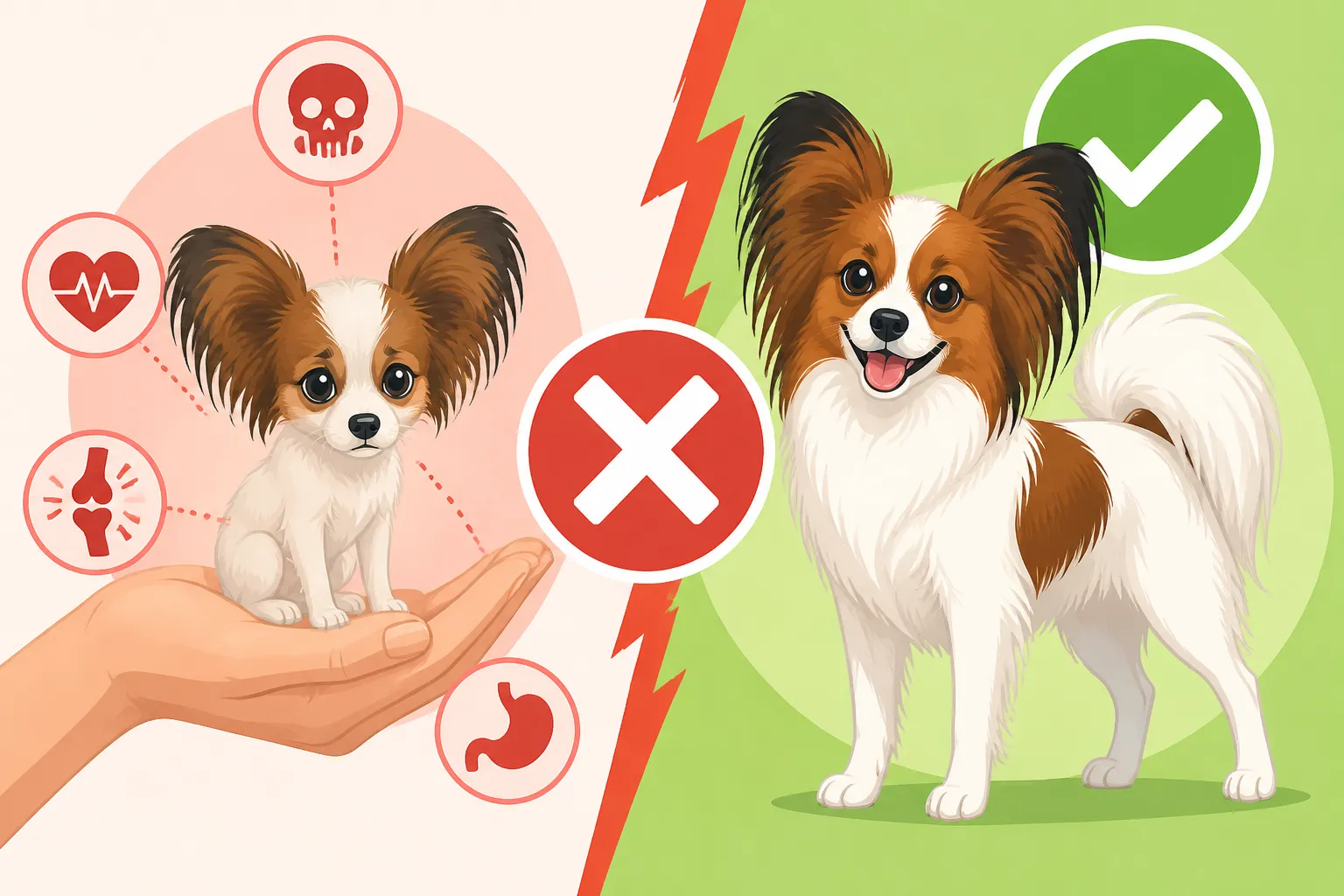
A Papillon advertised as “teacup” or unusually tiny can sound appealing, but a very small body may come with real questions about growth, structure, and everyday safety. This guide explains what breed size standards mean, why extreme miniaturization can be a warning sign, how to assess an individual puppy, and what to do if you already have a very small Papillon.
What “very small” means for a Papillon
Breed standard size is not the same as a health diagnosis
Papillons are small, fine-boned dogs, but there is a difference between being petite and being so small that normal movement, growth, or health becomes a concern. The breed standard describes a size range; it is a guide to the breed’s typical proportions, not a guarantee that every dog within that range is healthy or that every dog outside it has a disorder. For the accepted height range, see What Height a Correct Papillon Stands and What a Papillon Weighs and How Tall It Stands.
“Unsound” is about function and wellbeing, not simply a number on the scale. A dog may be smaller than average yet move comfortably, eat well, maintain a healthy body condition, and have no significant medical problems. Another dog of a typical size may still have weak knees, poor movement, or other health concerns. Size is one clue to assess, not a diagnosis on its own.
The concern is that exceptionally small size can be linked with fragile structure or poor growth, particularly when a puppy is deliberately bred or marketed to be as tiny as possible. A responsible discussion should therefore focus on the whole dog: body proportions, development, ability to function, health history, and veterinary findings—not just a promised adult weight.
Why “teacup” deserves careful scrutiny
“Teacup Papillon” is a marketing description, not a separate recognized Papillon variety with its own established health standard. The label may be used to suggest a dog will stay unusually small, even though a puppy’s adult size cannot be predicted precisely. A tiny puppy could be naturally petite, still growing, underweight, or affected by a medical problem; the label does not tell you which.
There is also no dependable way to make an exceptionally small puppy healthy simply by calling it a special size. Some very small puppies are the smallest in a litter, but being the smallest does not automatically mean they are sick. What matters is whether the puppy is growing steadily and meeting normal developmental milestones, and whether a veterinarian can identify a reason for poor growth or unusual proportions.
When a seller emphasizes “teacup,” ask what that means in practical terms. Request the puppy’s growth records, veterinary examination history, and information about the parents’ adult size and health. Be cautious if the seller promises an exact adult weight, dismisses questions about health, or treats smallness itself as proof of special quality. For more on the label, see Whether a Teacup Papillon Exists.
Why extreme smallness can raise health and soundness concerns
Fragile structure and everyday injury risks
A very small dog has less margin for rough handling, accidental falls, or a poorly judged jump. A slip off a sofa or being stepped on can be more consequential for a tiny puppy than for a sturdier dog. That does not mean every petite Papillon is destined to be injured, but it does make safe handling and a thoughtful home setup especially important.
Structure matters as much as scale. Look at whether the puppy stands and walks comfortably, uses all four legs, and moves without persistent wobbling or reluctance. A puppy that repeatedly favors a leg, seems weak, struggles to keep up, or has difficulty standing should be assessed by a veterinarian. Some Papillons can have kneecap problems, so intermittent skipping or holding up a back leg deserves attention rather than being dismissed as a cute quirk. Patellar Luxation Is the Papillon Problem You Will Actually Meet explains this breed concern in more detail.
A fine-boned Papillon should still appear functional, not frail. Breed appearance is not a reason to accept instability or chronic discomfort. The distinction is useful when comparing small dogs: delicate-looking features may be normal for the breed, while poor balance, painful movement, or a body that seems unable to manage ordinary activity calls for investigation. See Why a Papillon Should Look Fine Boned but Not Frail.
Growth, feeding, and vulnerability in puppies
Young toy-breed puppies have small bodies and limited reserves. A puppy that misses meals, has vomiting or diarrhea, or is not gaining as expected can become unwell quickly. This is one reason a tiny puppy’s feeding routine and weight trend should be discussed with a veterinarian instead of improvised from advice meant for a larger dog.
A single low weight reading does not explain the cause. The more useful picture is whether the puppy is growing consistently, eating willingly, staying alert, and developing normally. Keep a record of weight and appetite, and tell the veterinarian about any change in energy, coordination, or willingness to eat. If a puppy becomes weak, unusually sleepy, trembly, disoriented, or collapses, seek urgent veterinary care rather than waiting to see whether the next meal helps. For warning signs and growth concerns, read Signs a Papillon Puppy Is Not Thriving and Whether a Papillon Puppy Should Be Fed Four Times a Day.
Very small size can also make routine care more exacting. Medication amounts, equipment fit, and anesthesia planning need to account for the individual dog’s actual weight and condition. Never use a dose intended for another pet, and do not assume a product is suitable just because it is labeled for small dogs. A veterinarian should guide decisions about a puppy’s diet, feeding frequency, and any health concerns.
Dental and other issues that need individual assessment
Papillons have small jaws, and crowding or retained baby teeth can be an issue in the breed. Extreme smallness may make it particularly important to keep an eye on the mouth, but a tiny dog is not automatically destined to have dental disease. Checkups can help identify teeth that are not shedding normally, crowded teeth, sore gums, or difficulty chewing while the puppy is still young.
Do not try to decide from appearance alone whether a dog’s head, jaw, or teeth are healthy. A veterinary exam can distinguish normal variation from a problem that needs follow-up. The same principle applies to other concerns: a small dog might need extra attention, but its care should be based on observed health and professional assessment rather than assumptions based on a “teacup” label.
| What you notice | Why it matters | A sensible next step |
|---|---|---|
| Steady growth and normal energy | Reassuring signs, though not a complete health assessment | Keep routine veterinary visits and track weight |
| Poor appetite or a stalled growth trend | May reflect feeding difficulty or an underlying health issue | Contact the veterinarian for advice |
| Weakness, trembling, confusion, or collapse | Can signal an urgent problem in a small puppy | Seek urgent veterinary care |
| Repeated skipping or favoring a leg | Could indicate discomfort or a movement problem | Arrange an examination rather than assuming it is harmless |
| A seller guarantees a very low adult weight | Adult size is difficult to predict exactly | Ask for records and avoid buying based on a weight promise |
How to assess a very small Papillon before bringing one home
Ask for evidence, not just an estimate
A careful breeder should be willing to discuss the puppy’s development and the health of its relatives. Ask to see veterinary records, weight history, and information about the parents. Find out whether the puppy has been examined for concerns relevant to Papillons, and ask what the breeder will do if the puppy does not continue growing as expected. The questions in What a Papillon Breeder Should Have Tested can help you organize that conversation.
A breeder’s description of a puppy as “the tiny one” is not enough. Ask how the puppy compares with its littermates over time, whether it eats independently, and whether a veterinarian has raised any concerns. If the puppy is substantially smaller than its littermates, ask what explanation the breeder has and whether the veterinarian considers its growth appropriate. A responsible answer should be specific and calm—not a guarantee that smallness has no risks.
Be wary of sellers who offer a tiny puppy at a premium because of size, refuse to provide health documentation, or discourage an independent veterinary examination. Also be cautious if a seller suggests that a puppy can be kept extremely small through underfeeding. Restricting food to create a smaller adult dog is not a safe or humane way to manage size.
Use a veterinarian to assess the individual puppy
Arrange a veterinary examination soon after acquiring a puppy and bring any records you received. The veterinarian can assess body condition, growth, teeth, movement, and general development, then explain what should be monitored as the puppy matures. If you have concerns about a particular gait, take a short video at home; intermittent signs may not appear during a clinic visit.
Ask how often the puppy should be weighed and what kind of growth pattern would prompt a call. There is no one target weight that determines health for every Papillon puppy. A useful plan considers age, body condition, litter history, and the puppy’s own trend. If the veterinarian recommends tests or follow-up visits, ask what each is intended to clarify.
Do not wait for a scheduled appointment if the puppy is suddenly weak, cannot keep food down, has trouble breathing, collapses, or seems unable to use a limb. For anesthesia-related questions later in life, preoperative planning should be tailored to the dog’s actual health and size; Whether a Papillon Needs a Pre Anesthetic Exam is a useful related read.
Compare build and function, not just the number
When evaluating a puppy, look for comfortable, coordinated movement and a body that seems capable of ordinary activity. Notice whether the puppy can get up, walk, play briefly, and rest without persistent difficulty. No casual observation replaces a veterinary exam, but these details give you concrete questions to ask.
A puppy can be small and still be lively and well proportioned. Conversely, a puppy that looks exceptionally tiny in photographs may be difficult to assess because perspective, age, grooming, and camera angles can distort size. Whenever possible, meet the puppy and observe it on a safe, level surface. Ask to see the mother and, if available, learn about the adult size and health of close relatives.
Caring for a Papillon who is already very small
Make the home safer without limiting normal life
A very small Papillon may benefit from practical changes that reduce avoidable falls and collisions. Use secure steps or a ramp for favorite furniture if the dog can navigate them comfortably, keep floors from becoming slippery, and supervise interactions with children and larger dogs. Teach children to sit on the floor when handling the dog and never to pick up a puppy by its legs, tail, or scruff.
If you are comparing a carrier or harness from a local store or Chewy, focus on fit, secure fastening, and support rather than choosing the smallest item available. Check the fit as the puppy grows, and make sure the dog can breathe and move comfortably. Chewy or another retailer may be a place to browse supplies, but product labels cannot replace a veterinarian’s advice about what is appropriate for a particular puppy.
Ramps can be helpful when they are stable and the dog is comfortable using them; they should not become a reason to force a puppy into repeated climbing. A small dog still needs safe movement, play, and age-appropriate exercise. Ask the veterinarian whether any activity limits are needed because of a specific diagnosis, rather than restricting activity solely because the dog is petite.
Keep routine care consistent
Feed a complete, age-appropriate diet in the schedule recommended by your veterinarian. Track appetite and weight, and avoid frequent changes or a stream of treats that makes it harder to judge how much the puppy is eating. If the dog regularly refuses meals, discuss that pattern with the clinic rather than assuming it is simply pickiness.
Keep up with dental checks, nail care, vaccinations, and routine wellness visits. For a tiny dog, tell the veterinary team the current weight at each visit and mention any change in movement, eating, energy, or behavior. If shopping for bowls, carriers, or grooming supplies through Chewy or elsewhere, choose items that suit the dog’s current size and are easy to clean and use safely; reassess the fit as the dog grows.
Most importantly, separate a small body from a poor-quality life. Some Papillons are naturally petite and do well with ordinary care. The goal is not to make a dog bigger, nor to treat every small dog as fragile, but to recognize problems early and protect the dog from avoidable risks. A veterinarian who knows the dog can help you judge what is normal for that individual.
Disclaimer
This article is for general informational purposes only and does not constitute professional advice. Laws, prices and regulations vary by location and change over time. Consult a qualified professional for guidance on your specific situation.