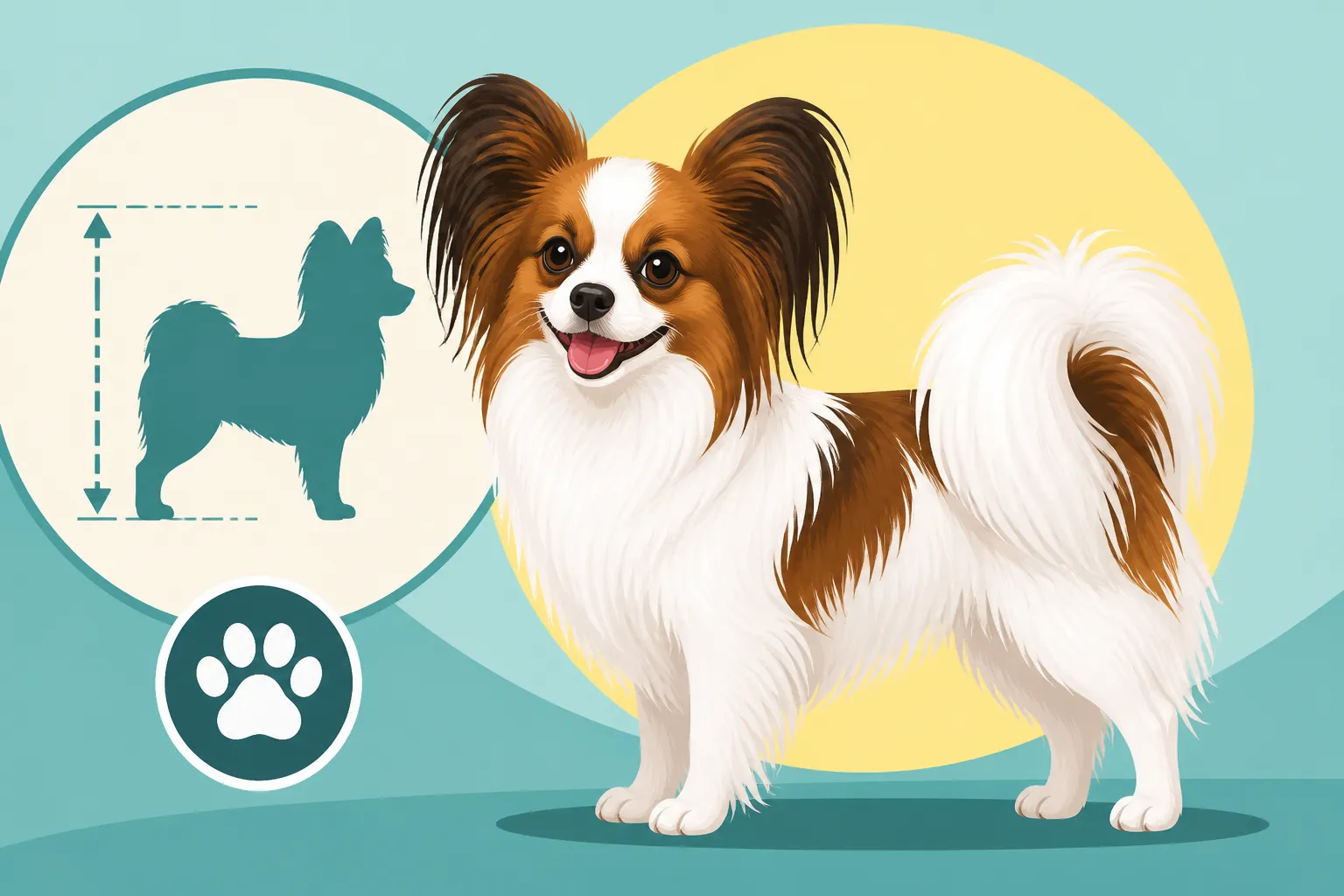
What Height a Correct Papillon Stands
A Papillon can look taller or shorter depending on its stance, coat, and how you measure it. The key measurement is height at the withers—the highest point of the shoulders—not the top of the head or its butterfly-shaped ears. This guide explains the standard range, how to measure accurately, and why a dog’s height alone does not determine whether it is correctly built.
The standard height for a Papillon
Where the measurement is taken
In the American Kennel Club breed standard, a Papillon stands 8 to 11 inches tall at the withers. That is roughly 20 to 28 centimeters. The withers are the point where the neck meets the back, between the shoulder blades. They remain the reference point whether the dog’s ears are upright like a Papillon’s or droop like a Phalene’s.
It is easy to measure the wrong place. A Papillon’s ears, head, and long coat can make its outline look taller, but none of those count toward its height. The measurement is taken vertically from the floor to the withers while the dog is standing naturally on a level surface.
That distinction helps explain why a dog that looks substantial in a photograph may still be within the standard, while a small-looking dog may measure taller than expected. If you want a broader overview of size and proportions, see What a Papillon Weighs and How Tall It Stands.
What the height range means
The 8-to-11-inch range describes the preferred height in the AKC standard. A dog below or above that range does not automatically become unhealthy or lose its identity as a Papillon. It does mean its height falls outside the stated range, which matters if the question is whether it conforms to that particular breed standard.
The distinction between a breed standard and a health assessment is important. A slightly taller Papillon may be perfectly comfortable, active, and well proportioned. Conversely, a dog within the height range can still have structural or health concerns that height alone will not reveal.
The AKC standard also identifies a dog over 12 inches as a disqualification in conformation judging. That is a show-standard rule, not a statement that every dog over that measurement is unwell. If you are considering showing a dog, check the rules for the registry and country where it will compete.
Standards can differ by country
Breed standards are written by kennel organizations, and the wording and measurements are not identical everywhere. The AKC uses inches, while organizations such as the Fédération Cynologique Internationale and The Kennel Club in the United Kingdom publish standards in their own formats. When comparing a Papillon’s height with a standard, use the rules relevant to the show system you care about rather than assuming one country’s wording applies everywhere.
This can matter when a dog is imported, registered in more than one country, or bred from lines developed under different standards. Converting inches to centimeters can also create tiny apparent discrepancies because measurements are rounded. A dog at the upper end of one stated range might seem just outside another range on paper, even when the difference is only a fraction of an inch.
For a closer look at how registry rules can vary, read How Papillon Standards Differ Between Countries. If you are evaluating a show prospect, the breeder or registry can tell you which standard applies; a pet owner generally does not need to treat a small difference in measurement as a problem by itself.
How to measure a Papillon’s height at home
Set up a calm, level measurement
Choose a firm, level floor rather than a cushioned rug. Ask the dog to stand squarely, with its weight balanced across all four feet. A relaxed, natural stance is more useful than stretching the dog upward or pressing it into a rigid pose.
A second person can help by keeping the Papillon calmly in place while you measure. Avoid pulling the head up by the ears or collar; that can change the posture and make the result less reliable. If your dog is wiggly, take a short break and try again rather than turning the measurement into a wrestling match.
A flexible measuring tape can help with routine home checks, and a proper measuring device is useful if you need a more repeatable result. If you shop for pet supplies through Chewy, check product descriptions carefully and choose equipment that can be used on a level surface. The tool matters less than taking the measurement from the floor to the same shoulder point each time.
Follow a repeatable measuring method
For a simple home measurement, stand the Papillon on the level surface and locate the highest point of the shoulder blades. Hold a ruler or other straight edge level across that point, then measure straight down to the floor. Take the reading more than once, especially if the dog shifted or lowered its body between attempts.
Write down the date and measurement rather than relying on memory. If you are tracking a puppy’s growth, record its age as well. Small variations can come from posture, measurement technique, or the floor—not necessarily from a real change in height.
For a show measurement or a dispute about whether a dog meets a registry rule, a home reading is not a substitute for an official measurement. Show officials use the procedures set by their organization. A tidy measurement record can still help you ask informed questions and describe what you have observed.
Avoid common measuring mistakes
The most common mistake is measuring to the top of the head or ears. Another is measuring while the dog is sitting, leaning, or standing with its back legs tucked under. Those positions change the apparent height and make comparisons unreliable.
Long coat can also confuse the eye. Papillons have a silky coat and feathering that can create a fuller outline, but the coat does not add to the official height measurement. Similarly, a dog standing on a sloped driveway or soft mattress can appear taller or shorter than it would on a firm, flat surface.
If an online harness size is the reason you are measuring, use the manufacturer’s sizing instructions as well as the dog’s height. Height alone usually does not tell you whether a harness will fit around the chest and neck. When comparing options on Chewy, check the product’s measurement guide and measure the relevant body areas rather than choosing by breed name alone.
Height is only one part of correct Papillon structure
Proportion matters as much as the number
A correct Papillon is not judged as a height measurement with ears attached. The standard describes a dog with a balanced outline and proportions that suit its height. In the AKC description, the body is slightly longer than the dog is tall, creating a compact but not square appearance.
This is why two dogs with the same height can look quite different. One may have a balanced body, sound movement, and a confident stance; another may look unusually long, short-legged, or poorly balanced. The measurement gives one useful piece of information, but it cannot tell you everything about structure.
If you are trying to picture the overall silhouette rather than a single number, What a Correct Papillon's Outline Looks Like explains the relationship between the dog’s height, body, and carriage. A judge assesses the complete dog, not just the tape reading.
A height reading does not diagnose health
It is tempting to use height as a shortcut for judging a dog’s health or quality, especially when browsing puppy listings. But a very small Papillon is not automatically healthier, and a taller one is not automatically unsound. Genetics, body condition, movement, veterinary history, and responsible breeding practices all matter.
The same caution applies to labels such as “teacup.” Papillon is already a toy breed, and marketing language that promises an unusually tiny adult dog should not replace questions about the parents, growth, and health. For more context, see Whether a Teacup Papillon Exists and Why Very Small Papillons Are Unsound.
If you are choosing a puppy, ask the breeder how they assess adult size and what health testing they perform on the parents. A breeder can estimate, but cannot guarantee, an individual puppy’s mature height. To understand what to ask about breeding and screening, see What a Papillon Breeder Should Have Tested.
Judges assess the whole dog
In conformation, height is considered alongside the dog’s proportions, movement, expression, coat, and overall condition. A judge may look at the dog standing and moving, then examine its structure by hand. The purpose is to assess how closely the dog matches the breed standard—not to rank pet dogs by inches.
A dog that is within the height range can still be less typical in other ways, while a dog outside it can still be a much-loved companion. If you are curious about the hands-on portion of judging, What a Papillon Judge Puts a Hand On First describes what an examination can involve.
| Question | Practical answer |
|---|---|
| What is the AKC height range? | 8 to 11 inches at the withers |
| Where are the withers? | At the top of the shoulders, where the neck meets the back |
| Do ears count toward height? | No; measure to the shoulders, not the head or ear tips |
| Does being outside the range mean a dog is unhealthy? | No; height alone does not determine health |
| Is a home measurement official for a show? | No; show measurements follow the registry’s procedures |
Height as a puppy and as an adult
Puppies change quickly, but estimates are not promises
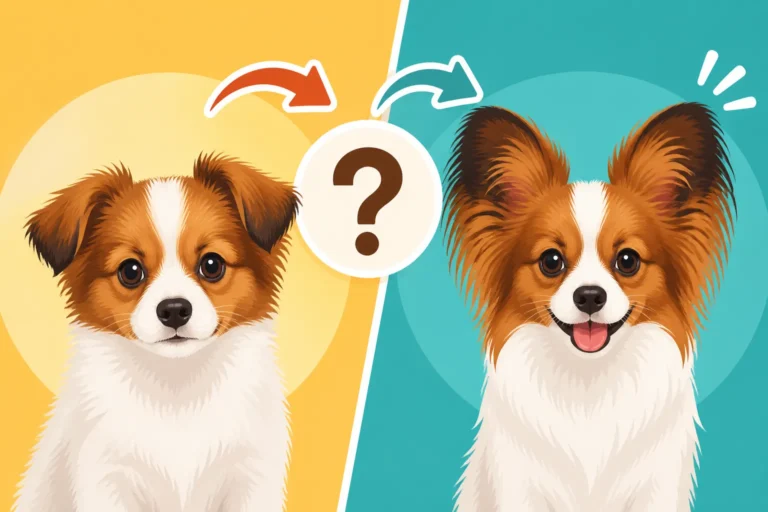
A young Papillon’s height is not a reliable guarantee of its final adult size. Puppies grow at different rates, and a single measurement can be thrown off by posture or a wobbly stance. The breeder may be able to discuss the size of the parents and relatives, but that remains an estimate rather than a precise prediction.
If you want to follow growth, keep notes at regular intervals and use the same method each time. A small household scale can help track weight, but weight and height are different measurements; one does not directly substitute for the other. If you already order routine pet supplies from Chewy, a scale may be convenient to consider, but ask your veterinarian whether the tracking you are doing is useful for your puppy.
Watch the puppy as a whole. Steady development, good energy, and normal appetite are more meaningful than trying to make an early measurement fit an adult standard. If growth or body condition worries you, discuss it with your veterinarian instead of changing the puppy’s food based on height alone.
When growth usually settles
Papillons are small dogs and generally reach much of their adult height while young, but the exact pace varies. A dog may continue to fill out after its legs and shoulder height seem close to finished. The breed’s coat also develops with age, so an adolescent Papillon can look quite different from the same dog as an adult.
Do not use a puppy’s current height as a reason to restrict food or encourage extra feeding. Nutrition should support healthy growth and body condition, not a target number on a tape measure. If you are uncertain about your dog’s development, your veterinarian can assess its growth and overall condition in person.
For more on the timing of maturity, see The Age a Papillon Stops Growing. And while owners sometimes wonder whether sex predicts size, individual variation is substantial; Whether Male and Female Papillons Differ in Size looks at that question in more detail.
What to do if your Papillon measures outside the range
First, repeat the measurement on a level surface with the dog standing naturally. Confirm that you measured to the withers, not the top of the head, and consider asking a veterinarian, breeder, or experienced handler to check your technique. If the result is still outside the range, the next step depends on why you are measuring.
For an ordinary pet, a measurement outside the standard is usually just information about that individual dog. For a show prospect, check the exact standard and procedure used by the registry. If your concern is whether the dog is growing normally, focus on veterinary assessment rather than conformation measurements alone.
A correct Papillon is defined by more than a number: height is useful when measured consistently, but proportion, movement, health, and the dog’s individual needs matter too. Chewy may be one place you look for routine supplies, but a product size chart cannot determine whether a dog conforms to a breed standard or needs veterinary care.
Disclaimer
This article is for general informational purposes only and does not constitute professional advice. Laws, prices and regulations vary by location and change over time. Consult a qualified professional for guidance on your specific situation.