Whether Male and Female Papillons Differ in Size
A male Papillon may be a little larger than a female, but sex alone won’t tell you how tall or heavy an individual dog will be. Their sizes overlap considerably, and family lines, build, age, and body condition all matter. This guide explains what the breed standard says, how to compare two Papillons fairly, and what size means when choosing a dog or buying everyday gear.
Do male and female Papillons differ in size
The breed standard does not set separate sizes by sex
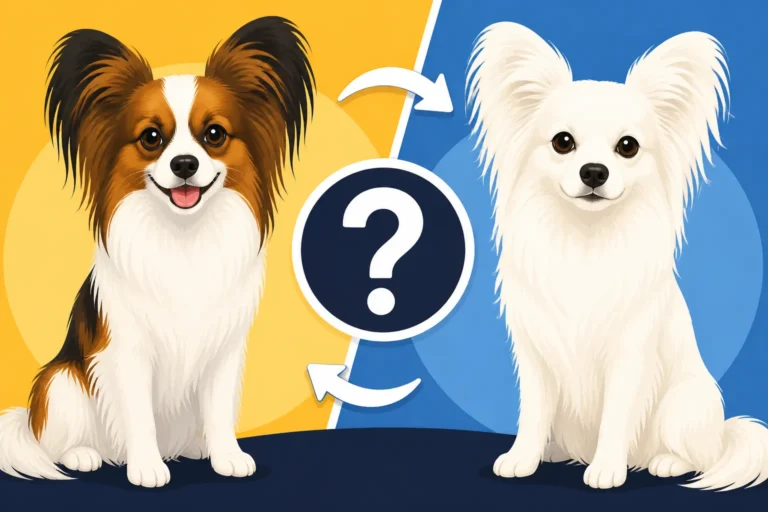
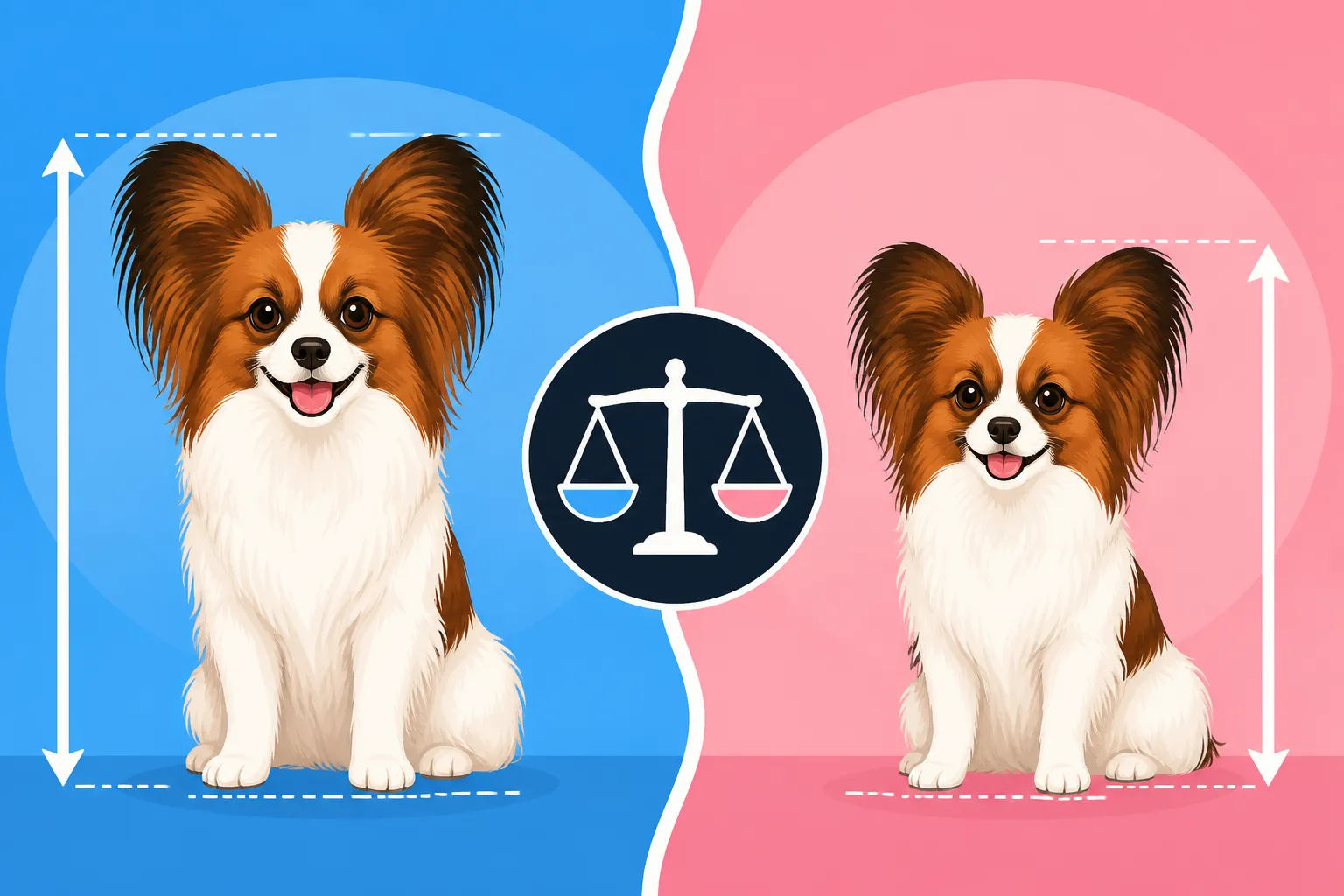
The Papillon breed standard describes a size range for the breed rather than one range for males and another for females. Adult Papillons are generally expected to stand about 8 to 11 inches at the shoulder. The standard does not say a male must be taller or heavier than a female, so a female at the upper end of the range may be bigger than a male at the lower end.
That overlap is the key detail to keep in mind when comparing dogs. A male may have a slightly heavier or more substantial build, while a female from another line may be taller or weigh more. Neither pattern guarantees what you’ll see in a particular dog. For a fuller look at the breed’s measurements, see What a Papillon Weighs and How Tall It Stands and How Tall a Papillon Stands.
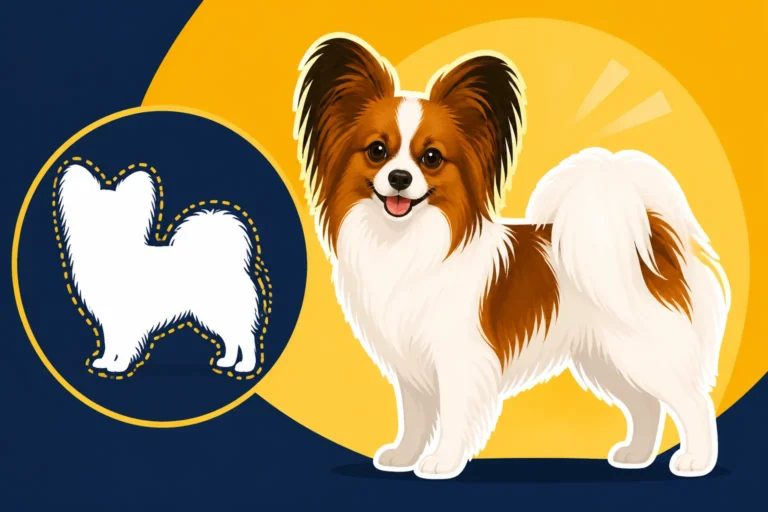
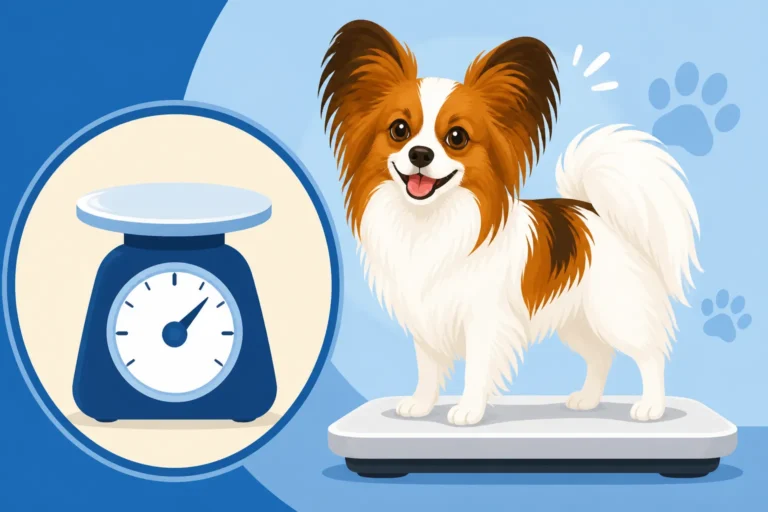
Height and weight are also different measures. Height is taken at the withers, the high point between the shoulder blades. Weight changes with age, muscle, body condition, and even time of day, so it cannot tell you on its own whether a dog is within the breed’s typical proportions. A Papillon’s long coat can also make the dog look larger or fluffier than its frame actually is.
Males may average a little larger, but individual variation matters more
People sometimes find that male Papillons feel a little more substantial, while females seem slightly finer boned. That can be a broad tendency in some lines, but it is not a dependable way to predict an individual dog’s adult size. Genetics come from both parents and earlier generations, and puppies in the same litter can mature into noticeably different-sized adults.
Imagine two littermates: the male has a compact frame and stays on the smaller side of the family range, while his sister inherits a taller build from a grandparent. That is entirely plausible. If you are meeting a puppy, look at the parents and close relatives when possible, but remember that even their size only offers clues—not a precise forecast.
The How Much a Papillon Weighs guide can help put adult weight in context, but there is no single number that makes every Papillon healthy. A small dog with a sturdy frame may be in good condition at a different weight from a taller, finer-framed dog. Your veterinarian can help assess whether a particular Papillon’s weight suits its build.
| Comparison point | What it tells you | What it does not tell you |
|---|---|---|
| Sex | A male may be somewhat larger on average in some lines | The exact adult height or weight of one dog |
| Height at the shoulder | The dog’s standing height and how it compares with the breed range | Whether the dog is carrying too much or too little weight |
| Weight | A useful measure to track over time | Whether the dog is a healthy size without considering its frame |
| Parents and relatives | Helpful clues about likely family size | A guarantee of the puppy’s final size |
| Body condition | Whether weight appears appropriate for the dog’s frame | A substitute for veterinary advice when weight changes unexpectedly |
How age and build affect a Papillon’s size
Puppies grow at different rates
A young Papillon’s current size does not tell the whole story. Puppies grow in stages, and one may look leggy for a while before filling out, while another may seem more compact early on. Their adult proportions take time to emerge, so comparing two puppies of the same age can be misleading.
A puppy’s paws, overall frame, and the size of its parents may offer rough clues, but none predicts adult weight exactly. Even a breeder who knows a family line well should treat estimates as estimates. If you are planning for a carrier, harness, or travel setup, it is sensible to account for growth rather than buying a close-fitting item that the puppy may quickly outgrow.
Papillons are small dogs, but they still need steady growth and appropriate nutrition. Avoid trying to make a puppy smaller by restricting food, or to make a small puppy grow faster by overfeeding. Ask the breeder and veterinarian about an appropriate feeding plan, and keep an eye on steady development. For more about growth timing, see The Age a Papillon Stops Growing.
Height, frame, and body condition are not interchangeable
Two Papillons can weigh the same and still look quite different. One may be taller and fine boned; another may be shorter and more compact. A dog’s body condition matters as much as the scale reading. You should generally be able to feel the ribs without pressing hard, while the ribs should not be sharply visible on a dog with a healthy coat and build.
It is easy to misjudge a Papillon’s body under all that feathering. The coat can obscure the waist, and a dog that looks round may be due for a closer hands-on assessment rather than an immediate diet. Conversely, a coat that lies close to the body can make a lean dog look especially delicate. Regular weighing and a veterinarian’s assessment help identify a real trend rather than relying on appearances.
A sudden shift in weight deserves attention, particularly if it comes with reduced appetite, unusual thirst, low energy, vomiting, or other changes. Don’t assume a change is simply because the dog is male or female, or because one sex is “supposed” to weigh more. For practical body-condition clues, read What a Papillon Should Weigh and Signs a Papillon Is Overweight.
Why size matters in everyday Papillon care
Measure the dog instead of shopping by sex
When buying a harness, collar, coat, carrier, or bed, use the individual dog’s measurements. A label such as “small” can mean different things from one seller to another, and two Papillons of the same sex may need different sizes. For a harness, follow the maker’s instructions and measure the chest at the widest point, as well as the neck if requested. Check the fit again after the dog has moved around, since a harness that looks fine while the dog stands still may rub or shift during a walk.
When shopping online, including on Chewy, compare your dog’s measurements with the item’s size chart rather than relying on a male-versus-female assumption. If your Papillon is between sizes, check the maker’s fitting advice and the retailer’s return terms before ordering. A growing puppy may need a different size soon, so adjustable gear can be useful, provided it still fits securely and comfortably.
Collars should not be so loose that a dog can slip out, nor so tight that they press into the neck. A carrier needs enough room for the dog to sit or lie comfortably, while still being appropriate for the intended use. Chewy listings may include product-specific measurements, but check the dimensions of the actual item: a carrier’s outer measurements are not the same as the usable space inside.
Keep jumping, footing, and handling in mind
A tiny dog can be surprisingly athletic, but furniture height and slippery floors still matter. A Papillon that jumps down from a high sofa repeatedly may land awkwardly, especially if the floor is slick. Ramps or steps can make access easier for some dogs, but they need to be stable and easy for the dog to use. A ramp that wobbles or has a steep angle may be ignored altogether.
The dog’s size can also affect how you lift and handle it. Support the chest and hindquarters rather than lifting by the front legs or scruff. This matters for both sexes: a smaller female is not automatically more fragile than a male, and a slightly heavier male still needs careful handling. For home adjustments, see What a Correct Papillon's Outline Looks Like and Whether a Papillon Is Sturdier Than a Chihuahua.
If you are choosing ramps, steps, or other home gear, measure the space and consider the dog’s comfort and confidence. Chewy may offer a range of sizes, but the product’s height, surface, and footprint matter more than the general label. Give your Papillon time to learn new equipment with calm encouragement rather than expecting an immediate leap onto it.
Choosing between a male and female Papillon
Base the decision on temperament and fit, not a size guess
If you prefer a smaller dog, asking whether a puppy is male or female is not a reliable way to get one. Instead, talk with a responsible breeder or rescue about the adult sizes in the dog’s family, the puppy’s development so far, and how they assess temperament. Even then, a predicted adult size is not a promise.
Daily life with the dog will be shaped by much more than a small difference in height or weight. Consider how the individual dog responds to handling, noise, visitors, grooming, and time alone. Ask about health history and the care the dog may need, and make sure the breeder or rescue is willing to answer questions. A good match is about the particular dog and your household, not a general rule that one sex is easier to manage.
Also think about your practical setup. If your concern is fitting a dog into a carrier for travel, choosing a safe harness, or carrying the dog up stairs, you’ll need measurements of that individual dog regardless of sex. A Papillon’s confident personality can make it seem bigger than it is, but its real-world needs are still those of a small dog.
Don’t seek the smallest puppy at any cost
It can be tempting to choose the tiniest puppy in a litter, especially if you want a dog that is easy to carry. But extremely small size is not automatically a health advantage. A very small dog may be more delicate, and tiny size by itself does not predict a longer life. The priorities should be sound structure, healthy development, and a breeder or rescue that is open about the dog’s history.
A puppy’s future adult size should not be confused with health testing or careful breeding. Ask what health checks are appropriate for the parents and what documentation is available. If a seller promises a specific adult weight or uses “teacup” as a selling point, treat that claim cautiously and focus on the dog’s welfare and background. Why Very Small Papillons Are Unsound explains why unusually tiny size deserves careful thought, and Whether a Smaller Papillon Lives Longer addresses the common assumption that smaller always means healthier.
In short, male and female Papillons can differ a little in average build, but the breed standard does not prescribe separate sizes by sex, and individual dogs vary. Compare measurements, body condition, family background, and temperament—not just the sex listed on a puppy’s paperwork. That approach gives you a more realistic picture of the Papillon in front of you and helps you choose the right care and equipment for that dog.
Disclaimer
This article is for general informational purposes only and does not constitute professional advice. Laws, prices and regulations vary by location and change over time. Consult a qualified professional for guidance on your specific situation.