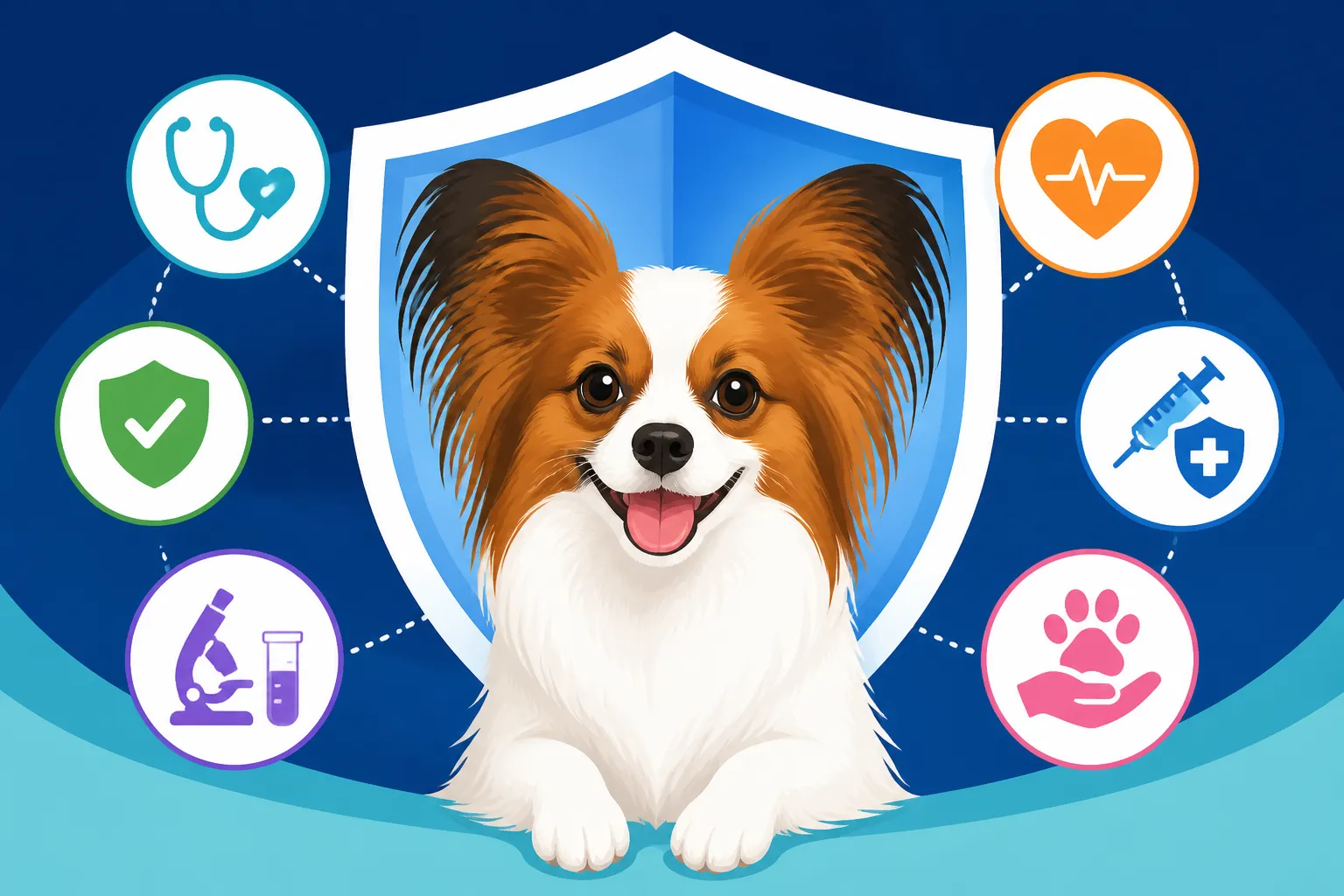
What the Papillon Club’s Health Program Covers
A Papillon can look perfectly healthy while carrying a gene variant or developing a knee or eye problem that is not obvious at home. The Papillon Club’s health program helps owners and breeders understand which screenings matter, where results may be recorded, and what those results do—and do not—tell you about an individual dog.
What the Papillon Club’s health program is designed to do
Health education and breed-specific screening
A breed club health program is not a veterinary clinic, and it does not diagnose or treat individual dogs. Its value is helping Papillon owners and breeders focus on health concerns that are relevant to the breed, understand available screening options, and make better-informed decisions about breeding and care.
That guidance matters because a dog’s appearance and everyday energy are not reliable substitutes for health testing. A Papillon may run, play, and compete while having a kneecap that moves out of place, or while carrying a gene variant associated with an inherited condition. Screening can identify some risks before they become obvious, although no test can promise that a dog will never develop a health problem.
Health programs also help owners distinguish between different kinds of testing. A DNA test looks for a particular genetic variant. An eye examination checks for visible signs of eye disease at the time of the exam. A patella evaluation assesses the kneecaps. These tests answer different questions; one cannot replace the others. For a broader discussion of breeder screening, see What a Papillon Breeder Should Have Tested.
Supporting responsible breeding decisions
When breeders use health results thoughtfully, they can make more informed choices about pairings. This does not mean that every dog with a genetic finding should automatically be excluded from breeding. For some inherited conditions, a carrier dog can be bred responsibly to a dog that does not carry the same variant, while avoiding a pairing that could produce affected puppies.
The distinction between “carrier” and “affected” is especially important. A carrier result for a recessive condition generally means the dog has one copy of a variant, not that the dog will develop the condition. The exact implications depend on the condition and its inheritance pattern, so a breeder should interpret results with a veterinarian or a qualified genetic counselor rather than relying on a single label.
A health program can help keep these conversations grounded in evidence instead of rumor. It can encourage breeders to share test results, explain why a particular pairing was chosen, and consider the health of the breed over time. Buyers can use that information to ask better questions, as covered in Which Questions to Ask a Papillon Breeder.
The health checks Papillon owners may encounter
Kneecap evaluations
Patellar luxation is a concern owners of small dogs often hear about. It happens when the kneecap does not remain in its normal track. A veterinarian can examine a Papillon’s knees and assess whether the kneecaps move abnormally. Depending on the dog and the findings, the veterinarian may grade the condition and recommend monitoring, activity adjustments, or further evaluation.
A normal result is useful, but it is not a lifetime guarantee. A dog’s joints can change, and a screening result describes what was found at the time of the examination. If a Papillon occasionally skips a step, holds up a hind leg, or suddenly resumes walking as if nothing happened, it is worth discussing the pattern with a veterinarian rather than assuming it is harmless. The article Patellar Luxation Is the Papillon Problem You Will Actually Meet explains why this issue deserves attention without treating every skip as an emergency.
For breeding decisions, knee results are one part of a wider picture. A breeder may also consider the dog’s relatives, age, overall structure, and other health results. For owners, the practical takeaway is to ask what an evaluation showed and when it was done, rather than settling for a vague assurance that the dog has “good knees.”
Eye examinations and inherited eye risks
Eye screening can help detect abnormalities that may not be apparent during a casual look at a dog’s eyes. A veterinary ophthalmologist examines the eyes using specialized equipment and records findings from that examination. Because some eye conditions can develop or become detectable over time, one normal exam does not necessarily mean the dog will never have an eye problem.
Papillons may also be screened for specific inherited conditions through DNA testing. A DNA result and an eye exam are not interchangeable: a genetic test checks for a defined variant, while an examination assesses the eyes themselves. A dog can have a useful DNA result and still need routine veterinary eye care for other reasons.
Owners who notice trouble seeing in dim light, bumping into familiar objects, cloudiness, redness, or sudden changes should contact their veterinarian. Do not wait for a routine screening appointment if a change is new or worsening. For additional context, see The Papillon Type of Progressive Retinal Atrophy and the CNGB1 Gene and Why a Papillon Can Go Blind at Night and Still See in Daylight.
DNA tests for specific inherited conditions
A breed health program may point breeders toward DNA tests for known inherited conditions in Papillons, including tests associated with progressive retinal atrophy and neuroaxonal dystrophy. These tests can help identify whether a dog is clear, a carrier, or genetically affected for the particular variant being tested. The exact result categories and their meaning depend on the laboratory and condition.
A DNA test has a defined scope. It does not screen for every possible genetic disorder, and a “clear” result for one condition should never be interpreted as a general health certificate. Likewise, a carrier result does not automatically mean a dog is ill. Ask which specific variant was tested, which laboratory performed the test, and whether the result can be matched to an official record.
A useful way to think about the program’s main screening categories is:
| Screening area | What it can help assess | What it cannot establish by itself |
|---|---|---|
| Patella evaluation | Whether the kneecaps move abnormally during the exam | That knee health will never change |
| Eye examination | Visible eye findings at the time of the exam | That every inherited or future eye problem is ruled out |
| DNA testing | Whether a specific tested genetic variant is present | That the dog is free of all inherited conditions |
| Health history | Patterns among relatives and across generations | A definite diagnosis for an individual dog |
If you are comparing test reports, look for the dog’s identifying details, the test name, the date, and the organization or professional that recorded the result. A screenshot without a name or registration number can be difficult to verify. For background on one DNA test, see The DNA Test for Papillon Neuroaxonal Dystrophy.
How health results are recorded and understood
What a registry listing can tell you
Health results may appear in an official registry or database, depending on the test and how the owner or breeder chose to submit the information. A listing can make it easier for buyers, breeders, and researchers to check documented results rather than relying only on a verbal claim. When reviewing a record, make sure it refers to the same dog you are considering; similar names and incomplete identifiers can cause confusion.
A registry record is best treated as documentation, not a guarantee. It tells you what was submitted and recorded under a particular system. It does not necessarily describe every aspect of the dog’s health, and it may not include every test a veterinarian considers appropriate. Ask the breeder to explain the results in plain language and show how the dog is identified in the record.
A CHIC number, where relevant, generally indicates that the required tests for that program have been completed and results made public. It should not be read as a stamp saying that every result is normal. The individual findings still matter. If a breeder says a dog is “CHIC clear,” ask what specific results they mean and review the records themselves.
How owners can keep useful health records
You do not need a complicated system to keep your Papillon’s records organized. Save copies of exam reports and DNA results, note the dates, and keep the veterinarian’s name with each document. If your dog has a recurring symptom—such as occasional limping or difficulty seeing in low light—write down when it occurs and what was happening. A short, accurate history can help a veterinarian identify patterns that are easy to miss during a brief appointment.
For everyday organization, keep test reports separate from medication and routine-care notes. If you order a veterinarian-recommended product or refill through a pet retailer such as Chewy, save the order record alongside the instructions from your veterinary practice. Chewy can be a convenient way to keep track of some routine supplies, but it cannot interpret an abnormal screening result or replace advice from the veterinarian who examined your dog.
It is also reasonable to ask the clinic to send you copies of lab reports and examination notes. If a Papillon changes veterinary practices, having those documents on hand can prevent repeated guesswork and help the new clinic see what has already been assessed. Keep the original records even if you also store digital copies.
Using the program as a buyer or Papillon owner
Questions to ask a breeder
A good conversation about health testing should feel specific and open, not like a sales script. Ask which tests were performed on the puppy’s parents, when the exams took place, and where you can review the results. If the breeder mentions a DNA result, ask which condition and variant it covers. If a result is a carrier finding, ask how the planned pairing accounts for that result.
Also ask about health patterns in the family. A test can be useful, but relatives’ history may add important context. Find out whether close relatives have had knee problems, vision changes, or other significant diagnoses, and whether the breeder keeps in touch with puppy buyers to learn about health over time. For a more complete checklist, read What Health Results a Papillon Breeder Should Show.
Be cautious if a breeder refuses to identify the tests, cannot provide records, or treats a single clear DNA result as proof that the whole litter is free of health concerns. That does not automatically prove that a puppy is unhealthy, but it does mean you have less information for making a decision. The club’s health recommendations are most helpful when they lead to transparent records and sensible follow-up questions.
Questions to ask your veterinarian
If you already have a Papillon, ask your veterinarian which screenings make sense for your dog’s age, health history, and circumstances. A puppy, a senior dog, and a dog being considered for breeding may need different conversations. Bring any breeder-provided results to the appointment so the veterinarian can explain what they mean and whether further examination is appropriate.
Mention small changes even if they seem intermittent. A dog that skips one step and then runs normally may still benefit from a knee evaluation. A dog that hesitates in a dim hallway may need an eye assessment. When you describe what you have noticed, include how often it happens, whether it is getting worse, and whether it affects one side or both. For more on breeder screening standards, see Which Health Tests a Papillon Breeder Should Run.
Routine preventive care remains important even when a dog has excellent genetic results. Papillons can still develop dental disease, injuries, infections, or age-related conditions unrelated to the specific tests in a breed health program. In particular, small jaws can make dental care a regular concern; The Teeth in a Papillon's Small Jaw offers more detail. Chewy may help owners manage selected recurring supply needs, but a veterinarian should guide decisions about treatment, testing, and changes in diet or medication.
A breed club health program is most useful when it is treated as a practical resource rather than a promise of perfect health. It can help families understand what to screen for, encourage responsible breeding choices, and make test records easier to discuss. For an individual Papillon, the next step is to pair those records with regular veterinary care and pay attention to the small changes that may be worth checking.
Disclaimer
This article is for general informational purposes only and does not constitute professional advice. Laws, prices and regulations vary by location and change over time. Consult a qualified professional for guidance on your specific situation.