Whether the Papillon Reached Britain Before America
The short answer is probably yes: Papillons appear to have reached Britain before they became established in America. The tricky part is that “reached” can mean an individual dog arrived, a recognizable type was being kept, or a breed was formally registered. Those are different milestones, and the surviving records do not clearly identify the first Papillon in either country.
What it means for the Papillon to have reached Britain first
Arrival is not the same as recognition
A small continental toy spaniel could have arrived in Britain long before anyone recorded it under the name “Papillon.” Dogs travelled with people, crossed borders through trade and family connections, and were often described by broad terms rather than by the standardized breed names used today. An early dog might have been called a toy spaniel or simply a dwarf spaniel, even if it looked much like a Papillon.
That makes “the first Papillon in Britain” difficult to establish. A dated photograph, kennel record, or show catalogue using the modern breed name would be useful evidence, but it would not necessarily prove that no similar dog had arrived earlier. The earliest documented mention is not always the same thing as the earliest arrival.
Formal recognition is a separate milestone again. A kennel club can recognize a breed only after people have begun keeping, breeding, and identifying dogs as belonging to it. For that reason, recognition dates are helpful clues about a breed’s organized history, but they do not provide a complete travel log.
Britain was a likely early destination
Britain had close connections with continental Europe, including France and Belgium, where Papillon history is often discussed. Dogs could travel with visiting families, diplomats, merchants, or breeders, and the movement of companion dogs did not always leave a neat official record. It is plausible that small continental spaniels reached Britain through these ordinary routes well before the breed had a strong presence in the United States.
There was also an active interest in pedigree dogs and dog shows in Britain during the period when modern breed identities were taking shape. That environment could help turn a handful of imported dogs into a more visible, organized population. But the presence of a dog fancy does not tell us exactly when the first individual arrived, or whether British owners initially used the name Papillon.
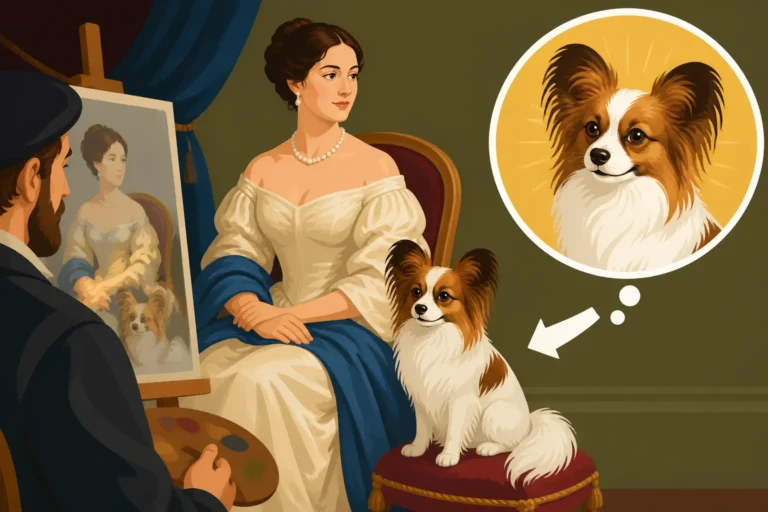
The breed’s wider background matters here. Papillons are part of a much older European story involving small spaniels depicted in portraits and kept as companion dogs. For a broader look at that history, see Where the Papillon Comes From and How Old the Papillon Breed Is. The breed’s roots are continental; Britain was a destination, not its point of origin.
The Papillon’s route from continental Europe
The breed’s name came after a longer history
The word Papillon means “butterfly” in French, a reference to the breed’s upright, fringed ears. The name is relatively specific, but the dog’s ancestry is older than the modern label. Small spaniel-like dogs appear in European art and historical accounts long before breed registries created consistent categories for them.
The dogs seen in old paintings should not automatically be treated as modern Papillons. Some may have been ancestors or related types, and their appearance can vary from the breed familiar today. In particular, the ears are an important difference: the Papillon has erect ears, while the drop-eared variety is known as the Phalène. The two forms are closely connected within the same breed tradition, rather than being evidence of entirely separate origins.
The historical record also does not settle a simple national ownership question. France and Belgium are both associated with the Papillon’s development, and the movement of dogs across borders makes it hard to assign the breed’s history to one place alone. The discussion in Whether France or Belgium Owns the Papillon helps explain why a single-country origin story can be misleading.
Erect ears and breed identity developed over time
The Papillon’s distinctive upright ears helped give it its familiar name and appearance, but breed characteristics do not always become fixed at one exact moment. Different ear types existed within the broader continental toy spaniel tradition, and breeders gradually shaped the forms people now recognize as Papillon and Phalène.
That gradual change matters when comparing old images with later records. A dog that resembles a Papillon in a portrait may have had drop ears, partly erect ears, or features that do not match today’s breed standard. Similarly, an imported dog in Britain might have been identified by its general type rather than by its ear shape or a formal breed label.
By the time kennel clubs began keeping more systematic records, the modern breed identity was clearer. That later organization helps us trace the Papillon’s spread, but it cannot reliably pinpoint the first dog to set paw in Britain. The distinction between an ancestral type and a registered breed is central to understanding why historical timelines can appear inconsistent.
Britain and America followed different timelines
A British presence may predate an American breed community
The available picture supports a cautious conclusion: Papillons were likely present in Britain before a substantial, organized American population had formed. Britain’s proximity to continental Europe made importation relatively direct, while the American breed community developed across a much greater distance and appears later in the breed’s formal history.
However, “before America” should not be taken to mean that no Papillon ever reached the United States until after Britain had established the breed. An individual dog could have arrived in America without appearing in a kennel-club record, and a small number of imports might have gone unnoticed in the wider history. The safer comparison is between documented or organized breed presence, not between the first dog in each country.
The American Kennel Club recognized the Papillon in 1915, a useful marker for the breed’s formal standing in the United States. It does not establish the date of the first American import. For more on the difference between arrival and recognition, see When the AKC Recognized the Papillon and How Long the Papillon Waited for AKC Recognition.
Dates in breed histories may describe different events
When one history says the Papillon arrived in Britain early and another gives a date for its American recognition, those statements may not actually conflict. One may refer to imported dogs, another to a breed club, and another to official registration or show classification. Without checking what each date describes, it is easy to compare unlike events and draw an overly definite conclusion.
| Milestone | What it tells us | What it does not prove |
|---|---|---|
| First known import | A dog was recorded as arriving in a country | That it was truly the first one to arrive |
| Early mention in a show catalogue | The type was visible in organized dog circles | That no similar dogs were present earlier |
| Breed club activity | Owners or breeders were organizing around the breed | The exact date the breed first reached the country |
| Kennel-club recognition | The breed received formal recognition from that organization | The date of the first individual import |
| Later popularity | The breed gained a wider following | When the earliest small community began |
When you encounter a precise claim about the “first” Papillon in Britain or America, look for the record behind it. Does it name a dog and provide a date? Does it describe an import, a show entry, or an official recognition? Those details make a claim much more meaningful than a bare timeline.
Retailer information is a different kind of record. If someone is researching the breed before bringing one home, a modern retailer such as Chewy may be useful for browsing general dog-care products, but a contemporary listing cannot establish the Papillon’s historical arrival. The same is true of Chewy product descriptions: they can help with present-day shopping questions, not early breed chronology. Chewy belongs to the modern ownership context, not the historical evidence.
How to answer the question carefully
The best-supported conclusion
If the question is whether the Papillon reached Britain before America, the most responsible answer is: probably, if “reached” means that dogs of the type were present or the breed had begun to take hold. Britain’s location and close links with continental Europe make an earlier presence plausible, while the American breed’s formal organization and recognition came later.
It is harder to prove that the very first individual Papillon arrived in Britain before the very first one arrived in America. The earliest dog in each country may never have been recorded, and early descriptions may not have used the word Papillon. A strict first-arrival claim would require records that clearly identify both the dogs and their dates, and such evidence is not generally available in a simple, definitive form.
That is why a careful article should avoid turning “Britain had an earlier documented breed presence” into “we know the first Papillon entered Britain on a particular date.” The former is a reasonable historical conclusion; the latter requires stronger evidence than a broad breed timeline usually provides.
What the comparison says about the breed’s spread
The likely Britain-before-America sequence reflects geography and networks more than any special claim about where the Papillon belongs. Continental Europe was the source region; Britain was a nearby destination with an established dog-show culture; America developed its formal breed community later. Each stage left a different kind of trace in the historical record.
The distinction also explains why Britain and America may have developed slightly different traditions around the breed. Once Papillons were being bred and shown in separate countries, local preferences and registry rules could shape how the breed was described. For a closer comparison of those later developments, see Whether British and American Papillons Differ.
If you are following the breed’s story because you are considering ownership, keep the historical question separate from practical decisions. A modern breed profile, a breeder’s records, and a retailer’s product catalogue answer different questions. Chewy can be part of a present-day supply search, but it is not a substitute for breeder documentation or veterinary guidance; similarly, a current Chewy listing should not be read as evidence about the breed’s past.
The most useful takeaway is not a single disputed date, but the sequence: the Papillon developed from a continental European toy spaniel tradition, likely reached nearby Britain before a substantial American breed community formed, and later gained formal recognition in the United States. That distinction gives a fair answer without pretending the records can identify every early dog.
Disclaimer
This article is for general informational purposes only and does not constitute professional advice. Laws, prices and regulations vary by location and change over time. Consult a qualified professional for guidance on your specific situation.