Why a Papillon Should Look Fine Boned but Not Frail
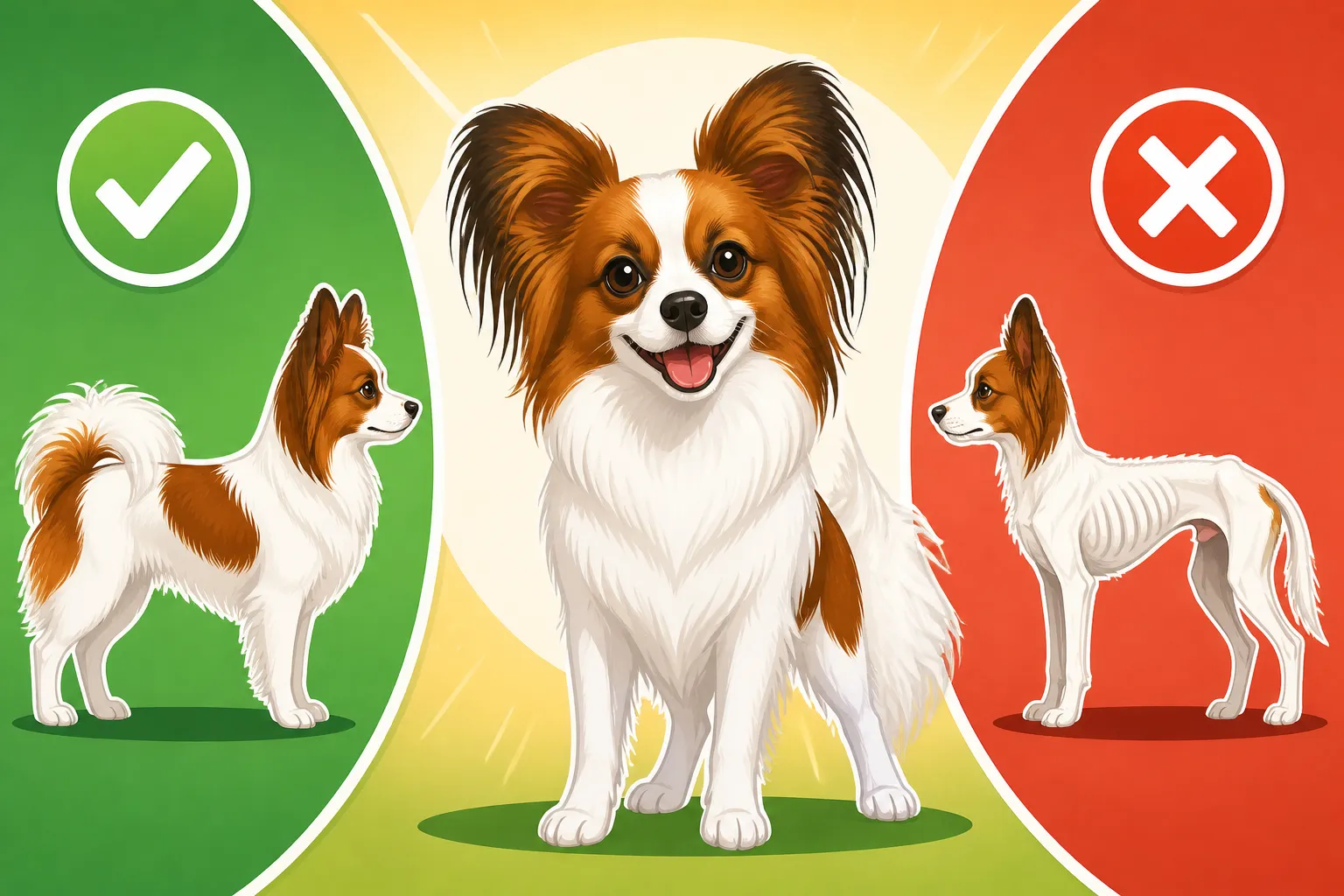
A Papillon’s delicate outline can make people assume the breed is fragile, but “fine boned” does not mean weak, sickly, or unable to move confidently. The useful distinction is in proportion: a sound Papillon looks light and elegant while still standing, walking, and playing with steadiness. This guide explains what that balance looks like and what to notice in a puppy or adult dog.
What fine boned means in a Papillon
Elegance is not the same as weakness
A Papillon is a small toy dog with a refined frame. Its legs and paws look neat rather than heavy, and its body should appear balanced instead of bulky. That lightness is part of the breed’s characteristic appearance, not a sign that the dog should look bony, shaky, or exhausted.
A fine-boned Papillon still has enough substance for its size. When standing naturally, the dog should look coordinated and comfortable, not as if its legs are struggling to hold it up. It should be able to trot with an easy, purposeful rhythm. Delicate proportions can coexist with alertness, muscle, and energy.
This distinction matters because people sometimes mistake a naturally slight dog for an unhealthy one, or assume that every small dog should be exceptionally tiny. A Papillon can be petite without looking undernourished. For a broader look at the breed’s proportions, see What a Papillon's Outline Looks Like.
Proportion matters more than a single measurement
A number on a scale does not tell the whole story. Two Papillons can weigh the same and have different frames, muscle tone, and body condition. One may be naturally compact; another may be slightly taller or longer through the body. What matters is whether the dog’s weight and build look appropriate together.
Look at the whole dog rather than focusing only on its legs or ribs. Does the body appear balanced? Are the limbs straight and coordinated when the dog moves? Is there visible muscle over the shoulders and hindquarters? A dog that is simply slim may still have a healthy outline, while a dog that is genuinely too thin may have prominent bones, reduced muscle, and less energy.
The breed’s outline should also be judged in motion, not just in a posed photograph. Long ear fringe and a tail plume can create an impression of softness or extra size, while a still image may hide awkward movement. If you are evaluating a puppy, watch it walk on a level, nonslip surface and notice whether its steps look even and confident.
Small does not mean “teacup”
A very small Papillon may attract attention, but unusually tiny size is not a reliable measure of refinement or quality. Selecting for extreme smallness can encourage an unhealthy idea of what a desirable Papillon looks like. The goal is not to make the dog as slight as possible; it is to preserve a balanced, functional little dog.
A puppy’s size also changes with growth, and early appearance is not a guarantee of its adult proportions. Ask the breeder about the parents and relatives, and consider the puppy’s overall health and development rather than choosing based on the smallest body in the litter. Why Very Small Papillons Are Unsound offers more context on why extreme miniaturization should not be treated as a virtue.
How to tell a refined Papillon from a frail one
Check body condition without expecting a bulky dog
A healthy Papillon should not look padded or heavy, but it should not look hollow either. Gently feel along the ribs: they should be possible to feel without pressing hard, but they should not feel sharply prominent beneath a thin covering. The spine and hip bones should not stand out conspicuously, and the dog should have enough muscle to move with control.
Coat can make this assessment tricky. Feathering may disguise a narrow body, while a recently trimmed coat or a wet coat can make the dog appear much thinner than usual. Use your hands as well as your eyes, and ask a veterinarian to assess body condition if you are unsure. A routine weigh-in can be useful, but changes over time are often more informative than one isolated number.
If your Papillon has lost weight without an obvious explanation, is eating less, or seems unusually tired, do not assume that it is simply a naturally delicate dog. A change in appetite or body condition deserves attention, especially in a small dog. For practical guidance on assessing shape and weight, see What a Papillon Should Weigh and How to Feel a Papillon's Ribs.
Watch how the dog moves
Movement often tells you more than appearance. A sound Papillon should be able to walk and trot without repeated stumbling, dragging a paw, or consistently shifting weight away from one leg. Notice whether it gets up comfortably, turns smoothly, and uses both hind legs in a coordinated way.
A brief skip or a moment of awkwardness in an excited puppy does not, by itself, establish a problem. But repeated hopping, limping, reluctance to jump onto a low surface, or a leg that is carried differently should not be brushed off as part of a dainty build. If you see a consistent pattern, take a video and discuss it with a veterinarian. How a Papillon Should Move explains the role of movement in the breed’s overall outline.
Papillons can have orthopedic concerns, including patellar luxation, in which the kneecap moves out of its normal position. A dog with a knee issue may occasionally skip for a few strides and then return to normal movement, so the symptom can be easy to miss. That does not mean every skipping Papillon has luxation, but recurring episodes merit a professional examination. See Patellar Luxation Is the Papillon Problem You Will Actually Meet for more on this breed-specific concern.
Consider age, condition, and individual differences
A puppy can look lanky during one stage of growth and more balanced later. Adults may also differ in muscle tone depending on activity, age, health, and how much exercise they get. Compare a dog with itself over time rather than expecting every Papillon to match the same silhouette.
Older dogs may lose muscle or move less readily, while illness can affect weight and energy at any age. A newly prominent spine, worsening weakness, or a sudden change in gait is not simply a cosmetic shift. A veterinarian can help distinguish normal individual variation from a problem that needs attention.
| What you notice | What it may suggest | A sensible next step |
|---|---|---|
| Light, balanced frame with steady movement | A naturally refined build | Maintain routine wellness care and a healthy body condition |
| Ribs easy to feel but not sharply visible | Often consistent with an appropriate condition | Track weight and body shape over time |
| Prominent ribs, spine, or hips with reduced muscle | Possible underweight condition or health concern | Arrange a veterinary assessment |
| Repeated skipping, limping, or uneven steps | Possible pain or orthopedic issue | Record the movement and contact a veterinarian |
| Sudden weight loss or reduced appetite | A change that should not be dismissed as “small-dog build” | Seek veterinary guidance |
Why a fine frame still needs practical protection
Prevent falls and awkward landings
Papillons are lively and athletic, but their small size can make everyday furniture a bigger obstacle than it appears. A jump down from a high bed or sofa may be a poor routine choice, particularly for a young puppy, a senior dog, or one with a known knee concern. That does not mean a Papillon needs to be carried everywhere; it means planning safe routes up and down.
A sturdy ramp or low set of steps can help if your dog repeatedly uses furniture. Introduce it gradually with treats and praise rather than placing the dog on it and expecting an immediate climb. Check that the surface is stable and does not slide on hardwood. If you are comparing home-access options, retailers such as Chewy may list different ramp and step designs, but measure the height and available floor space before choosing one.
For more on making common household jumps safer, read Whether a Papillon Needs Ramps to Furniture and Whether a Papillon Should Jump Off the Sofa. The best solution depends on the dog, the furniture, and how reliably the dog will use the alternative.
Use equipment that fits the actual dog
A collar that is loose enough to slip over a Papillon’s head or a harness that rubs behind the front legs can create avoidable problems. Fit matters more than the label size. Check that equipment sits securely without restricting breathing or movement, and inspect it regularly if your dog is still growing or has changed weight.
A well-fitted harness can be a practical choice for walks, especially when a dog tends to pull or lunge. Measure according to the maker’s instructions and check the fit with your dog standing naturally. Chewy can be one place to compare harness options, but sizing charts vary by product, so use the measurements rather than guessing from breed or weight alone.
Keep nails short enough that the feet can rest naturally on the floor. Overgrown nails may affect foot placement and traction, while feathering can make long nails harder to see. On slippery floors, nonslip runners can give a small dog more confidence when turning or getting up. These adjustments support comfortable movement without treating the Papillon as breakable.
Build fitness without pushing through discomfort
Regular, age-appropriate activity helps a Papillon maintain coordination and muscle. Walks, training games, and controlled play can provide both physical and mental engagement. Start with a level route and let the dog build stamina gradually, particularly if it has been inactive or is recovering from illness.
Do not use exercise as a test of toughness. If a dog starts limping, repeatedly sits down, pants unusually hard, or seems reluctant to continue, stop and assess what is happening. A Papillon that enjoys activity may still need rest, and a dog with a diagnosed orthopedic concern may need a veterinarian’s advice about the type and amount of exercise that suits it.
Agility can be a wonderful activity for many Papillons, but athletic talent does not remove the need for sensible conditioning and health checks. Talk with your veterinarian before starting intense or repetitive jumping, particularly if you have concerns about the dog’s knees. Whether a Papillon's Knees Limit Agility explores how owners can think about the sport alongside joint health.
Choosing and caring for a sound Papillon
Evaluate the whole dog, not just a photograph
When meeting a puppy or adult Papillon, observe the dog at rest and in motion. Look for a comfortable stance, clear and coordinated steps, and an alert response to its surroundings. You do not need to judge every detail of breed structure yourself; you can ask a knowledgeable breeder, veterinarian, or qualified breed evaluator to explain what they see.
Ask the breeder about health screening and the health history of the puppy’s close relatives. A refined-looking dog is not automatically healthy, just as a slightly sturdier-looking dog is not automatically better. The more useful question is whether the dog is well cared for, moves comfortably, and comes from a responsible breeding program that takes health seriously. What a Papillon Breeder Should Have Tested is a useful starting point for those conversations.
If you are considering an adult dog, ask about its normal gait, activity level, appetite, and any history of limping or orthopedic care. A rescue or previous owner may not have every detail, but a careful veterinary exam can establish a baseline. Give the dog time to settle, too: stress in a new home can temporarily affect how it eats, sleeps, and moves.
Keep daily care straightforward and consistent
A Papillon does not need to be treated as if every ordinary movement is dangerous. It does benefit from a home that reduces preventable slips and falls, a body condition that does not add unnecessary strain, and regular opportunities to move. A stable routine makes it easier to spot changes: the dog that suddenly avoids stairs or loses interest in a familiar walk is easier to notice when you know its usual habits.
Keep track of weight, appetite, energy, and movement at routine checkups. If you notice a change, describe when it began and whether it happens consistently. Short videos can help a veterinarian see an intermittent skip or uneven gait that does not occur during an appointment.
The Papillon’s delicate appearance is part of its charm, but it should not become a reason to overlook either normal capability or real symptoms. A sound Papillon can be lively, quick, and confident while remaining fine boned. The aim is a dog that looks refined without looking depleted, and that moves with ease rather than being protected from every ordinary activity.
Disclaimer
This article is for general informational purposes only and does not constitute professional advice. Laws, prices and regulations vary by location and change over time. Consult a qualified professional for guidance on your specific situation.