Whether a Papillon Needs Color Over Both Ears
A Papillon with one mostly white ear can still be a healthy, wonderful companion. The question matters most when you are comparing a dog with the breed standard or considering the show ring: in the American Kennel Club standard, colored markings are expected to cover both ears and extend over both eyes. Here’s how to understand that rule without confusing appearance with health or pet quality.
What the Papillon standard says about color over both ears
The expected head pattern
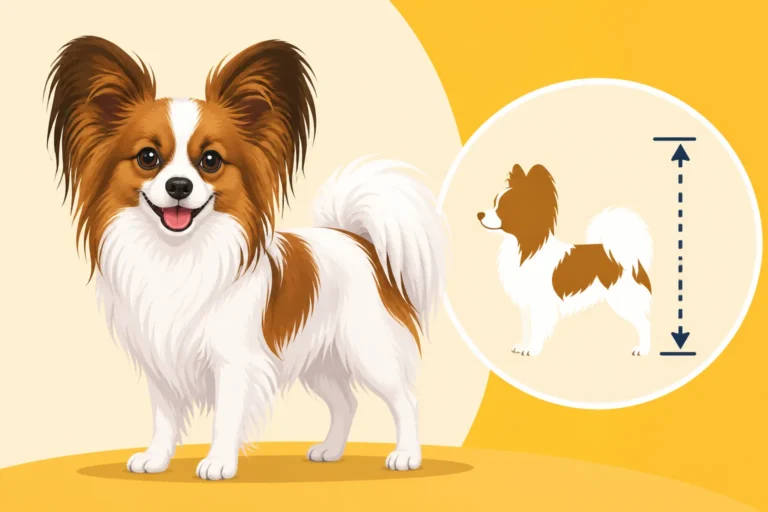
The American Kennel Club standard describes Papillons as parti-colored or white with patches of another color. On the head, the color must cover both ears, front and back, and continue from the ears over both eyes without a break. In practical terms, the standard looks for color on each ear and colored areas extending across the top and sides of the face.
That does not mean every Papillon has an identical mask. One dog may have broad, dark patches around the ears and eyes, while another has more white on the forehead and smaller, lighter patches. A clearly defined white blaze down the middle of the face is preferred, but the standard allows some variation in that blaze, including a narrow band or one interrupted by color.
If you are comparing a dog’s markings with the written standard, it helps to look at the whole head rather than judging from one photograph. Ear fringe can cover part of the ear, and the angle of a photo may make a patch look smaller or more uneven than it is. For a broader overview of permitted patterns, see Which Colors the Papillon Standard Accepts and Which Colors a Papillon Comes In.
Does color have to cover every part of each ear?
The standard’s wording refers to color covering both ears, including the front and back. That describes the desired show pattern, not a requirement that every hair on the ear be colored. Papillon ears are feathered, and the long hair can make the boundary between colored and white areas look soft or irregular.
The same distinction applies to the face. The standard says color should extend from the ears over both eyes, but it does not demand perfectly mirrored patches. A dog can have one colored area that reaches farther down the face than the other and still look balanced overall. The rules allow variation in the blaze, too; it need not be a broad, perfectly straight stripe.
Because a photograph can hide the markings on the back of the ear, ask to see the dog in natural light from more than one angle if you are assessing show-standard appearance. For help thinking about facial symmetry, Whether a Papillon's Face Markings Should Be Symmetrical explains why an even-looking face is not the same thing as perfectly matching markings.
Is missing color over one ear a disqualification?
A Papillon with one mostly white ear may not match the AKC standard’s preferred head pattern. That can matter in conformation judging, where the judge compares the dog with the written standard. It does not automatically mean the dog is unhealthy, poorly bred, or unsuitable as a companion.
A standard describes the traits expected in an ideal show specimen. It is not a health checklist, and a mismatch in coat pattern is not, by itself, evidence of a medical problem. A mostly white ear, an uneven blaze, or a face with more color on one side does not tell you whether the dog can see, hear, learn, or enjoy an active life.
If you are asking because you have a Papillon at home, you do not need to worry about the pattern simply because one ear is white. If you are buying a puppy specifically for conformation showing, ask the breeder how they assess markings and whether the puppy’s pattern appears likely to meet the standard. You can also read What a Papillon Judge Puts a Hand On First for a sense of how appearance fits into a broader evaluation.
How ear markings affect show prospects and pet life
Show evaluation is different from choosing a companion
In a conformation show, the dog is assessed against a breed standard that covers much more than color. Structure, movement, expression, proportions, coat, and overall balance all matter. A head pattern that does not follow the standard may affect how a dog is evaluated, but it is only one part of the picture.
That distinction can be frustrating if you have fallen for a puppy whose markings are not the classic pattern you imagined. It may help to decide what you want from the dog before getting caught up in show terminology. If your priority is a loving companion, a white ear or an uneven blaze is generally a cosmetic detail. If your goal is to show in conformation, ask an experienced breeder or knowledgeable judge to assess the puppy in person.
A breeder may also be cautious about promising show potential while a puppy is still growing. Coat length, ear fringe, and the way markings appear beneath the hair can change how the pattern reads as the dog matures. For other examples of how a puppy’s appearance can develop, see Whether a Papillon Puppy's Markings Change.
Does coat color affect health or temperament?
The presence or absence of color over an ear is not a reliable way to judge a Papillon’s health or personality. A dog’s suitability as a companion depends on many things, including health, early socialization, individual temperament, and the home environment—not whether the ears have matching patches.
When evaluating a breeder, focus on health information and thoughtful care rather than treating a particular marking as proof of quality. Ask what health screening is appropriate for the parents and what records the breeder can share. A dog with ideal show markings is not automatically healthier than one with an atypical pattern. For a useful checklist, read What a Papillon Breeder Should Have Tested.
Likewise, a puppy with a nonstandard pattern can still come from responsible breeding. Look for a breeder who is open about the parents, the puppies’ care, and any known health concerns, and who is willing to answer questions without making sweeping promises. A coat pattern is visible at a glance; responsible breeding practices take more careful discussion.
| What you are considering | What ear color can tell you | What it cannot tell you |
|---|---|---|
| Companion suitability | The dog’s visible coat pattern | Whether the dog will be healthy, affectionate, or easy to train |
| Conformation showing | Whether the head pattern appears to follow the standard | Whether the dog will excel in every other part of judging |
| Breeder quality | Whether the breeder can explain the puppy’s markings | Whether health testing and good care have been done |
| A mostly white ear | That the pattern differs from the expected show pattern | That the dog has a health problem |
Reading Papillon markings in real life
Why photos can make markings look different
Papillon ear fringe is long and flowing, so it can conceal the ear’s actual color pattern. A front-facing photo may show a white-looking ear even when colored hair is present on the back or near the base. Conversely, shadows or a dark background can make a small colored patch seem larger than it is.
Coat length also affects the impression of the pattern. Puppy hair may be shorter and less feathered, while an adult coat can frame the face differently. If a puppy is being assessed for show potential, ask for clear views of both sides of the head, the back of the ears, and the face in ordinary daylight. Avoid drawing a firm conclusion from a single cropped image.
A dog’s white facial hair may also pick up food, dust, or outdoor grime, making the markings seem less distinct. If you need basic grooming supplies, you may find combs and gentle coat-care products through retailers such as Chewy; choose products appropriate for dogs and follow the label directions. The aim is to keep the coat clean, not to change or enhance the dog’s natural color.
Should you try to change or emphasize the color?
No. A Papillon’s natural markings are part of its coat pattern, and grooming should not be used to create the appearance of colored coverage where there is none. Avoid dyes, harsh whitening products, or anything intended to alter the coat for a photograph or show presentation. If you are preparing a dog for an event, ask a qualified groomer or the show’s governing organization what grooming is permitted.
For ordinary care, focus on gentle brushing and keeping the ear fringe free of tangles. If facial hair gets dirty after meals, wipe it gently with a damp, soft cloth and dry it without rubbing hard. Chewy may be one place to look for a basic dog comb or a mild grooming product, but check the product instructions and avoid getting cleanser into the eyes or ears.
A coat-care routine should make the dog comfortable, not make its markings conform to an ideal. If you are unsure whether a product is safe around the face, ask your veterinarian or groomer before using it. A naturally white ear does not need to be “corrected,” and colored patches should not be treated as a problem that needs fixing.
What to ask when choosing a Papillon puppy
If show prospects matter to you, explain that clearly to the breeder and ask how the puppy’s markings compare with the applicable breed standard. Ask to see the dog from different angles and, if possible, ask what the breeder can reasonably predict as the coat develops. No one should guarantee a show career based on color alone; the dog’s full conformation and temperament matter as well.
If you are choosing a pet, it is reasonable to ask about markings because you like a certain look. Just keep that preference in perspective. A puppy with matching colored ears may not be a better fit for your household than its littermate with a white ear. Ask about the puppy’s temperament, socialization, health records, and the support the breeder provides after the puppy goes home.
For anyone comparing litters, treat coat pattern as one preference among many, not a shortcut for assessing breeding quality. A responsible breeder should be comfortable discussing both appearance and health without suggesting that a particular marking guarantees either. You can also explore Whether a Papillon Must Have a White Blaze to understand why a white blaze is preferred but can vary.
The practical answer for Papillon owners
A Papillon does not need colored markings over both ears to be a healthy or cherished pet. The expectation that color cover both ears and extend over both eyes belongs to the AKC breed standard and is most relevant when considering conformation showing. A dog whose markings differ from that pattern may be less suited to the show ring, but that alone says little about the dog’s health, temperament, or value as a companion.
If you are buying a puppy for showing, confirm which registry’s standard applies and ask for an experienced assessment rather than relying on a single picture. If you are looking for a family companion, choose based on health, temperament, responsible breeding, and the bond you feel with the dog. The ears may catch your eye first, but they are only one small part of living with a Papillon.
Disclaimer
This article is for general informational purposes only and does not constitute professional advice. Laws, prices and regulations vary by location and change over time. Consult a qualified professional for guidance on your specific situation.