Whether a Teacup Papillon Exists
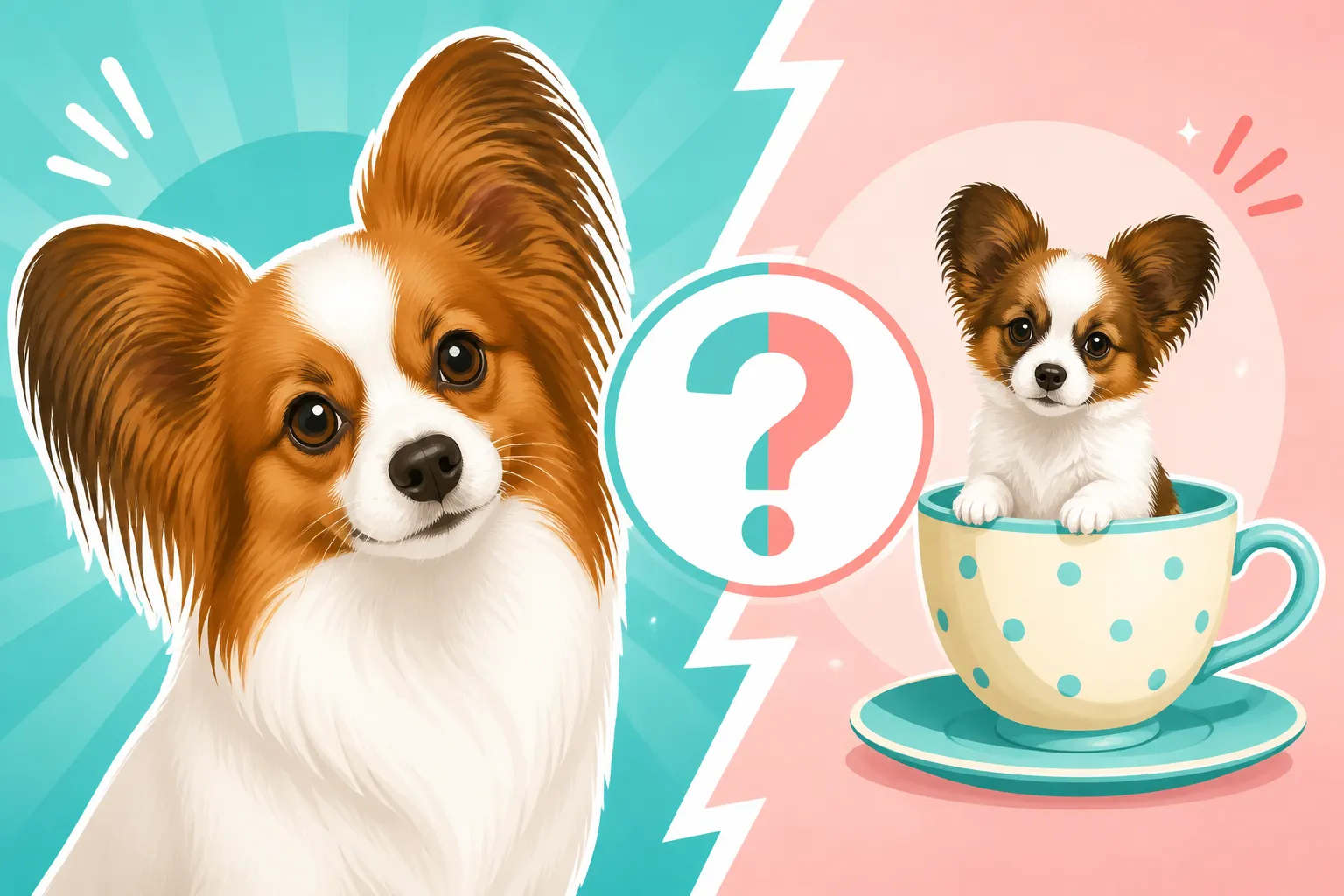
A “teacup Papillon” may sound like a distinct, extra-small version of this already petite breed, but it is not an officially recognized variety. The label has no consistent size definition, so it can hide anything from a naturally small Papillon to a puppy bred or marketed for extreme tininess. Here’s how to judge the difference, understand the health concerns, and assess a breeder’s claims.
Is a teacup Papillon a real variety
What the teacup label actually means
There is no separate teacup Papillon breed or official teacup category within the Papillon breed. “Teacup” is an informal marketing term, not a formal size classification with an agreed height or adult weight. One seller might use it for a particularly small puppy; another might apply it to any Papillon expected to stay below an arbitrary weight.
Papillons are small dogs already. A full-grown dog can be light and fine-boned without being a separate variety or having been intentionally bred for extreme size. The breed standard describes a compact dog with a particular outline and proportions, rather than a teacup version. For a practical overview of normal size, see What a Papillon Weighs and How Tall It Stands.
That lack of a shared definition matters when you’re comparing puppies. A seller calling a puppy “teacup” may not be promising a specific adult size in a way you can reliably verify. Puppy growth varies, and an estimate based on a young puppy’s current weight is not a guarantee of how large the dog will be when mature.
How a small Papillon differs from a teacup claim
A Papillon can be smaller than another Papillon and still be a healthy individual. Natural variation occurs in any breed, and being on the small end does not, by itself, prove that a dog has a health problem. The more useful questions are whether the dog is growing appropriately, has sound proportions, and has been bred and cared for with health in mind.
The concern is the promise that a dog will be unusually tiny, especially if the seller treats extreme smallness as the main selling point. If breeding decisions prioritize a very low adult weight over sound structure and health, puppies may be more vulnerable to the problems associated with being exceptionally small. That is different from simply meeting a small Papillon whose size is within normal individual variation. Why Very Small Papillons Are Unsound explores why extreme size deserves careful scrutiny.
A “teacup” label also tells you little about temperament, adult structure, or long-term health. Ask for the puppy’s current weight and growth history, but don’t treat either as proof of a guaranteed adult weight. A responsible breeder should be willing to discuss the puppy’s parents, relatives, veterinary care, and the limits of size predictions.
Health and safety concerns with exceptionally small dogs
Why extreme size can make daily care less forgiving
A very small dog has less margin for everyday mishaps. A fall from a sofa, a misjudged jump, or rough play with a larger dog can have more serious consequences for a tiny, delicate puppy than for a sturdier adult. That doesn’t mean every small Papillon is fragile or must be kept in a bubble. It does mean that handling, supervision, and a safe home setup matter.
Small puppies can also be more susceptible to low blood sugar, particularly when they are very young, stressed, cold, ill, or not eating regularly. Signs such as unusual weakness, shaking, poor coordination, or difficulty waking need prompt attention from a veterinarian. Don’t try to solve a suspected medical emergency by relying on a seller’s reassurance or an online feeding schedule. Learn the warning signs in Whether a Papillon Gets Hypoglycemia as a Puppy and ask your veterinarian what is appropriate for your individual puppy.
Some health conditions have no simple connection to a marketing label, but they may be important to investigate when a seller is emphasizing unusually small size. A veterinarian can assess growth, appetite, energy, and any signs that need further testing. For example, if a puppy has poor growth or recurring illness, your vet can decide whether additional evaluation is warranted; a seller’s claim that a puppy is “just tiny” should not replace that assessment. Whether a Papillon Gets a Liver Shunt explains one condition owners may want to understand when discussing Papillon health with a vet.
Protecting a tiny puppy without overreacting
For a small puppy, practical prevention is more helpful than constant worry. Use a secure harness and supervise outdoor time, particularly in areas where larger dogs are running loose. Teach children to sit on the floor when holding or playing with the puppy, and step in if play becomes rough. A small dog should always have a safe place to retreat.
At home, consider how the puppy gets on and off furniture. A short jump can still be a substantial drop for a little dog, especially if the landing surface is slippery. You can lift the puppy carefully or block access to risky spots while it is young. Keep food and water routines consistent, and contact your veterinarian if the puppy skips meals repeatedly, seems unusually sleepy, or is not gaining as expected.
The goal is not to assume that a small dog is sick. It is to avoid treating tiny size as a novelty that excuses poor care or prevents honest health questions. Ask your vet for advice tailored to the puppy’s age, weight, and condition, rather than relying on generic rules that claim to fit every “teacup” dog.
How to assess a puppy and the breeder
Questions that matter more than the word teacup
When a breeder advertises a teacup Papillon, ask what the term means to them. Request the puppy’s date of birth, current weight, growth records, and the adult sizes of both parents. Ask whether the parents have had recommended health screening and whether you can review the results. These details are more useful than a catchy label, though they still cannot guarantee an exact adult size.
Pay attention to how the breeder talks about health and uncertainty. A careful breeder should be comfortable saying that adult weight cannot be predicted with complete certainty. Be cautious if someone guarantees a very low weight, uses “rare” or “exclusive” language to pressure you, or dismisses concerns about a puppy’s health because it is supposedly just a tiny type.
Ask what happens if the puppy becomes ill after coming home, what veterinary care it has already received, and what support the breeder provides after adoption. A clear contract and transparent answers do not guarantee that a puppy will never have a health problem, but evasive answers make it harder to make an informed decision. Use Which Questions to Ask a Papillon Breeder and What Health Results a Papillon Breeder Should Show to prepare for that conversation.
| What the seller says or shows | What to ask next | Why it matters |
|---|---|---|
| “Teacup” or “micro” Papillon | How do you define that term, and what is the puppy’s growth history? | The label has no consistent official size definition |
| Guaranteed adult weight | How was that estimate made, and can you explain its limits? | Puppy size estimates are not exact guarantees |
| Very small parents | Can I meet them or see their records, and what health screening have they had? | Parent size alone does not establish good health |
| A puppy described as unusually tiny | Has a veterinarian examined the puppy and reviewed its growth? | A vet can assess whether development appears appropriate |
| “No health concerns” | Which health results can you share, and what care has the puppy received? | Specific records are more useful than broad assurances |
Look at the whole dog, not just the scale
A number on a scale cannot tell you whether a puppy is thriving. Ask a veterinarian to assess body condition, development, and overall health. A puppy that is small but bright, eating appropriately, and growing steadily is a different situation from one that is weak, failing to gain, or repeatedly unwell. Those concerns call for veterinary assessment, not a sales explanation.
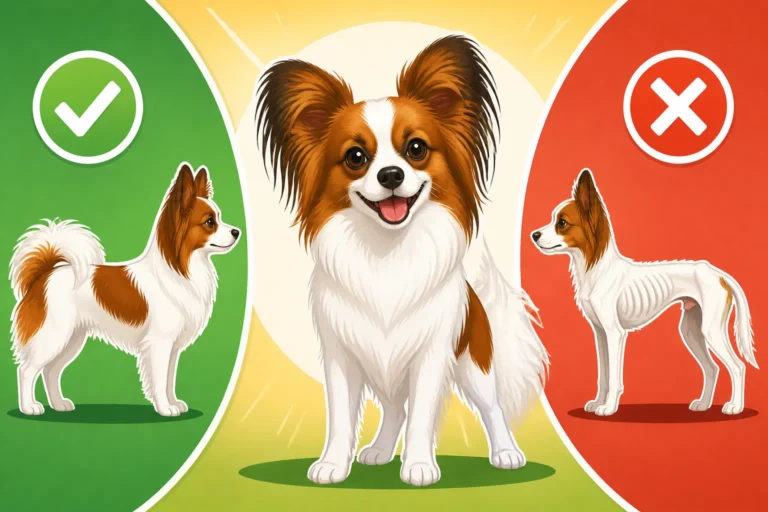
Look at the dog’s overall structure and proportions too. A healthy Papillon should not be reduced to a weight target; body balance, movement, and condition matter. What a Correct Papillon's Outline Looks Like offers more context on the breed’s outline, while How Small a Papillon Puppy Is at Eight Weeks can help you understand why a puppy’s age is essential when comparing size.
If you’re still choosing a breeder, ask to see relevant health documentation and discuss the puppy’s care with your veterinarian before making assumptions about its future. A breeder who prioritizes sound dogs may produce puppies of different sizes; selecting only for the smallest possible puppy is not a reliable shortcut to a healthy companion.
Making a sensible choice for your home
Decide whether the dog’s needs fit your household
A small Papillon may suit an apartment or a home without a large yard, but size doesn’t make a puppy maintenance-free. Young dogs need training, exercise, socialization, veterinary care, and safe supervision. A particularly tiny puppy may need extra attention around stairs, furniture, children, and larger pets. Be realistic about whether you can provide that care without making the dog’s size its main attraction.
Think through ordinary situations: Can you prevent a puppy from being accidentally stepped on in a busy household? Can you supervise interactions with a large resident dog? Do you have a plan for safe travel and a carrier that fits securely? When shopping for basic supplies, a retailer such as Chewy can be one place to compare carrier dimensions and other practical options, but confirm fit and safety for your particular dog rather than relying on a “teacup” category.
Also consider whether you are prepared for ordinary veterinary expenses and unexpected care. A small body does not mean every veterinary service is automatically simple or inexpensive. If you want to plan the broader costs of ownership, What a Papillon Costs Over Its Lifetime can help you think beyond the initial purchase.
A practical way to respond to a teacup listing
If you find a listing that uses the word “teacup,” slow down and evaluate the puppy as an individual. Ask for records, clarify what the seller means by the label, and consult a veterinarian if you have concerns about growth or health. Don’t send a deposit because a seller says the puppy will remain exceptionally small or that another buyer is waiting.
Before bringing any puppy home, make a basic safety plan. Choose a secure resting area, supervise play, establish a regular feeding routine appropriate to the puppy’s age and veterinary advice, and arrange a veterinary visit. If you need supplies, Chewy may help you compare sizes for essentials such as a harness or travel carrier; check measurements and adjust as your puppy grows. The right item is the one that fits the dog safely, not the one marketed specifically for “teacup” pets.
A teacup Papillon is not an officially recognized variety. The term is a seller’s description, and it does not guarantee a particular adult size or health outcome. Focus on a puppy’s development, health records, structure, and breeder transparency. A naturally small Papillon may be a wonderful companion; extreme tininess should never be the only reason to choose one.
Disclaimer
This article is for general informational purposes only and does not constitute professional advice. Laws, prices and regulations vary by location and change over time. Consult a qualified professional for guidance on your specific situation.