Whether a Papillon Suits a House With Toddlers
A Papillon can thrive in a family home, but a toddler’s unpredictable movements and a small dog’s delicate build call for careful management. The question isn’t simply whether Papillons are good with children; it’s whether the adults can supervise closely, protect the dog’s space, and teach a young child gentle habits. This guide explains what that looks like in everyday family life.
Is a Papillon a good dog for a home with toddlers
Temperament is only part of the picture
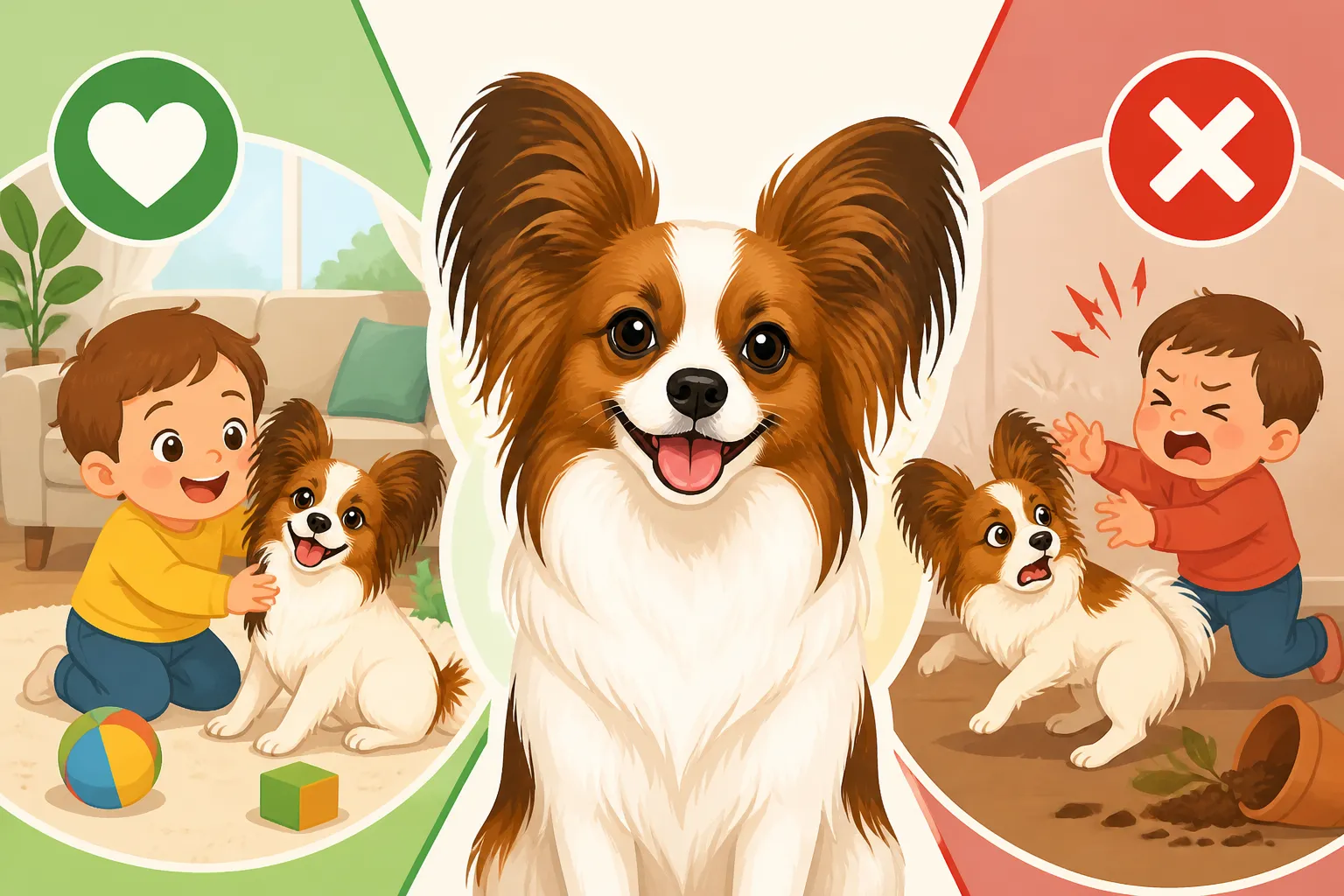
Papillons are often bright, lively, affectionate dogs. Many enjoy being near their people and can learn household rules quickly. But a friendly temperament does not make a dog automatically comfortable with every child or every kind of handling. A toddler may move suddenly, shout, reach toward a dog’s face, or try to pick it up without understanding that those actions can feel frightening.
A Papillon may respond by moving away, barking, or trying to defend itself if it feels cornered. Small dogs can also be injured by an accidental fall, a tight hug, or a child stumbling onto them. These risks aren’t a reason to assume a Papillon will be aggressive; they’re a reason to manage interactions rather than relying on the dog to tolerate anything.
Individual personality matters, too. One Papillon may be relaxed around familiar children, while another is sensitive to noise or quick movement. Ask about the dog’s past experiences and observe how it behaves around children from a safe distance. For a wider look at the breed’s family fit, see A Papillon With Children and Larger Dogs.
The child’s age and behavior make a difference
Toddlers are still learning impulse control. Even a gentle child may grab fur, poke at an eye, crowd a resting dog, or drop a toy nearby with a startling clatter. It’s not realistic to expect a toddler to reliably remember every safety rule, so the adults must create a safe setup and step in before a situation becomes tense.
A school-age child who can follow directions may be ready to help with simple dog-care tasks under supervision, such as tossing a treat into a puzzle toy or helping an adult refill a water bowl. A toddler needs much closer oversight and should not be responsible for walking, feeding, or handling the dog alone. The distinction is important: a family may love dogs and still find that a tiny, quick-moving breed is challenging during the toddler years.
If you’re weighing the breed against your child’s current stage, Why a Papillon Suits Older Children Better offers a useful comparison. It’s also worth reading How a Papillon Handles a Toddler to think through what ordinary interactions may look like at home.
A “good with kids” label cannot replace supervision
Even a Papillon that has lived peacefully with children needs an adult present whenever a toddler and dog share space. Supervision means watching closely enough to intervene—not merely being in the same room while looking at a phone or cooking with your back turned.
If you need to leave the room, separate the dog and child with a secure gate, closed door, or safe enclosure. Don’t ask the dog to “be patient” while a toddler hugs it or blocks its path. A dog’s ability to walk away is part of its safety, and the child’s safety improves when the dog is not being pressured.
That’s the central point behind Whether a Papillon Is Safe With Toddlers: safety depends on the dog, the child, and the adults’ day-to-day management. No breed description can guarantee how an individual dog will respond.
The main risks families should plan for
Accidental injury is a real concern
Papillons are small dogs, and a toddler is large and unsteady by comparison. A child can trip while holding the dog, drop it while trying to carry it, or bump into it during play. Dogs can also be injured when a child lands on them or closes a door or gate without noticing where the dog is.
Set a firm rule that toddlers do not pick up the Papillon. If the dog needs to be moved, an adult should do it with the dog’s body supported. Keep the dog off a child’s lap unless an adult is right there and the dog is comfortable. A low, stable dog bed in a quiet corner is safer than a high sofa where a startled dog might jump down.
Teach children not to chase the dog, even when they’re excited to play. Instead, have them sit still and let the dog choose whether to approach. If the Papillon walks away, the interaction is over. For additional perspective on handling mishaps, see What Happens When a Papillon Is Dropped and Whether a Papillon Is Safe on a Sofa.
Stress signals can be easy to miss
A dog does not need to growl or snap for an interaction to be uncomfortable. Turning its head away, leaning back, trying to leave, becoming unusually still, or repeatedly licking its lips can all be signs that it wants more space. A toddler may not notice these signals, so an adult should watch the dog’s body language and interrupt calmly.
Avoid punishing a Papillon for growling. A growl is useful information: the dog is asking for space. Scolding it may suppress the warning without changing the discomfort underneath. Instead, separate the dog and child and work out what made the dog uneasy. If fear or defensive behavior is recurring, ask a veterinarian or qualified behavior professional for advice.
Make sure adults agree on the same rules. If one person allows the toddler to hug the dog while another stops it, the household becomes confusing for both child and pet. Consistency makes it easier to recognize problems early and gives the dog predictable ways to relax.
Noise and busy routines can wear on a small dog
Toddlers bring a lot of sound and motion: toys clattering across the floor, sudden squeals, visitors, and frequent changes in routine. Some Papillons adapt well, while others need regular quiet breaks. A dog that has no dependable retreat may become jumpy or bark more as the household gets busier.
Create a child-free resting area where the dog can sleep or eat without being approached. A baby gate can help maintain that boundary while allowing the dog to see what’s happening. Put food bowls, chews, and favorite toys in places the toddler cannot reach. Children should never be allowed to take something from the dog’s mouth or disturb it while it eats.
How to make the home safer for both
Set up boundaries before the dog and toddler share space
Prepare the home before bringing a Papillon into a toddler’s routine. Use gates to separate rooms, move small dog toys out of the child’s play area, and identify a quiet retreat the child cannot enter. Think about the parts of the day when supervision is hardest—school runs, meal preparation, or getting ready for bed—and plan where the dog will be during those moments.
A pen, crate, or gated room can be useful when introduced positively. It should be a comfortable place for the dog, not a punishment, and the toddler should not be allowed to climb inside, reach through the bars, or bother the dog there. For practical ideas on making the living space safer, read Setting Up a House That Protects a Papillon's Knees. Some of the same choices that prevent slips or risky jumps can also help protect a small dog from household tumbles.
Keep the setup simple enough to maintain. A gate that adults can open easily, a bed that stays in a quiet corner, and a routine for separating the dog during busy periods are more helpful than a complicated plan nobody follows. Families shopping for gates, washable bedding, or food puzzles may find it useful to compare options at Chewy, while checking that each item fits the dog and the space rather than choosing by appearance alone.
Teach toddler-friendly interactions in small steps
Children learn best when adults show them exactly what to do. Demonstrate gentle strokes on the dog’s shoulder or back, rather than allowing a toddler to pat the head, pull the ears, or touch the face. Keep the first interactions brief. Invite the Papillon to approach; don’t carry it over to the child or hold it in place.
Give the toddler a simple rule to remember, such as “Let the dog come to you” or “When the dog walks away, we stop.” Repeat the rule calmly and step in immediately if the child forgets. Praise quiet behavior, like sitting still while the dog sniffs, rather than encouraging the child to chase or shout to get the dog’s attention.
A newly adopted or young dog may need time to settle before meeting a toddler closely. Start with distance and calm observation, then gradually allow brief interactions if the dog remains relaxed. How a Papillon Adjusts to a New Home can help families think about the transition, while Teaching a Papillon Puppy to Be Handled All Over is relevant when preparing a puppy for gentle, necessary handling by adults.
Use play that does not involve rough handling
Choose activities that keep hands away from the dog’s face and body. An adult can supervise a toddler rolling a soft toy along the floor for the dog, or tossing a treat a short distance. Skip tugging games, chasing, wrestling, and any game that encourages the child to grab the dog. If the Papillon becomes overexcited, pause the game and give it a break.
Puzzle toys and food-dispensing toys can give a Papillon something to do away from the toddler’s play. Introduce these toys when the child is not nearby, especially if the dog guards food or objects. Chewy carries a range of enrichment products, but choose a size and design that are safe for a small dog, and supervise use until you know how the Papillon interacts with it.
Keep the dog’s exercise and attention needs in mind as well. A Papillon that has had a calm walk, training game, or sniffing activity may be more settled than one who has spent the day without stimulation. At the same time, don’t expect the toddler to provide that exercise. An adult should manage the dog’s routine independently of the child.
Deciding whether the timing is right
Use your household routine as a reality check
Before choosing a Papillon, consider whether the adults can provide daily supervision and whether the home has space for a dog-only retreat. Ask yourself what happens when the toddler is tired, the dog is excited, and dinner still needs to be made. If the answer is that no adult can reliably separate them or watch closely, waiting may be the kinder option for everyone.
A family might be well suited to a Papillon if adults are prepared to set consistent limits, the child can be kept away from the dog’s food and bed, and the dog has a calm place to rest. It may be a poor fit right now if a toddler is very physical, the home is frequently chaotic, or the adults expect the dog to tolerate constant attention. A small dog is not a low-effort substitute for teaching children how to behave around animals.
| Household situation | What to consider | A safer approach |
|---|---|---|
| Toddler often grabs or chases pets | The dog may feel trapped or frightened | Use gates and wait to allow close contact until the child can follow basic rules |
| Adults can supervise every interaction | Calm introductions are easier to manage | Keep meetings brief and let the Papillon choose whether to approach |
| Home has little quiet space | The dog may struggle to rest | Create a gated dog-only area before bringing the dog home |
| Family wants the toddler to carry the dog | A fall could seriously injure a small dog | Have an adult carry the dog; let the child interact while seated and supervised |
| Household is busy or unpredictable | Noise and movement may overwhelm a sensitive dog | Schedule quiet breaks and separate the dog during the busiest periods |
Choose the individual dog, not just the breed
If you’re considering a puppy, ask the breeder how the puppies respond to ordinary household sounds and gentle handling. A puppy’s early experiences matter, but no puppy can be guaranteed to become perfectly comfortable with toddlers. Ask what health and temperament information is available, and meet the puppy with an adult supervising the toddler from a safe distance.
An adult Papillon may have a known history, which can help you understand how it behaves around children. Still, don’t assume that a calm meeting tells the whole story. Ask the rescue or previous caregiver specific questions: Has the dog lived with toddlers? Does it guard food or toys? Does it startle at sudden movement? Does it seek out children or avoid them? A careful, honest answer is more useful than a broad claim that the dog is “great with everyone.”
For broader questions to ask before choosing a dog, see What Papillon Owners Wish They Had Known. A thoughtful match includes the dog’s individual needs as well as the family’s present routines.
Make the decision reversible when possible
Even with careful planning, the first weeks may reveal that the arrangement is harder than expected. Watch both the child and the dog. If the toddler repeatedly ignores boundaries or the Papillon seems unable to relax, increase separation and seek professional guidance rather than waiting for a bite or an injury to force a decision.
If a dog already lives in the home, management can improve the situation: give it more protected rest, prevent access to the toddler’s toys and food, and keep interactions short and adult-led. If you are still deciding whether to bring one home, there is no shame in waiting until your child is older and more reliable around animals. The best outcome is not simply having a Papillon in the house; it is a home where the child stays safe and the dog has room to feel safe, too.
Chewy can be one place to compare practical supplies such as gates, beds, and enrichment toys, but equipment works only when adults use it consistently. A secure boundary, close supervision, and respect for the dog’s signals matter more than any product.
Disclaimer
This article is for general informational purposes only and does not constitute professional advice. Laws, prices and regulations vary by location and change over time. Consult a qualified professional for guidance on your specific situation.