Why a Papillon’s Kneecap Slips Out
It’s truly disheartening when you notice your sweet Papillon suddenly skip a step, hold a back leg up, or even yelp in pain. That little fluttery-eared companion is supposed to be full of boundless energy, not hobbled by a joint issue. If you've ever seen your Papillon's kneecap slip out of place, even just for a moment, you know the worry it causes. This guide is all about shedding light on why this frustrating condition, known as patellar luxation, happens in Papillons and what you can do about it.
Understanding the Mechanics of a Healthy Papillon Knee
Before we dive into why things go wrong, let's first get a picture of how a healthy Papillon knee is supposed to work. It’s a marvel of tiny engineering, designed for all those playful leaps and sprints. Understanding the normal setup helps us see where the "slipping" issue originates.
The Anatomy of the Patella and Femoral Groove
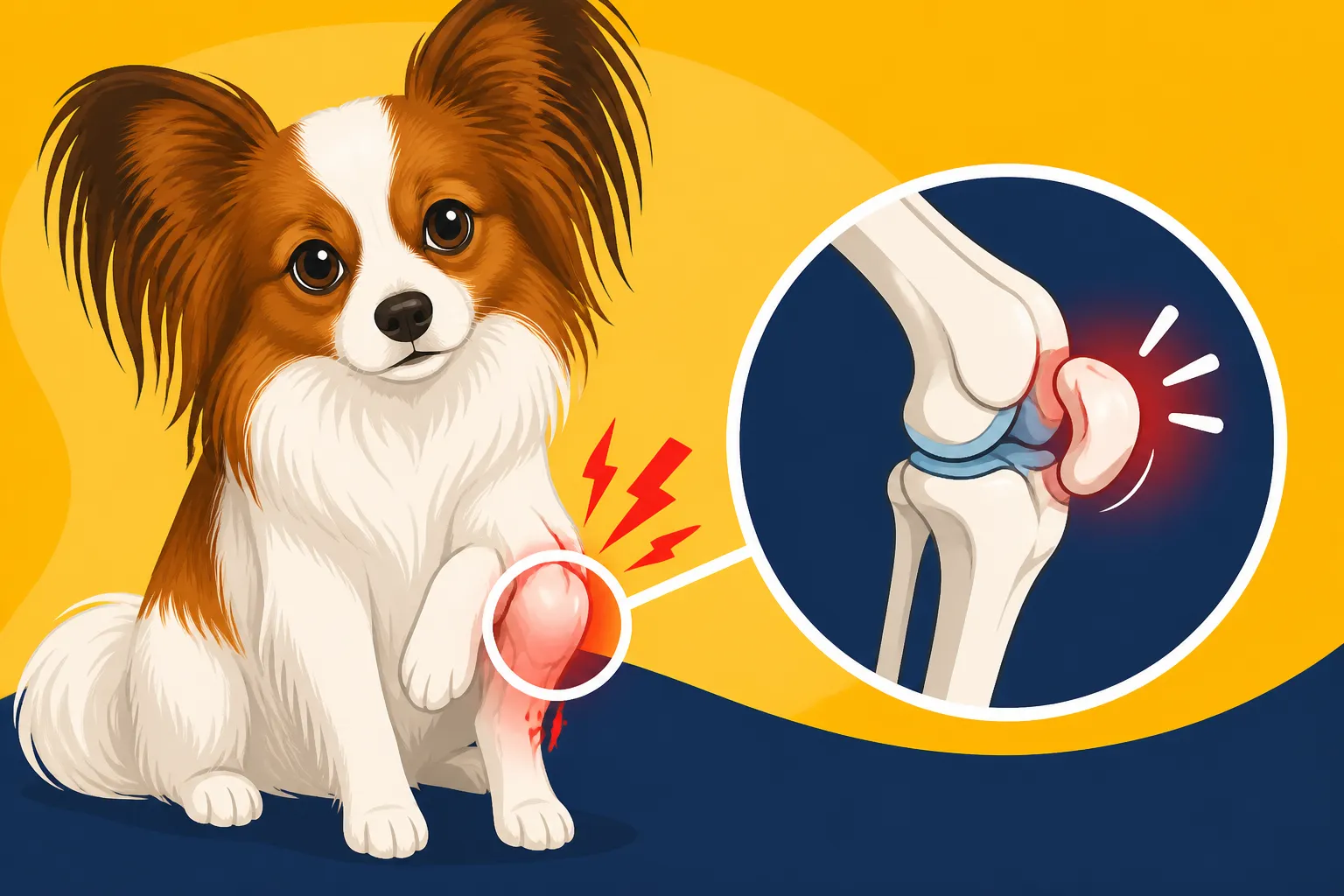
Imagine your Papillon’s knee. Just like ours, it’s a hinge joint, but on a much smaller scale. The kneecap, or patella, is a small, oval-shaped bone that sits right in front of the knee. Its job is crucial: it protects the joint and acts as a pulley for the quadriceps muscle, helping to extend the leg. For the patella to do its job smoothly, it needs to glide up and down within a specific groove on the end of the thigh bone (femur), called the trochlear groove.
This groove is like a perfectly fitted track, keeping the patella centered. The patella itself is encased within the patellar ligament, which connects the quadriceps muscle (on the front of the thigh) to the shin bone (tibia). When your Papillon runs or jumps, the quadriceps muscle contracts, pulling on this ligament, and the patella slides smoothly within its groove. It’s a ballet of bones, ligaments, and muscles, all working in harmony to allow that fluid, graceful movement we adore in our Papillons.
The Papillon's Delicate Bone Structure
One of the defining characteristics of a Papillon is its delicate, fine-boned structure. They are, after all, a toy breed, known for their petite stature. While this contributes to their elegant appearance and agility, it also means their skeletal system is inherently more fragile and susceptible to certain conditions compared to their larger canine cousins.
In a Papillon, the bones of the leg – the femur, tibia, and patella – are all quite small and slender. This delicacy means that even subtle deviations in bone shape or alignment can have a significant impact on joint function. Think of it like a finely tuned miniature clock; any tiny imperfection can throw the whole mechanism off. This inherent structural characteristic makes the Papillon breed particularly prone to issues like patellar luxation, where the patella struggles to stay within its shallow trochlear groove. It's not that their bones are weak, but rather that their precise, tiny structure leaves less room for error in alignment.
Primary Causes of Patellar Luxation in Papillons
When a Papillon's kneecap slips, it's not usually a random event. There are some very specific underlying reasons, most of which are rooted deeply in their genetics and physical build. This is where the breed's history and unique characteristics come into play.
Genetic Predisposition and Breed-Specific Traits
Hands down, the leading cause of patellar luxation in Papillons is genetics. This isn't just bad luck; it's often a condition passed down through generations. What happens is that the genes controlling the formation and alignment of the knee joint aren't quite right. This can result in a trochlear groove that isn't deep enough to hold the patella securely, or an alignment issue with the tibia (shin bone) or femur (thigh bone) that causes the patellar ligament to pull the kneecap out of line.
Many reputable breeders are keenly aware of this genetic component and take extensive measures to try and breed it out of their lines. This is why it’s so important to ask about health testing when looking for a puppy. A good breeder will have certifications from organizations like the Orthopedic Foundation for Animals (OFA) for patellar health in their breeding dogs. These certifications indicate that the parents have been examined and found to have healthy knees. You can read more about what types of health screenings a responsible breeder undertakes in our guide, "What a Papillon Breeder Should Have Tested." Unfortunately, even with careful breeding, the genetic trait can still pop up, which is why patellar luxation is a problem you will actually meet if you own a Papillon. It’s a persistent challenge in the breed.
Shallow Femoral Groove and Weak Ligaments
One of the most common structural problems leading to a slipping kneecap in Papillons is a shallow trochlear groove. Picture that groove we talked about earlier, the track for the patella. In a dog prone to luxation, this groove isn't deep enough. Instead of being a secure channel, it's more like a subtle indentation, making it easier for the patella to simply pop out to the side, either medially (towards the inside of the leg) or laterally (towards the outside).
Compounding this issue can be laxity in the ligaments that support the patella. Ligaments are tough bands of fibrous tissue that connect bones and stabilize joints. If these ligaments are weaker or stretchier than they should be, they can't effectively hold the patella in its proper place, allowing it to dislocate more easily. This combination of a shallow groove and loose ligaments creates a prime scenario for the kneecap to slip out during normal movement, causing that characteristic skip or lameness. It truly highlights how delicate the balance within such a small joint can be.
Misalignment of the Quadriceps Muscle
Beyond the groove and ligaments, the way the powerful quadriceps muscle group pulls on the patella also plays a significant role. The quadriceps tendon connects this large muscle to the patella, and then the patellar ligament continues from the patella down to the tibial crest (a bony bump on the shin bone). This entire "quadriceps mechanism" is designed to pull in a perfectly straight line.
However, if there's any anatomical misalignment in the leg bones themselves – perhaps the upper part of the tibia is rotated slightly inward or outward, or the femur has a bow to it – this straight line of pull is compromised. When the quadriceps contracts, instead of pulling the patella smoothly up and down the center of the trochlear groove, it pulls it off to one side. Over time, this constant off-center pulling can effectively "wear" a new, incorrect track for the kneecap, or simply force it out of the shallow groove it’s already in. This misalignment is largely a developmental issue, meaning it occurs as the puppy grows, guided by its genetic blueprint.
Contributing Factors and Environmental Triggers
While genetics lay the groundwork for patellar luxation, certain everyday factors and environmental situations can either trigger the symptoms or exacerbate an already existing predisposition. It's not always a single cause but often a combination of factors at play.
Trauma and Injury
Even though patellar luxation is largely a genetic and developmental condition, acute trauma can certainly play a role in either initiating a luxation or worsening an existing, mild one. Imagine your Papillon misjudging a jump off the sofa, landing awkwardly, or having a minor collision during spirited play. Such incidents can put sudden, immense stress on the knee joint.
For a Papillon with a naturally shallow trochlear groove or slightly lax ligaments, a sudden twist, fall, or impact could be enough to force the kneecap out of place. While it might slip back in quickly on its own, repeated minor traumas can weaken the surrounding tissues or chip away at the edges of the groove, making future luxations more frequent and more severe. This is precisely why it’s so important to think about how your small dog navigates your home. Our article, "Whether a Papillon Should Be Stopped From Jumping Off Furniture," discusses ways to minimize these kinds of household accidents, helping to protect those vulnerable joints.
Weight and Activity Level
Believe it or not, your Papillon's weight and how they exercise can have a measurable impact on their knee health, especially if they are already predisposed to patellar luxation. An overweight Papillon, even by just a pound or two, carries extra strain on all its joints, and the knees are no exception. That added burden increases the pressure on the patella and the forces pushing it out of its groove. Maintaining a lean, healthy weight is one of the most proactive steps you can take to support your Papillon's joint health, alongside what you'll learn in "Getting Weight Off a Papillon."
Similarly, while Papillons are active and love to run and play, certain high-impact activities might need careful consideration. Repetitive jumping, twisting, or sharp turns, especially on slippery surfaces, can put undue stress on a knee that's already structurally compromised. This isn't to say your Papillon shouldn't be active – quite the opposite! Regular, moderate exercise helps build muscle tone around the joint, which can offer some stability. However, understanding the specific mechanics of patellar luxation means recognizing that some types of activity might exacerbate the condition, leading to more frequent or painful episodes of slippage.
Age and Degenerative Changes
While patellar luxation is often identified in Papillon puppies or young adults because of its developmental nature, its impact can certainly evolve and sometimes worsen as a dog ages. Over the years, even a mildly luxating patella can contribute to degenerative changes within the joint. Each time the kneecap slips out and grinds back in, it can cause wear and tear on the cartilage lining the bones. This ongoing friction can lead to inflammation and the development of arthritis.
For an older Papillon, the symptoms of patellar luxation might become more pronounced, not necessarily because the luxation itself is getting worse structurally, but because the secondary effects like arthritis are making movement more painful. An aging Papillon with a previously well-managed luxation might start showing more persistent lameness, stiffness, or reluctance to use the affected leg. This progression underscores the importance of lifelong joint care and managing the condition from a young age to minimize long-term impact. Our guide, "Caring for a Papillon Past Eleven," delves into many aspects of supporting your senior companion, including joint health.
Recognizing the Signs and What to Do Next
Spotting the signs of a slipping kneecap early can make a big difference in your Papillon’s comfort and long-term joint health. It's a common issue, and knowing what to look for and how to react is key.
Common Symptoms and Grades of Luxation
The most obvious sign that a Papillon's kneecap is slipping is often a characteristic "skip" or "hop" in their gait. You might see them run a few steps, suddenly lift a back leg for a stride or two, and then put it down and continue as if nothing happened. This happens when the patella pops out and then spontaneously pops back in. Sometimes, they might hold the leg up for a longer period, appearing completely non-weight-bearing, especially if the kneecap is momentarily stuck out of place. In more severe cases, you might hear a clicking sound, or your Papillon might yelp or show clear signs of pain. These are the classic "Signs a Papillon's Kneecap Slips."
Veterinarians classify patellar luxation into four grades:
| Grade | Description | Symptoms | Typical Treatment Approach |
|---|---|---|---|
| Grade I | Patella can be manually luxated but immediately returns to normal position. | Often asymptomatic, occasional skip. | Conservative management (weight, exercise moderation, supplements). |
| Grade II | Patella luxates spontaneously or manually, but can be manually reduced. Stays out some of the time. | More frequent skipping, holding leg up briefly. Mild lameness. | Conservative management or surgery, depending on frequency/pain. |
| Grade III | Patella is luxated most of the time but can be manually reduced. | Persistent lameness, awkward gait, pain. | Often surgical correction. |
| Grade IV | Patella is permanently luxated and cannot be manually reduced. | Severe lameness, bowed legs, significant pain. | Surgical correction (often more complex). |
Understanding these grades, especially "Which Grade of Luxation Needs Fixing in a Papillon," helps you grasp the severity and potential treatment paths for your furry friend.
Diagnosis and Veterinary Consultation
If you suspect your Papillon has a slipping kneecap, the very first step is to schedule an appointment with your veterinarian. During the examination, your vet will perform a thorough orthopedic check, carefully manipulating your dog's knee joint to feel for any instability or luxation. They can usually feel the patella pop out of its groove during this physical exam, which helps them determine the grade of luxation.
In addition to the physical exam, your vet might recommend X-rays. While X-rays don't directly show the patella slipping (it's cartilage and soft tissue that's primarily affected), they are crucial for evaluating the overall bone structure of the leg. X-rays can reveal the depth of the trochlear groove, any rotation in the tibia or bowing of the femur, and signs of arthritis or other joint degeneration that might be contributing to the problem. This comprehensive assessment is vital for formulating the best treatment plan for your Papillon.
Management and Treatment Options
Once patellar luxation is diagnosed and graded, your vet will discuss the best course of action. For lower grades (Grade I or II) where the luxation is infrequent and doesn't cause significant pain or lameness, conservative management might be recommended. This often involves strict weight management to reduce stress on the joint, moderate exercise to build supportive muscle tone (avoiding high-impact activities), and possibly joint supplements like glucosamine and chondroitin.
However, for more severe cases (Grade II with significant symptoms, Grade III, or Grade IV), or if conservative management isn't effective, surgical correction is usually the recommended path. The goal of surgery is to stabilize the kneecap and prevent it from luxating. This can involve deepening the trochlear groove, realigning the patellar ligament by moving the tibial crest, or tightening/loosening soft tissues around the joint. Deciding "Whether a Papillon Needs Knee Surgery" is a big decision, but it's often the most effective way to restore comfort and function.
The cost of knee surgery for a small dog like a Papillon can be substantial, which is where pet insurance can be a real lifesaver. Many owners find that policies from providers like Healthy Paws can significantly reduce the financial burden of such unexpected medical expenses. It’s worth noting that "Knee Surgery Is the Bill Most Papillon Owners Meet" for Papillons due to the breed's predisposition to this condition. Post-surgery, rehabilitation and careful management are crucial for a full recovery, as detailed in our guide, "How a Papillon Recovers From Knee Surgery." The path to recovery requires patience and dedication, but seeing your Papillon run and play pain-free makes it all worthwhile.
Disclaimer
The information provided in this article is for general informational purposes only and is not intended as a substitute for professional veterinary advice. Always consult with a qualified veterinarian regarding any medical concerns or before making any decisions about your pet's health.