Whether a Papillon Has Dewclaws on Its Hind Legs
A Papillon’s delicate legs can make any extra claw look surprising, especially when you find one tucked high on a hind leg during grooming. Hind dewclaws are possible, but they are not a feature every Papillon has. Here’s how to tell a dewclaw from an ordinary toe, what to do if your dog has one, and when it needs veterinary attention.
Do Papillons Have Dewclaws on Their Hind Legs
Hind dewclaws can be present, absent, or removed
A Papillon may have a dewclaw on one or both hind legs, but many Papillons do not. Some have a single hind dewclaw on one leg or both; a dog can also have double hind dewclaws. And a claw that is missing now may have been removed when the dog was very young rather than absent from birth.
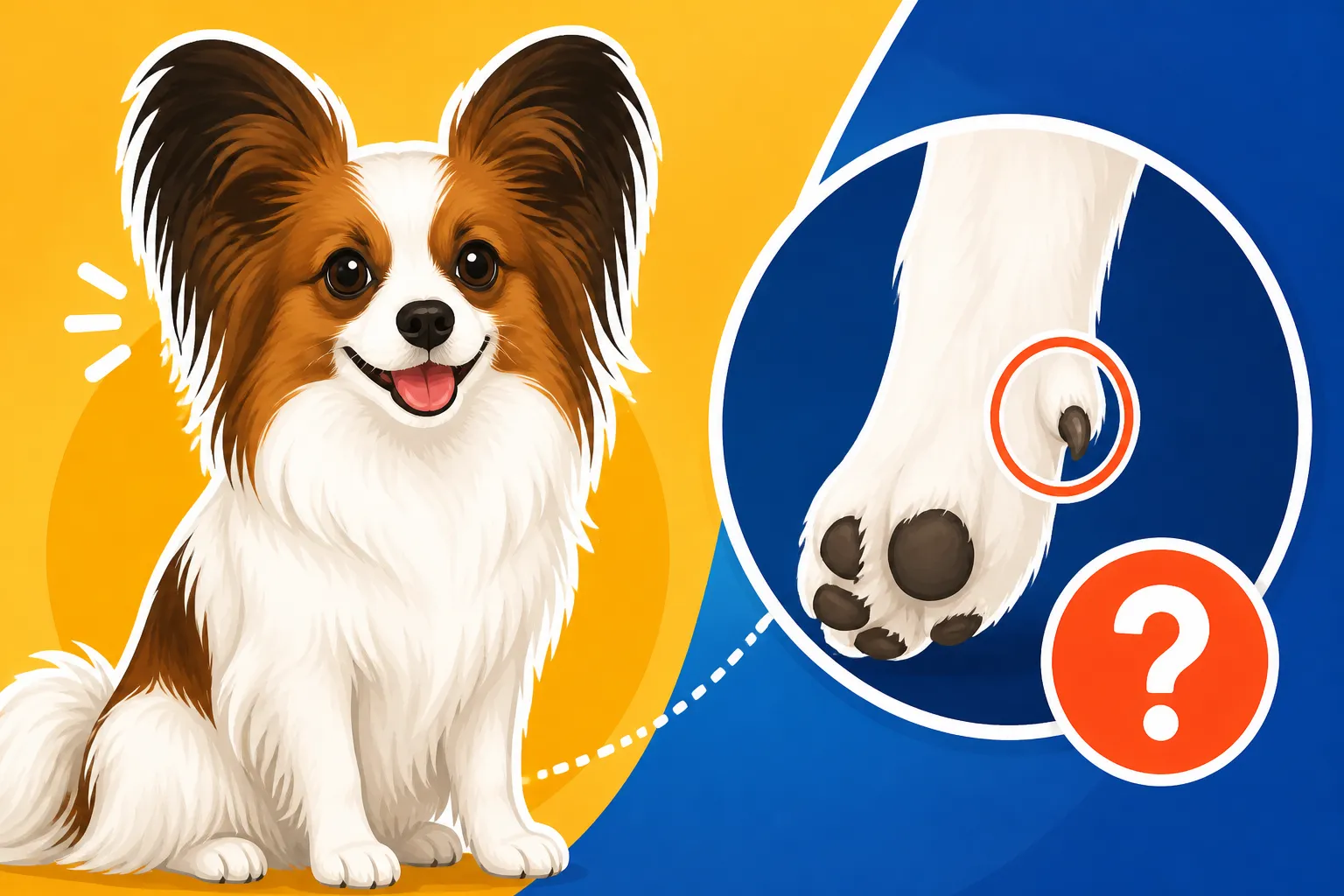
Dewclaws are the small claws set higher on the inside of a leg, away from the row of toes that touches the ground. On the hind legs, they can be easy to miss beneath the feathering, particularly if they sit close to the leg or have little hair around them. A quick check during brushing can help you notice them without tugging at the coat or bending the leg.
Papillons usually have front dewclaws, though the details can vary from dog to dog. The presence of a hind dewclaw is not, by itself, a sign that something is wrong or that a dog is not a Papillon. For a closer look at how the breed’s feet are shaped, see What Shape a Papillon's Feet Are.
What the breed standard does and does not tell you
A breed standard describes the desired appearance and structure of a breed; it is not a checklist proving what every individual dog must have. The Papillon standard permits dewclaws to be removed, but that does not mean every Papillon’s hind dewclaws were removed, or that every dog is born with them. Practices can differ between breeders, veterinarians, and locations.
That distinction matters when you are looking at a puppy or an adult dog. A Papillon with intact hind dewclaws is not automatically unusual, and a dog without them may have been born without them or had them removed early. If you are curious about your own dog’s history, the breeder or rescue may know whether removal was performed, but the appearance alone may not settle the question.
If you are choosing a puppy, ask the breeder what was done and when, rather than assuming a missing claw is natural. You can also ask your veterinarian to note the dog’s dewclaws at a routine exam. The same practical approach applies to other physical traits: breed information can offer useful context, while an individual dog’s medical record fills in the details.
How to Identify a Hind Dewclaw
Look above the toes, on the inside of the leg
A hind dewclaw sits on the inner side of the lower hind leg, higher than the main toes. It may look like a tiny extra toe with a nail, but it may not rest on the floor when your Papillon stands. Some dewclaws are attached by bone and tissue; others are more loosely attached and move more freely. The exact structure can vary, so appearance alone does not tell you how firmly it is connected.
To check, have your dog stand comfortably or lie on their side, and gently part the feathering with your fingers. Look at the inside of each hind leg, above the paw. You do not need to pull the claw, spread the toes forcefully, or test whether it moves. If your dog seems uncomfortable or starts to pull away, stop and ask your veterinary team to check it instead.
It is useful to inspect both sides because a Papillon may have a dewclaw on just one hind leg. Double dewclaws can also be mistaken for a small tangle of fur, especially when the nails are short. For routine foot care, Whether a Papillon's Feet Need Trimming explains why tidying the hair around the paw is different from cutting a claw.
Dewclaws are different from ordinary toes
A hind dewclaw is positioned higher and farther inward than the toes that form the paw’s main contact with the ground. A regular toe has a pad and nail in line with the rest of the foot. A dewclaw may have a smaller pad, a differently placed nail, or a looser feel, depending on how it is attached.
| What you notice | What it may indicate | What to do |
|---|---|---|
| A small nail high on the inside of the hind leg | A hind dewclaw | Check it gently during regular grooming |
| A claw aligned with the main toes | An ordinary toe | Include it in normal nail care |
| Redness, swelling, bleeding, or a split nail | Injury or irritation | Contact your veterinarian for advice |
| A claw that curls toward the skin | An overgrown nail | Arrange careful trimming and ask about a safe maintenance routine |
| A small, loose-looking claw that catches on fabric | A dewclaw that may snag easily | Have a veterinary professional assess it rather than trying to remove it |
If you are uncertain whether a small growth is a claw, a skin tag, or an injury, do not cut it. A veterinarian can identify it safely, especially if the area is tender or the nail is partly hidden under hair. Dewclaws can be easy to snag, but their position alone is not a reason to remove them.
Caring for a Papillon’s Hind Dewclaws
Keep the nail short enough to avoid snagging
Because a hind dewclaw often does not touch the ground, it may not wear down as naturally as a weight-bearing nail. Over time, it can grow long, curve inward, catch on blankets, or press into nearby skin. Check it during the same routine you use for the rest of your Papillon’s nails. Nail growth differs among dogs, so the right checking rhythm depends on your dog’s own growth and activity.
Use a small dog nail trimmer or a pet nail grinder only if you are comfortable handling it and can see what you are doing. A small-pet nail tool from a retailer such as Chewy or a local pet shop may be an option, but choosing a tool does not replace learning how to use it safely. Keep your dog relaxed, work in good light, and take off only a small amount at a time.
The quick—the living tissue inside the nail—can be difficult to see, especially in dark nails. If you are unsure where it ends, ask your veterinarian or groomer to demonstrate a safe trim. You can also read Whether a Papillon's Quick Is Hard to See and How Fast a Papillon's Nails Grow for more on nail visibility and maintenance. Do not force a trim if your Papillon is frightened or struggling; a calm professional appointment is safer than a rushed cut.
Watch for catching, irritation, and injury
A dewclaw that catches on carpet, a sweater, or a grooming comb may twist or tear. Check the claw if your Papillon suddenly licks one hind leg, pulls away when you touch the area, or starts holding the leg differently. A cracked nail, fresh blood, swelling, heat, or a dangling claw deserves veterinary attention. Avoid pulling off a partially torn nail or wrapping the leg tightly at home.
If you notice a small amount of bleeding after an accidental nail nick, gentle pressure with clean gauze may help while you contact your veterinary clinic for guidance. A pet first-aid product such as styptic powder may be available from Chewy or other pet-supply sellers, but it is not a fix for a deeply torn or badly damaged nail. If bleeding continues or your dog appears very painful, seek veterinary care promptly.
It also helps to look at the surrounding skin while you brush. Feathering can hide dirt, mats, or irritation around the feet, and a comb that snags can make a dog wary of paw handling. A small comb or grooming brush from Chewy may be useful for routine coat care, but use it gently around the dewclaw and stop if it catches. Guidance on Whether a Papillon's Feathered Feet Hide Long Nails can help you build the feet into an ordinary grooming check rather than discovering a problem only after a snag.
Should a Papillon’s Hind Dewclaws Be Removed
Removal is not automatically necessary
An intact hind dewclaw does not automatically need to be removed. If it is healthy, comfortable, and manageable with regular nail care, your veterinarian may recommend simply monitoring it. The decision depends on the individual dog’s anatomy, the dewclaw’s attachment, its history of injuries, and any health concerns—not just the fact that it sits higher than the other toes.
Removal in an adult dog is a veterinary surgical procedure, not a home grooming task. It involves assessing the claw and surrounding tissue and making a plan for pain control and recovery. Ask your veterinarian to explain the reasons for and against removal in your dog’s specific case, including what signs would make surgery worth considering. A claw that has repeatedly torn or become injured may need a different discussion from one that has never caused trouble.
For a puppy, practices around removal can vary. If a breeder says a puppy’s dewclaws were removed, ask when and why, and request the relevant veterinary information. If you are considering removal for a puppy, talk with a veterinarian rather than treating it as a routine choice. Local rules and veterinary standards may differ, so the safest decision is one made with a qualified professional who can examine the puppy.
Make paw handling part of everyday care
Many dogs dislike having their feet handled, and Papillons can be especially quick to pull a paw away when a nail trim feels unfamiliar. Start with brief, easy practice: touch a shoulder, move down the leg, touch a paw for a moment, then reward your dog. Build gradually toward gently parting the feathering and looking at the dewclaw. Keep sessions short enough that your dog stays comfortable.
A simple routine could be: check both hind legs during brushing, look at each dewclaw, check whether the nail is beginning to curl, and note any tenderness or redness. Keep a record if one claw grows faster than the others or has been injured before. That kind of consistent, low-key handling makes it easier to notice a change before it becomes a painful snag.
If your Papillon resists, do not pin them down or keep going through escalating fear. Pause and practice handling in smaller steps, or ask a groomer or veterinary team to show you a gentler approach. Teaching a Papillon Puppy to Be Handled All Over offers useful groundwork for making foot checks less stressful, while Why a Papillon's Nails Affect Its Knees explains why keeping every nail at a comfortable length is part of overall foot care.
Disclaimer
This article is for general informational purposes only and does not constitute professional advice. Laws, prices and regulations vary by location and change over time. Consult a qualified professional for guidance on your specific situation.