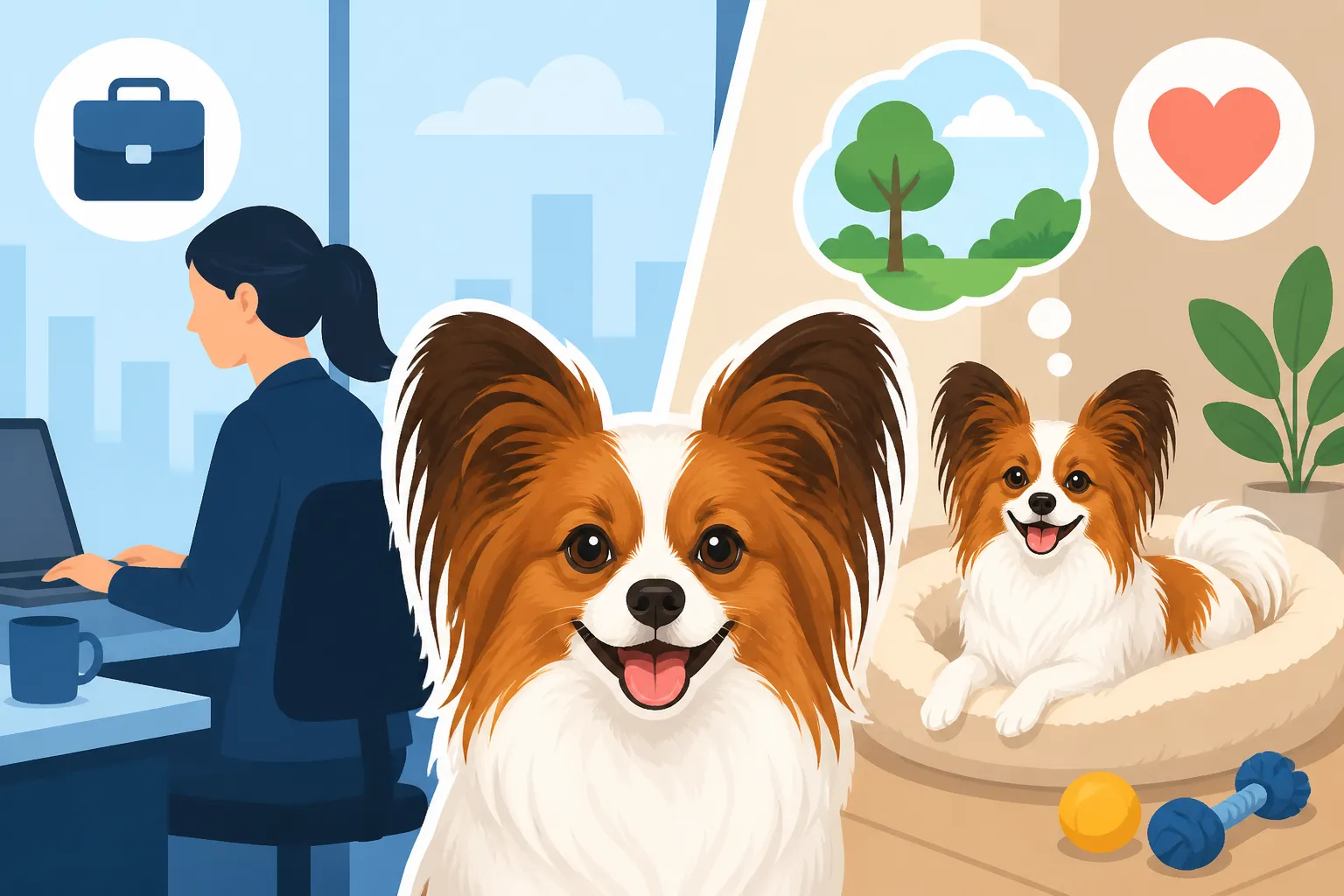
Whether a Papillon Suits Someone Who Works Full Time
Working full time does not automatically rule out a Papillon, but this people-oriented, energetic little dog may struggle if left alone for long stretches without a plan. The key questions are how long your dog would be by itself, whether someone can provide a midday break, and how you’ll meet its exercise and companionship needs before and after work.
Can a Papillon Be Left Alone While You Work
The length of the workday matters
Papillons often enjoy staying close to their people. That does not mean every Papillon will panic when alone, but it does mean you should take the daily routine seriously. A dog left alone from the early morning until evening, with no visit or break, may become bored, distressed, or uncomfortable. Even a dog that seems settled at first can find a long, predictable absence difficult.
An adult dog that has gradually learned to relax alone may cope with a few hours better than a puppy or a dog newly adopted into your home. But there is no single number that works for every Papillon. Age, health, past experience, temperament, toilet habits, and the quality of the alone-time routine all matter. A quiet dog may still need a chance to stretch, drink, use the bathroom, and have some company.
Puppies need a different plan. They are still learning where to toilet, how to settle, and what is safe to chew. A very young Papillon generally cannot be expected to stay alone through a full workday. You may need to arrange help at home, stagger work hours, or take time off while the puppy settles in. For more on this, see How Long a Papillon Copes Alone and The First Year With a Papillon Puppy.
Build in a reliable break
For many full-time workers, the most practical solution is a midday visit from a trusted person. That might be a family member, neighbor, dog walker, or pet sitter. The visit does not need to turn into an elaborate outing: a toilet break, a short sniffing walk, some gentle interaction, and a check that your Papillon is comfortable can make the day much more manageable.
Dog daycare can suit some Papillons, but it is not automatically the best option. A sensitive or easily overwhelmed dog may prefer a quiet home visit, while a social, confident dog might enjoy supervised play. Ask how dogs are grouped, how rest breaks work, and whether staff can accommodate a small dog that needs careful handling. Try short visits first rather than making a full day the first test.
If nobody can visit, consider whether your schedule can be adjusted. Working from home part of the week, coming home at lunch, sharing care with another household member, or hiring a sitter for selected days may all help. Think about the actual pattern, not just the average: a Papillon may cope with one longer day differently from five long days in a row. Whether a Papillon Suits a Full Time Worker explores the lifestyle fit from another angle.
Watch for signs that the plan is not working
A dog’s behavior can offer clues, though one isolated mess or bark does not prove separation anxiety. Repeated vocalizing, pacing, destructive chewing near doors or windows, attempts to escape, excessive drooling, or toileting despite being house-trained are reasons to investigate. A camera can help you see whether your Papillon settles after you leave or stays unsettled for much of the day.
Also notice what happens before and after work. Does your dog become frantic as you pick up your keys? Is it unable to settle when you return? Does it ignore food or toys while you’re away but eat eagerly once you’re home? These details can help your veterinarian or a qualified behavior professional understand the pattern. Avoid scolding your dog for damage discovered after the fact; that response does not teach it how to feel safe alone.
If the signs are persistent, take them seriously and get help rather than simply extending the alone time in the hope that the dog will get used to it. Separation-related distress can be difficult for both the dog and the household, especially in an apartment where neighbors may hear prolonged barking. Read Signs a Papillon Has Separation Anxiety for behaviors worth discussing with a professional.
Make the Workday Easier for Your Papillon
Give the morning a useful rhythm
A rushed exit can leave both dog and owner stressed. Build in enough time for a toilet break, a walk or play session suited to your dog, breakfast if that fits its feeding routine, and a calm wind-down before you leave. A brisk, age-appropriate walk gives your Papillon a chance to sniff and explore; it should not be a forced workout, particularly for a puppy or dog with a health concern.
Mental activity can be just as useful as physical exercise. A few minutes of cue practice, finding treats around a room, or working through a food puzzle can help make the morning feel purposeful. Keep the activities safe for a dog left unsupervised: avoid anything that could break into small pieces, become lodged, or tangle around the dog. If you use a food toy, test it while you are home first.
It can help to make departures ordinary rather than dramatic. Put on your coat, pick up your bag, and leave without a long, emotional goodbye. Practice brief absences when you are home, beginning with a duration your dog can manage and increasing gradually. For broader daily needs, see What a Papillon Needs Every Day and How Much Exercise a Papillon Needs.
Set up a safe, comfortable place
Choose a resting area where your Papillon can settle without access to hazards such as loose cords, cleaning products, small objects, or food it should not eat. Some dogs relax in a pen or a gated room; others do better with access to a larger dog-proofed area. A crate may be useful if your dog has been patiently trained to enjoy it, but it should not be treated as a way to confine a distressed dog for an entire workday.
Keep fresh water available and make sure the space is a comfortable temperature. A small dog should not be left in a sunny room that heats up or in a chilly area without a warm resting place. Leave familiar bedding if your dog does not chew it, and consider low-key background sound if it seems to help your individual dog settle. Watch the dog’s response rather than assuming music or a television will solve loneliness.
Before leaving, check that gates latch securely and that your Papillon cannot reach furniture or windowsills it might jump from. Small dogs can be quick and athletic, and a dog trying to follow you may take risks around doors or elevated furniture. If you live in an apartment, consider how barking carries through shared walls and whether your dog has enough opportunity to toilet comfortably. See Whether a Papillon Suits an Apartment for more on that living arrangement.
Use enrichment thoughtfully
Food puzzles, safe chew items, and simple scent games can help break up a quiet day, but enrichment is not a substitute for companionship or a toilet break. Rotate a few options rather than leaving every toy out at once. If a toy is new, watch your dog use it while you are present before deciding it is suitable to leave unsupervised.
A small supply of familiar food and enrichment items can make planning easier. Some owners use Chewy to arrange delivery of their dog’s usual food or browse for puzzle toys, which can be convenient when work hours make shopping difficult. Whatever the source, introduce a new food or toy gradually and check that the size and design are appropriate for your Papillon.
You can also hide a few pieces of kibble in safe, easy-to-find places before leaving, as long as your dog is comfortable eating when alone and the daily food amount is accounted for. Chewy may be one place to look for treat-dispensing toys, but a simple snuffle mat or supervised training game can work too. The goal is a calm, manageable activity—not a complicated setup that risks frustration.
Plan for Your Schedule and Your Dog’s Age
Match the arrangement to the dog
A confident adult Papillon with a history of settling alone may need a different setup from a newly adopted adult who has never lived in a quiet home. A puppy needs more frequent toilet opportunities and closer supervision. A senior dog may sleep more but could need more frequent bathroom breaks or help moving comfortably. Adjust care as your dog’s needs change rather than relying on the routine that worked years ago.
When adopting or choosing a dog, ask about its experience being left alone. Find out what happens when the previous caregiver leaves the room, how the dog behaves in a crate or pen if one is used, and whether it has shown distress around departures. These answers are not guarantees, but they can help you plan a gradual transition. A rescue Papillon may need time to settle before you can accurately judge its comfort with your regular work schedule. See How a Papillon Adjusts to a New Home and How a Rescue Papillon Settles.
A useful starting point is to map out the day honestly:
| Part of the day | What your Papillon may need | Questions to ask yourself |
|---|---|---|
| Before work | Toilet break, movement, breakfast as appropriate, calm attention | Can I allow enough time without rushing? |
| Midday | Toilet opportunity, check-in, interaction, and a chance to move | Who can reliably visit, and what is the backup plan? |
| After work | Walk, play, training, dinner, and companionship | Will I still have time and energy after a long day? |
| Overnight | A safe resting place and a predictable bedtime routine | Does the dog settle comfortably, and can it reach water? |
Be realistic about the whole week
A Papillon may be physically small, but it is not a decorative dog that can simply wait for its person to come home. The household plan should include exercise, training, grooming, health care, and social contact, alongside the workday. The time commitment varies by dog, but a routine that leaves only a hurried walk and a few minutes of attention each evening is unlikely to suit a lively, people-focused individual.
Think through the difficult days as well as the ordinary ones. What happens when you have an early meeting, a late commute, or an evening commitment? Who can step in if your regular walker is unavailable? If your work schedule changes, can you afford or arrange additional care? Chewy can help with practical supply planning, such as keeping familiar food stocked, but deliveries do not replace a person who can check on the dog and provide a break.
Before bringing a Papillon home, try writing out a typical weekday and a worst-case weekday. Include commute time, not just paid work hours. If the dog would regularly be alone for most of the day with no visit, consider whether another arrangement is possible before committing. That is not a judgment on working owners; it is a way to avoid discovering too late that the routine is stressful for the dog and unsustainable for you.
How to Decide If a Full-Time Schedule Can Work
Look for a workable care plan, not a perfect one
A full-time job and Papillon ownership can fit together when the dog’s needs are planned for consistently. A realistic plan might combine a morning walk, a midday sitter, a dog-proofed resting area, and attention and play after work. Another household may be able to share the day so the dog is rarely alone for a long stretch. The best arrangement is the one you can maintain, not an ambitious routine that collapses after the first busy week.
Before making a decision, consider whether you can provide a break every day your Papillon needs one, not just on days when your calendar is easy. Think about the cost and reliability of care, travel time, apartment rules, the dog’s temperament, and your willingness to arrange professional help if distress develops. If a puppy is your plan, make sure your schedule allows for the more hands-on early months.
It may help to talk with a veterinarian, responsible breeder, rescue organization, or qualified dog behavior professional about the specific dog you are considering. Ask for guidance based on the dog’s age, health, previous routine, and behavior when alone. A Papillon that has already learned to settle may be a better fit for your circumstances than a puppy, but individual temperament matters more than a broad label.
Make the decision around the individual dog
A Papillon can thrive in a home where people work, provided its day includes appropriate care, breaks, and companionship. It may be a poor fit if your schedule requires the dog to remain alone for a long time every weekday and you cannot arrange help. Being honest about that difference protects both your future dog and your own peace of mind.
If you already have a Papillon, change the routine gradually and monitor how the dog responds. Keep notes about barking, appetite, toilet habits, destructive behavior, and how quickly it settles after you leave. Those observations can show whether your arrangements are working and give a professional a clearer picture if you need support. Small adjustments—such as shifting a walk, adding a midday visit, or making the departure routine calmer—can sometimes improve the day, but ongoing distress deserves expert attention.
The most important question is not simply whether Papillons can be left alone. It is whether the particular Papillon in your care can manage the hours your job requires with a routine that is safe, humane, and sustainable. If you can build that routine around the dog rather than expecting the dog to adapt to an empty day, full-time work may be compatible with Papillon ownership.
Disclaimer
This article is for general informational purposes only and does not constitute professional advice. Laws, prices and regulations vary by location and change over time. Consult a qualified professional for guidance on your specific situation.