What People Get Wrong About the Papillon
A Papillon’s butterfly-shaped ears and tiny frame can make the breed look like a decorative lapdog, but that first impression leaves out a lot. Papillons are bright, energetic little dogs with real exercise, training, and social needs. This guide clears up common misconceptions so you can picture daily life with one more realistically—and decide whether the breed fits your home.
Papillons are not just pretty lapdogs
Their size does not describe their personality
A Papillon is small, but many behave like dogs who have somewhere important to be. They tend to notice what is happening around them, learn quickly, and take an active interest in their people. One may curl up beside you after a walk, then spring up at the sound of a delivery van or the rustle of a treat bag.
That alertness can be delightful. Papillons often enjoy learning cues, playing games, and joining in household routines. It can also catch new owners off guard: a dog small enough to carry may still want a job, a say in what happens next, and regular chances to explore. Their compact size does not automatically make them content to be held or left out of family activity.
The breed’s history as a small companion dog helps explain the close bond many Papillons form with their owners, but “companion” does not mean “ornament.” If you want a better sense of how much this breed can bring to everyday life, What a Papillon Needs Every Day looks at the mix of movement, attention, and mental engagement that often suits them.
A lapdog can still be an athlete
Papillons are known for being nimble and quick. Some thrive in activities such as agility, obedience, rally, or scent work, while others are happiest with brisk walks, games, and short training sessions at home. You do not have to compete with your dog to meet its needs, but it helps to think beyond a short trip outside for a bathroom break.
For example, imagine a Papillon who has had a quiet day indoors and then starts barking at every sound, pestering you for attention, or racing laps around the living room. It is tempting to label the dog “naughty” or “hyper.” Sometimes the missing ingredient is simply a chance to sniff, move, solve a small problem, or practice a skill with you.
That does not mean every Papillon needs intense exercise. Activity should suit the individual dog’s age, fitness, and health, and puppies should not be pushed into repetitive jumping before their bodies are ready. For a realistic overview of their athletic side, see Starting a Papillon in Agility. The useful takeaway is not that every Papillon needs a sport, but that many appreciate having something engaging to do.
Being carried is not the same as being included
Because Papillons are portable, owners may be tempted to carry them everywhere or keep them on a lap whenever possible. That can be comforting in some situations, but a dog also benefits from learning to walk safely, explore at its own pace, and settle without constant physical contact.
A Papillon who is picked up every time something unfamiliar appears may miss opportunities to build confidence. On the other hand, asking a tiny dog to navigate crowded areas or interact with an approaching large dog without support is not sensible either. The goal is not to treat the dog as either a baby or a miniature athlete, but to judge the situation and help it feel secure while still allowing appropriate independence.
This matters especially when introducing a Papillon to new people, dogs, or places. Give the dog room to observe, reward calm behavior, and avoid forcing greetings. For more on the breed’s social style, What Papillon Owners Wish They Had Known offers a useful starting point.
Papillons are small, but not made of glass
Their bodies need sensible protection, not constant worry
Papillons are fine-boned dogs, so their size deserves respect. A fall from a high sofa, a careless step, or rough play with a much larger dog can be risky. Yet protecting a Papillon does not mean preventing every walk, game, or bit of exploration.
A practical home setup makes a difference. Keep an eye on furniture jumps, use a secure harness for walks, and supervise interactions with children and larger dogs. If the dog likes getting onto a bed or couch, steps or a ramp may help reduce repeated leaps. A non-slip surface can also make movement around the house easier for a small dog.
These precautions are especially helpful for puppies, seniors, and dogs with known mobility concerns. If your Papillon starts skipping a step, hesitating before jumping, or changing how it moves, note when it happens and discuss it with a veterinarian rather than assuming it is just a quirky habit. Whether a Papillon Is Sturdier Than a Chihuahua explores how to think about the breed’s build without confusing smallness with helplessness.
Gentle handling matters more than a “fragile dog” label
A Papillon can be sturdy enough for ordinary life while still being vulnerable to rough handling. Children should learn to sit down before holding the dog, support its body, and let it move away when it wants space. A dog should never be left alone with a young child, even if both seem comfortable together.
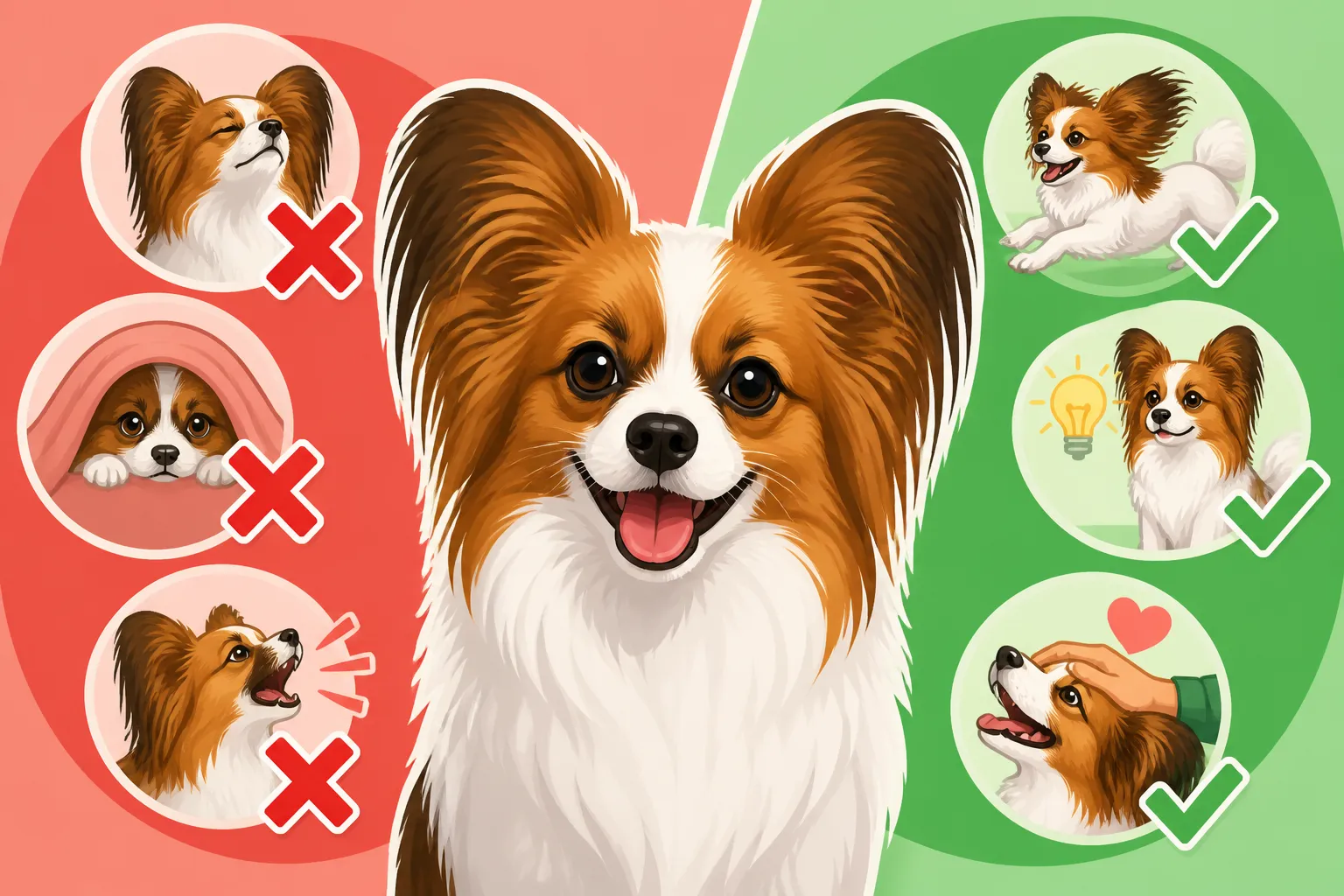
This is not a judgment about the dog or the child. A sudden squeeze, a stumble, or a dropped dog can happen in a moment. It is also easy to miss early signs that a Papillon is uncomfortable: turning its head away, freezing, moving off, or repeatedly licking its lips. Teach children to invite interaction rather than chase or corner the dog.
With other dogs, size differences matter. A friendly large dog may still bowl over a Papillon during play. Choose calm, supervised introductions and interrupt play if the Papillon is being knocked around or cannot get a break. For a fuller discussion of household fit, see A Papillon With Children and Larger Dogs.
Health awareness is not a reason to assume the worst
A common mistake is to swing between two extremes: assuming a Papillon is too delicate for normal activity, or assuming a small dog can never have significant health needs. Neither approach helps. Like any breed, Papillons can have individual health issues, and responsible care means noticing changes and keeping up with routine veterinary guidance.
For instance, a dog who suddenly avoids stairs or intermittently holds up a hind leg should not simply be told to “walk it off.” Those signs can have several explanations, and a veterinarian can assess what is going on. The same goes for persistent coughing, changes in vision, difficulty eating, or a noticeable shift in energy.
If you are considering a puppy, ask the breeder what health testing has been done and request the results rather than relying on reassuring general statements. What a Papillon Breeder Should Have Tested can help you understand the kinds of questions worth asking.
Papillons are not automatically easy or low-maintenance
Their coat is manageable, but it still needs attention
The Papillon’s long, silky coat can look like a major grooming project, but it is not the same as a dense, woolly coat that needs constant clipping. Regular brushing helps prevent tangles, especially behind the ears, around the chest, and on the feathering of the legs and tail. Those areas can collect debris or catch on small knots before you notice them.
A simple routine is often easier than waiting until the coat is tangled. Check the dog after walks, gently comb through the fringe, and make grooming a calm, familiar activity. If a knot is close to the skin, do not yank at it; work carefully or ask a groomer for help. Keeping the dog comfortable matters more than preserving every strand of feathering.
You do not need a complicated collection of tools to begin. A suitable brush and comb, dog-safe shampoo, and patient handling are more useful than a long list of products. Chewy can be one convenient place to look for basic grooming supplies, but choose tools based on your dog’s coat and ask a groomer or veterinarian if you are unsure what is appropriate. For a closer look at coat care, How Often a Papillon Needs Brushing explains where tangles tend to develop and how to keep them manageable.
Small does not mean no training
Papillons are often quick learners, but that does not mean they arrive knowing what you want. House training, recall, polite greetings, settling, and walking on a leash all take consistency. A clever dog may learn a cue quickly and still decide the reward for ignoring it is better.
Short, upbeat practice tends to work better than long, repetitive drills. Reward the behavior you want, make the next step easy enough to succeed, and practice in different places once the dog understands the cue at home. For example, a Papillon who comes reliably in the kitchen may need help learning to respond in a yard with birds, people, and new smells.
Training is also a way to prevent small frustrations from growing. Teaching a quiet cue can help with alert barking; rewarding a dog for settling on a mat can make visitors easier; and practicing a calm “wait” at the door can reduce the chance of bolting. The First Year With a Papillon Puppy covers the early routines that are easiest to establish before they become habits.
“Low maintenance” depends on what you mean
A Papillon may be convenient in some ways: it does not need a large home, and its coat is often manageable with regular care. But low maintenance is not the same as no maintenance. The dog still needs exercise, companionship, grooming, training, preventive care, and a plan for the hours when you are away.
A busy owner might picture a small dog that can simply stay home all day and entertain itself. In practice, some Papillons become vocal or unsettled when bored or left alone for longer than they can comfortably manage. Building up alone time gradually, providing safe activities, and arranging a midday break when needed can help. A puzzle toy may be useful, but it is not a substitute for social contact and exercise.
If you are preparing a home for a new dog, prioritize things that solve real problems: a well-fitted harness, a safe resting spot, a few engaging toys, and grooming tools you will actually use. Chewy may be a practical source for comparing everyday supplies such as puzzle toys or a washable bed. The best setup is the one that fits your dog’s habits, not a cart full of gear.
Papillons are not a perfect match for every home
Barking is a behavior to plan for
Papillons are alert, and many will announce a knock, hallway noise, or movement outside a window. That can be useful if you want a small watchdog, but it may frustrate you if you expect silence in an apartment or a home with shared walls.
Barking often becomes more manageable when you identify what is triggering it. A dog barking at the front window may benefit from reduced access to that view, while a dog who reacts to every hallway sound may need gradual exposure paired with rewards for calm behavior. Teaching the dog to alert and then settle can be more realistic than expecting it never to make a sound.
Avoid yelling over the barking; to a dog, that can sound like you are joining in. Instead, reward quiet moments and practice a consistent response before the dog is already highly excited. If noise is a major concern, The Papillon That Barks at Everything and How to Teach a Papillon a Quiet Cue address the issue more directly.
Families need to match the dog’s needs with the household
A Papillon can do well in many kinds of homes, including apartments, when its needs are met. A yard is not a requirement, but access to safe outdoor walks and daily activity is. Likewise, being a family dog does not mean every Papillon will enjoy the noise and unpredictability of young children.
Think about the household’s everyday rhythm. Can someone provide a walk, play, and brief training? Is there a quiet spot where the dog can rest undisturbed? Can children follow simple rules about handling? These questions matter more than whether the home is large or small.
Some Papillons are outgoing, while others take time to warm up. Some enjoy busy gatherings; others prefer a quieter routine. Meet the individual dog when possible, ask about its behavior in different settings, and do not assume that breed traits guarantee a particular temperament. Whether a Papillon Suits a Family and Whether a Papillon Suits an Apartment Dweller can help you think through those trade-offs.
The best fit is an engaged companion, not a tiny accessory
The Papillon may suit someone who enjoys teaching, playing, and spending time with a dog that pays close attention to the world. It may be less comfortable for a household that wants a pet who is content to be carried, ignored for long stretches, or left to figure out the day alone.
Before choosing one, picture an ordinary Tuesday rather than an ideal weekend. You come home tired, it is raining, and your dog still needs a bathroom break, a little movement, and interaction. You have visitors, and the dog alerts at the door. You need to brush a small tangle before it tightens. None of these moments is unusual, but together they describe the real commitment.
| Common assumption | More realistic expectation |
|---|---|
| A Papillon is only a lapdog | Many enjoy cuddling but also need activity and engagement |
| A tiny dog needs almost no exercise | Walks, play, sniffing, and training all contribute to a satisfying day |
| The long coat requires constant professional grooming | Regular brushing and occasional bathing can keep it manageable |
| Small dogs are automatically easy to train | Papillons can learn quickly, but consistency still matters |
| A Papillon is suitable for every family | Safe handling, supervision, and individual temperament all matter |
| Barking is unavoidable and cannot improve | Triggers can be managed, and calm behaviors can be taught |
The most useful correction is simple: a Papillon is a small dog, not a small commitment. When you respect both sides of that, the breed’s intelligence, energy, and companionship are easier to appreciate—and everyday care becomes more predictable.
Disclaimer
This article is for general informational purposes only and does not constitute professional advice. Laws, prices and regulations vary by location and change over time. Consult a qualified professional for guidance on your specific situation.