The Age a Papillon Stops Growing
A Papillon usually reaches close to its adult height by about six to eight months, but that does not mean every puppy is fully mature then. Some keep filling out for several more months, and coat changes can continue after the skeleton has mostly finished growing. This guide explains what to expect, how to track healthy development, and when a growth concern deserves a veterinarian’s attention.
When a Papillon Usually Stops Growing
Height and body growth happen on different timelines
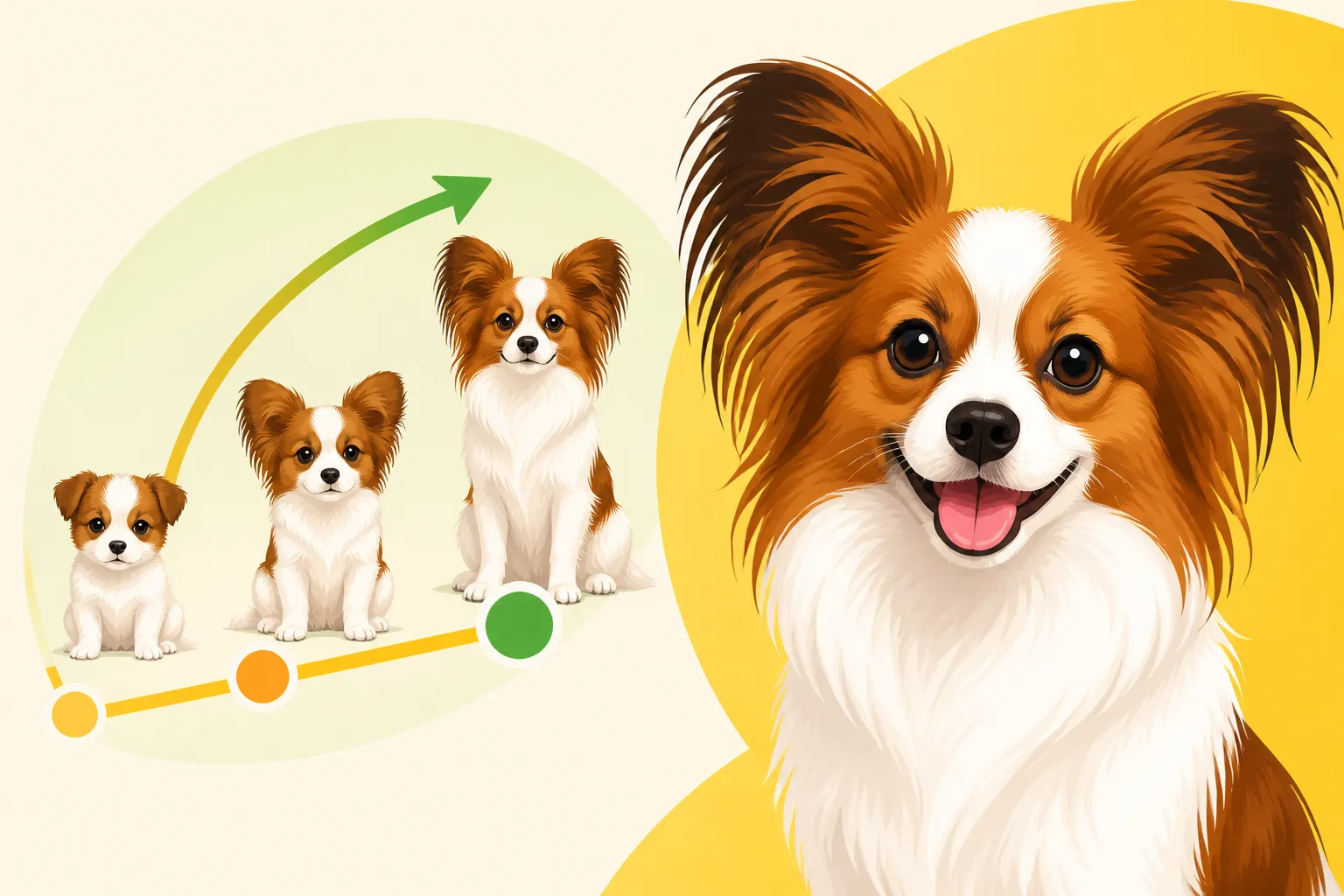
Papillons are a small breed, so their most noticeable physical growth often happens early. Many are close to their adult height by around six to eight months. After that, a puppy may still gain a little height, but changes tend to be subtler: the body becomes more proportionate, the chest develops, and the puppy gradually looks less lanky.
That timeline is a guide, not a deadline. One Papillon may look nearly adult at seven months, while another of the same age still has a puppyish shape. Genetics, sex, overall health, and the size of the puppy’s parents all play a part. A puppy’s current size alone cannot tell you exactly how large that individual will be as an adult.
Height is also only one part of the picture. A young Papillon may reach its adult height before it has finished building muscle or filling out through the body. Many continue to mature physically through roughly the first year, with some taking longer to look fully grown. This does not necessarily mean they are still getting taller.
The breed’s light build can make growth hard to judge
Papillons are fine-boned, small dogs, so minor changes can look dramatic. A few ounces gained or lost may be much more noticeable on a tiny puppy than on a large-breed dog. A growth spurt can make a puppy seem suddenly leggier, while a later period of filling out can change its outline again.
It helps to compare your puppy with its own earlier measurements rather than with a neighbor’s dog or a photo online. Even littermates can grow at different rates and mature into different sizes. A puppy that is smaller than a friend’s Papillon is not automatically failing to thrive, just as a larger puppy is not automatically overweight.
For a broader sense of puppy development, see How Small a Papillon Puppy Is at Eight Weeks and The Age a Papillon Stops Growing. If you are trying to estimate adult size, the parents’ build and the puppy’s growth pattern are more useful clues than any single measurement.
Coat maturity can make a dog look older or larger
A Papillon’s coat may keep changing after its height has mostly settled. The long ear fringe, chest frill, and tail plume develop over time, and the adult coat may not be fully established until well after the puppy has reached much of its adult size. This can make a young dog seem to be “still growing” when the change is mainly coat rather than bone.
Puppies also go through awkward-looking stages. The coat may be uneven, the ears may look oversized for the head, and the body may appear narrow or leggy. These stages are normal for many growing dogs and do not predict the final outline with certainty. Learn more in The Age a Papillon's Adult Coat Arrives and Whether a Papillon Puppy's Coat Predicts the Adult.
How to Tell Whether Your Papillon Is Growing Normally
Track a trend instead of relying on one weigh-in
A single weight is a snapshot. A steady pattern over time gives a clearer picture of development. If your puppy is comfortable being handled, weigh it on the same scale under similar conditions and note the date. For a very small puppy, a baby scale or a veterinary clinic’s scale may be more reliable than trying to weigh the dog while holding it on a household scale.
A simple record can help you spot changes you might otherwise miss. Note appetite, energy, stool quality, and any changes in the puppy’s shape alongside its weight. If a puppy gains slowly but remains bright, active, and well, that pattern may be perfectly appropriate for its build. If the weight suddenly drops, stalls alongside poor appetite, or rises quickly while the waist disappears, contact your veterinarian rather than trying to diagnose the cause from the scale alone.
| What you notice | What it may mean | Helpful next step |
|---|---|---|
| Gradual weight gain and normal energy | Often consistent with ordinary puppy development | Keep recording growth and attend routine checkups |
| A lanky appearance during a growth spurt | The body may be growing unevenly for a while | Reassess over several weeks rather than judging one day |
| Weight loss, low energy, or poor appetite | Could signal illness or a feeding problem | Call your veterinarian for advice |
| Fast weight gain and no visible waist | May indicate excess calories or too many treats | Review portions and ask about body condition |
| Little or no growth across repeated checks | Could reflect individual size or a health issue | Share the growth record with your veterinarian |
Your veterinarian can assess body condition by feeling the ribs and looking at the waist and abdominal tuck. Those checks are more meaningful than trying to make a Papillon fit a generic weight chart. The breed has a range of adult sizes, and a healthy weight depends on the dog’s frame.
For a practical routine, Weighing a Papillon Puppy Every Week explains how to follow changes without turning every small fluctuation into a worry. If you are unsure how to interpret your dog’s shape, What a Papillon Should Weigh can help you prepare questions for a veterinary visit.
Look at body condition, not just the number
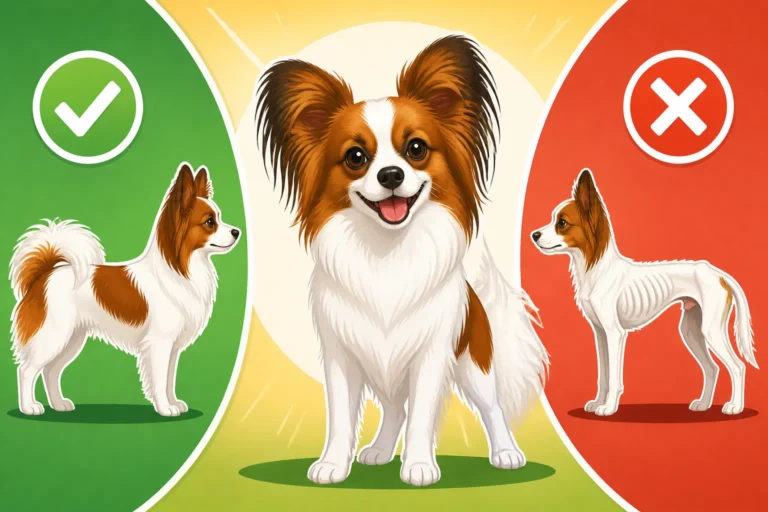
A healthy Papillon should not look or feel like a round little ball simply because it is small. You should generally be able to feel the ribs with light pressure, though they should not be sharply prominent. Viewed from above, many dogs have a visible waist behind the ribs; from the side, the abdomen often rises slightly toward the hind legs.
Long feathering can disguise the outline. A fluffy coat may make a lean dog appear heavier, while a narrow frame can make a healthy puppy look unusually delicate. Use your hands as well as your eyes, and ask your veterinary team to show you what a suitable body condition feels like on your own dog.
If your puppy’s weight changes but its body condition remains appropriate, that may simply reflect normal growth. If you notice a sudden change in the ribs, waist, appetite, or energy, bring it up even if the number on the scale still seems ordinary. Small dogs can have little reserve when they are ill, so a clear change in behavior or eating deserves attention.
Feeding and Activity While Your Papillon Is Growing
Feed for steady development, not maximum size
It can be tempting to offer extra food because a puppy looks small or seems hungry. But feeding more will not reliably make a Papillon taller or sturdier; it can instead encourage excess weight, which puts unnecessary strain on growing joints. Follow the feeding guidance for the food you choose, then adjust portions with your veterinarian based on your puppy’s body condition and growth.
Choose a complete food formulated for puppies, and make any transition gradually unless your veterinarian advises otherwise. Keep track of treats too. Training treats, chews, table scraps, and food used for enrichment all add up, particularly in a tiny dog. If you compare puppy foods at a retailer such as Chewy, check the product label and discuss any diet change with your veterinary team, especially if your puppy has digestive symptoms or a medical condition.
A puppy that skips meals can be more concerning than an adult dog that occasionally leaves food behind. Very small puppies may be vulnerable to low blood sugar, so persistent refusal to eat, weakness, unusual sleepiness, trembling, or unsteadiness warrants prompt veterinary advice. For related feeding guidance, see How Often a Papillon Puppy Should Be Fed and Signs a Papillon Puppy Is Not Thriving.
Give growing joints sensible, age-appropriate activity
Papillon puppies are lively, and it is easy to assume that a small dog can safely jump from any height or race around without limits. Their enthusiasm does not mean their bodies are fully mature. Provide regular, age-appropriate play and walks, but avoid repeatedly encouraging high jumps or hard landings while the puppy is still developing. Use steps or a ramp where practical, and supervise play with larger dogs so a size mismatch does not lead to an accidental knock or fall.
This is not a reason to keep a puppy inactive. Gentle movement, play, and positive training help build coordination and confidence. The goal is to avoid repetitive, high-impact activity and uncontrolled situations, not to prevent normal exploration. If your puppy limps, seems reluctant to move, or repeatedly holds up a leg, pause strenuous play and ask a veterinarian what to do.
Food and exercise work together. A puppy who is growing normally but gaining excess fat may need a portion adjustment, not extra exercise to “burn it off.” For safe home setup and joint-friendly habits, see Whether a Papillon Needs Ramps to Furniture and Whether a Papillon Should Jump Off the Sofa.
When to Ask a Veterinarian About Growth
Slow growth is not always a problem, but a sudden change matters
Some Papillons are naturally smaller than others. A healthy puppy may sit at the petite end of the range because of its family background, while another develops into a larger adult. The important question is whether the puppy is following a reasonably steady pattern and feels well, rather than whether it matches an online estimate.
Arrange a veterinary check if your puppy is not gaining as expected, loses weight, has a persistent poor appetite, or seems unusually tired. Also mention vomiting, diarrhea, a swollen-looking abdomen, difficulty chewing, or changes in thirst or urination. These signs do not point to one specific cause, but they can help your veterinarian decide whether an examination or testing is needed.
Bring your weight notes and, if possible, a brief record of meals, treats, and symptoms. “She has seemed smaller lately” is understandable, but a timeline such as “her weight has changed very little over several checks, and she has been eating less” gives the clinic a more useful starting point.
Ask about development at routine visits
Wellness visits are a good time to ask whether your Papillon’s growth, body condition, teeth, and activity level look appropriate. Your veterinarian can compare current findings with previous visits and discuss any questions about diet or exercise. If you have a puppy from a breeder, the parents’ size and the puppy’s early records may provide helpful context, but they do not replace an individual health assessment.
It is also reasonable to ask what changes are expected over the next few months. A veterinarian can explain whether your puppy appears to be near adult height, still filling out, or simply going through an uneven growth stage. That reassurance can be useful when one week your puppy looks all legs and the next it seems to have changed shape again.
If the puppy has ongoing feeding difficulties or a special dietary need, Chewy may be one place to compare available foods and supplies, but the choice should still fit your veterinarian’s advice. Keep the focus on a complete diet and a healthy body condition rather than trying to make the dog reach a particular size.
Don’t use age alone to decide whether growth is complete
A Papillon nearing its first birthday may look adult, but maturity is not a switch that flips on a specific date. Height, muscle, body shape, coat, and behavior can each settle at a different pace. A dog may stop getting taller while still gaining a more mature outline, and coat changes can continue after physical growth has slowed.
Likewise, a puppy that seems to have stopped growing earlier than expected is not automatically ill. Look at the full picture: appetite, energy, body condition, and the trend across several measurements. When something feels off, a veterinary check is more useful than comparing your puppy with a photo or a breed-size chart.
For more on the breed’s adult proportions, see How Tall a Papillon Stands and How Much a Papillon Weighs. If feeding questions are part of your concern, Feeding a Papillon That Weighs Seven Pounds offers related guidance for small-dog portions and routines.
Disclaimer
This article is for general informational purposes only and does not constitute professional advice. Laws, prices and regulations vary by location and change over time. Consult a qualified professional for guidance on your specific situation.