Whether a Papillon Skips a Step When Running
It can be incredibly alarming to watch your vibrant, energetic Papillon suddenly skip a step while they’re running or playing. One moment they’re zipping around like a tiny butterfly, and the next, they’re holding up a hind leg as if it’s bothering them, only to put it down a few strides later and act like nothing happened. This odd little hop isn't just a quirky gait; it’s often a tell-tale sign of a common orthopedic issue called patellar luxation, and understanding what’s happening and what to do next is crucial for your little companion's comfort and long-term health.
Understanding the "Skipped Step" Phenomenon in Papillons
The sight of your Papillon suddenly picking up a hind leg mid-stride, doing a sort of "bunny hop" on three legs, and then just as quickly putting the leg back down as if nothing was amiss, is a hallmark sign that many Papillon owners encounter. It’s confusing, it’s a bit unsettling, and it definitely makes you wonder if you just imagined it. But rest assured, you didn't imagine it, and it's a common concern in toy breeds like our beloved Papillons.
What it Looks Like When Your Papillon Skips a Step
When a Papillon skips a step, it's typically a very distinct motion. Imagine them trotting along, and then suddenly, one of their back legs just comes right up off the ground. They might take a few steps, or even several, on their three remaining legs, almost like they're trying to shake something off their paw. Then, without any apparent pain or effort, the leg goes back down, and they continue on their merry way, seemingly perfectly fine. It’s often referred to as a "skipping" or "bunny hopping" gait because of how quickly and seemingly effortlessly it occurs and resolves. You might also notice a slight hitch in their giddy-up, or a momentary stiffness that quickly disappears. It’s not usually a dramatic limp, at least not at first, which can make it easy to dismiss as a minor, fleeting incident.
The Anatomical Reason Behind the Skip
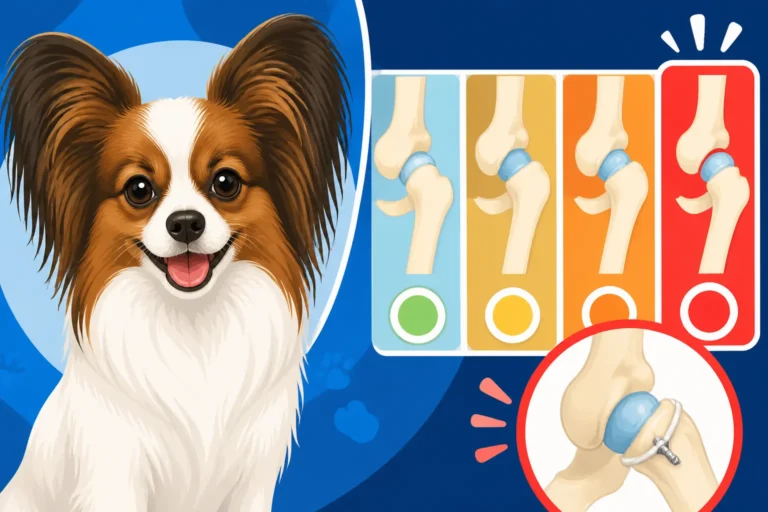
This characteristic "skipped step" is almost always a sign of a condition known as patellar luxation. In simplest terms, patellar luxation means the kneecap (patella) slips out of its normal groove on the thigh bone (femur). When the kneecap dislocates, your Papillon can’t fully extend their leg, which is why they pick it up and hold it bent for a few steps. Once the quadriceps muscle relaxes or the dog maneuvers their leg just right, the kneecap often pops back into its groove, and they can use the leg normally again. This is why the skipping can appear intermittent and doesn't always seem to cause immediate distress.
The kneecap is a tiny, triangular bone that sits within the quadriceps tendon. It slides up and down in a shallow groove at the end of the femur. Ligaments on either side help keep it aligned. When these structures aren't quite right – maybe the groove is too shallow, or the ligaments are too loose, or the alignment of the leg bones isn't perfect – the kneecap can slide out. While it can slip to the outside (lateral luxation), in Papillons and most small breeds, it usually slips to the inside (medial luxation). This is a developmental condition, meaning most dogs are born with the anatomical predisposition for it, even if the signs don't show up until later. It's truly one of those Papillon problems you will actually meet.
Grades of Patellar Luxation
Veterinarians classify patellar luxation into different grades, from 1 to 4, to describe the severity of the condition. This grading helps determine the best course of action, from conservative management to surgical intervention. Understanding these grades is key to knowing what might be happening inside your Papillon’s knee.
| Grade | Description | Symptoms Often Seen |
|---|---|---|
| Grade 1 | The patella can be manually luxated (slipped out of place) when the leg is extended, but it easily returns to its normal position on its own. | Infrequent skipping or occasional bunny-hopping. Often no persistent pain. May go unnoticed for long periods. |
| Grade 2 | The patella spontaneously luxates (slips out on its own) with movement or manipulation, and it may stay out of place for longer periods. It can be manually returned to the groove, or it may pop back in on its own when the leg is straightened. | More frequent skipping, limping, or holding the leg up for several steps. Your Papillon might shake the leg to pop it back in. |
| Grade 3 | The patella is almost always luxated. It can be manually reduced (put back into the groove) but will immediately pop back out when released. The groove is typically shallow, and the quadriceps muscle may be rotated. | Persistent lameness, difficulty extending the leg, bowed legs in severe cases. Pain is more common. |
| Grade 4 | The patella is permanently luxated and cannot be manually reduced. The groove is usually absent, and the thigh bone is severely deformed. | Severe, constant lameness, often a crouched stance, significant difficulty walking. Surgery is almost always recommended if the dog is to have any quality of life. |
It’s important to remember that even a Papillon with a low-grade luxation can experience discomfort, and it can progress over time. Knowing What Patellar Luxation Does to a Papillon beyond just the skip is vital for proactive care.
Recognizing Other Signs of Patellar Luxation
While the "skipped step" is the classic indicator, patellar luxation doesn't always present so clearly. Sometimes, the signs can be more subtle, or they can progress to something more noticeable over time. Keeping a close eye on your Papillon's movements and behavior is your best defense against the condition worsening.
Beyond the Skip: Subtle Clues to Watch For
Beyond the obvious skipping, there are several other subtle signs that your Papillon might be dealing with a slipping kneecap. You might notice your dog:
- Intermittent Lameness: This isn't a constant limp, but rather an on-again, off-again favoring of a leg. One day they might be fine, the next they might show a slight hesitation or stiffness.
- Reluctance to Jump or Use Stairs: If your normally fearless Papillon suddenly seems hesitant to jump onto the sofa, into your lap, or navigate a few stairs, it could be because these actions put strain on their knees. They might even whine or show discomfort when trying. Whether a Papillon Should Be Stopped From Jumping Off Furniture is a question many owners grapple with, and with luxation, the answer leans heavily towards prevention.
- Unusual Gait: Even when not actively skipping, you might notice a change in their overall gait. They might carry their hind legs a bit differently, or have a less fluid movement than before.
- Swelling or Pain (Less Common in Lower Grades): While not typically seen with Grade 1 or 2 luxation, if the condition is more severe or if there’s associated arthritis, you might notice swelling around the knee joint or your Papillon reacting with pain when you gently touch their knee.
- "Bow-legged" Appearance: In more severe, chronic cases (especially Grade 3 or 4), the continuous displacement of the kneecap can actually cause the leg to develop a bowed appearance over time as the bones grow abnormally.
- Licking or Chewing at the Knee: Dogs often lick or chew at areas of discomfort. If you see your Papillon doing this repeatedly to their knee area, it’s a strong signal something is wrong.
These Signs a Papillon's Kneecap Slips can be easy to overlook, especially if your Papillon is otherwise cheerful and active. Remember, they are often masters at hiding pain!
When to Seek Veterinary Attention
If you've noticed any of the signs we've discussed, especially the characteristic skipped step, it's absolutely time to schedule an appointment with your veterinarian. Don't wait until the skipping becomes constant or your Papillon is clearly in pain. Early diagnosis and intervention can make a significant difference in managing the condition and preventing further damage to the joint. Your vet will perform a thorough physical examination, including palpating your dog's knees to check for instability. They'll assess how easily the kneecap can be moved and if it pops back into place on its own. In some cases, X-rays might be recommended to evaluate the bone structure and check for any secondary arthritis or other orthopedic issues.
During your vet visit, be prepared to describe exactly what you’ve observed: how often your Papillon skips a step, for how long, whether it seems painful, and any other changes in their activity level or behavior. The more information you can provide, the better your vet can assess the situation.
Managing and Treating Patellar Luxation in Papillons
Once your veterinarian has diagnosed patellar luxation and assigned a grade, you'll need to discuss the best course of action. Treatment can range from conservative management, focusing on support and comfort, to surgical intervention, which aims to correct the anatomical issue. The decision will largely depend on the grade of luxation, your Papillon’s age, overall health, and how much the condition is impacting their quality of life.
Conservative Management: What You Can Do at Home
For Papillons with Grade 1 or even some mild Grade 2 luxations, or those who are not good candidates for surgery (perhaps due to age or other health concerns), conservative management is often the first approach. The goal here is to minimize discomfort, prevent progression, and support joint health.
- Weight Management: This is perhaps one of the most critical aspects. Whether Weight Affects a Papillon's Knees is a definite yes. Even a few extra ounces on a tiny Papillon can put tremendous strain on their knee joints. Keeping your Papillon at a lean, healthy weight is paramount. Talk to your vet about an ideal weight for your dog and a feeding plan if they need to lose a few pounds.
- Controlled Exercise: While exercise is important, it needs to be appropriate. High-impact activities, jumping, and sudden twists can exacerbate the problem. Focus on regular, moderate walks on soft surfaces. Avoid rough play with larger dogs that could lead to accidental injury. Whether a Papillon Should Be Stopped From Jumping Off Furniture isn't just about preventing new injuries, but also protecting existing weak joints.
- Joint Supplements: Many veterinarians recommend joint supplements containing ingredients like glucosamine, chondroitin, and MSM. These can help support cartilage health and reduce inflammation. While they won’t fix the anatomical problem, they can significantly improve comfort. Your vet can recommend a reputable brand and proper dosage.
- Environmental Modifications: Making your home safer for your Papillon's knees can also make a big difference. Consider using Whether Ramps Help a Papillon's Knees to access furniture or beds. Provide soft, non-slip surfaces for them to walk and play on, especially where they might jump off things. Rugs on hardwood or tile floors can prevent slipping and jarring movements.
- Anti-inflammatory Medication: For periods of increased discomfort or flare-ups, your vet might prescribe non-steroidal anti-inflammatory drugs (NSAIDs) to manage pain and inflammation. These are usually used short-term or as needed.
Surgical Intervention: When It Becomes Necessary
For Papillons with higher-grade luxations (typically Grade 2, 3, or 4), or those with lower-grade luxations that cause persistent pain or lameness despite conservative management, surgery is often the most effective solution. The aim of surgery is to stabilize the kneecap in its correct position and prevent it from slipping out again. Which Grade of Luxation Needs Fixing in a Papillon can vary, but generally, if it impacts their quality of life, surgery is considered.
There are several surgical techniques, often used in combination:
- Trochlear Widening/Deepening: This involves deepening the groove (trochlear sulcus) in the femur so the kneecap has a more secure channel to track in.
- Tibial Tuberosity Transposition: The tibial tuberosity is the bony prominence where the patellar ligament attaches to the shin bone (tibia). If it's out of alignment, the surgeon can cut it, reposition it to the correct alignment, and reattach it with pins. This corrects the pull of the quadriceps muscle.
- Capsular Overlap/Release: The joint capsule and surrounding soft tissues might be tightened on one side and loosened on the other to help keep the kneecap in place.
The decision Whether a Papillon Needs Knee Surgery is a big one, both emotionally and financially. Knee surgery is often Knee Surgery Is the Bill Most Papillon Owners Meet, so it's wise to consider pet insurance like Healthy Paws, especially if you have a young Papillon. They can help cover the costs of these procedures and the necessary follow-up care, making the best treatment option more accessible.
Post-Surgery Recovery and Long-Term Care
Surgery isn't the end of the journey; it’s just the beginning of recovery. Post-operative care is critical for a successful outcome. Your Papillon will need:
- Strict Rest: This typically means crate rest or very limited activity for several weeks, gradually increasing as advised by your vet.
- Pain Management: Your vet will prescribe pain medication and possibly anti-inflammatories to keep your Papillon comfortable during the healing process.
- Physical Rehabilitation: This is often recommended and can significantly improve recovery. It might include gentle range-of-motion exercises, massage, hydrotherapy (swimming or underwater treadmill), and controlled walks. A trained professional can guide you through these exercises, ensuring your Papillon regains strength and mobility safely.
- Monitoring: You'll need to carefully monitor the incision site for any signs of infection and follow up with your vet for suture removal and recheck appointments.
- Continued Joint Support: Even after successful surgery, maintaining a healthy weight, continuing with appropriate exercise, and potentially using joint supplements will be important for your Papillon's long-term joint health. Whether a Papillon Gets Arthritis From a Slipping Knee is a real concern even after surgery, so lifelong care is crucial. Pet insurance, like Healthy Paws, can also be invaluable for covering ongoing rehabilitation and potential long-term care needs.
Preventing Patellar Luxation: What You Can Do
While patellar luxation often has a genetic component, there are still steps you can take as a responsible owner to minimize the risk of its development or lessen its severity, especially if you’re bringing a new Papillon puppy into your home.
Responsible Breeding Practices
The single most impactful factor in preventing patellar luxation is responsible breeding. This condition is known to be hereditary, meaning it can be passed down from parents to offspring. Reputable Papillon breeders take this very seriously and screen their breeding dogs.
- Health Certifications: A responsible breeder will have their breeding stock examined by a qualified veterinarian, often a board-certified orthopedic specialist, and will provide documentation of patellar evaluations. Organizations like the Orthopedic Foundation for Animals (OFA) offer a system for grading patellas, and breeders should be able to show you OFA certificates for both parents, indicating a normal (Grade 0) patella. This is part of Which Health Tests a Papillon Breeder Should Run.
- Transparency: Good breeders are transparent about their dogs’ health histories and will answer all your questions about patellar luxation in their lines. They won't breed dogs that have been diagnosed with anything more than a Grade 1, if even that, and will certainly not breed affected dogs.
- Avoiding "Teacup" or Undersized Papillons: Extremely small Papillons, sometimes marketed as "teacups," are often more prone to a host of health issues, including more severe patellar luxation, due to poor bone structure and overall fragility. Sticking to the breed standard for size is generally a healthier choice.
When looking for a Papillon, always prioritize finding a breeder who actively tests for and prioritizes sound joint health.
Environmental Considerations for Your Papillon's Joints
Even with the best genetics, a Papillon’s small, delicate joints can be susceptible to injury or stress from their environment. Creating a safe home is a big part of preventative care.
- Non-Slip Surfaces: Hardwood, laminate, and tile floors can be incredibly slippery for dogs, especially small ones. Sudden slips, slides, and jarring movements can put undue stress on their knees. Consider runners, area rugs, or carpet tiles in high-traffic areas where your Papillon plays and runs.
- Ramps and Steps: Those adorable little leaps off the couch or bed might look cute, but repeated high-impact landings can contribute to joint issues over time. Provide ramps or pet steps to allow your Papillon safe access to furniture. Whether Ramps Help a Papillon's Knees is absolutely true – they minimize the impact of jumps.
- Supervised Play: While Papillons are often fearless, playing rough with much larger dogs can be risky. Accidental bumps or falls can lead to injuries, including patellar luxation or exacerbating an existing mild condition. Always supervise interactions with bigger dogs.
- Avoid Excessive Jumping: While some jumping is natural, try to discourage your Papillon from excessive, uncontrolled jumping, especially off high surfaces. If they are prone to luxation, every jump carries a small risk.
- Maintain a Healthy Weight: We can't stress this enough! Keeping your Papillon at their ideal weight is one of the most effective ways to reduce stress on all their joints, including their knees.
By combining responsible choices in breeding with careful daily management of your Papillon's environment, you can significantly contribute to their long-term orthopedic health and hopefully keep those little butterfly ears flying around without a single skipped step. Of course, even with the best care, sometimes issues arise, and for those times, a good pet insurance plan from a provider like Healthy Paws can be a real lifeline.
Disclaimer
The information provided in this article is for educational and informational purposes only and does not constitute veterinary advice. Always consult with a qualified veterinarian for any health concerns or before making any decisions related to your pet's care.